The Sodium Context: An Alternative, Not an Automatic Replacement
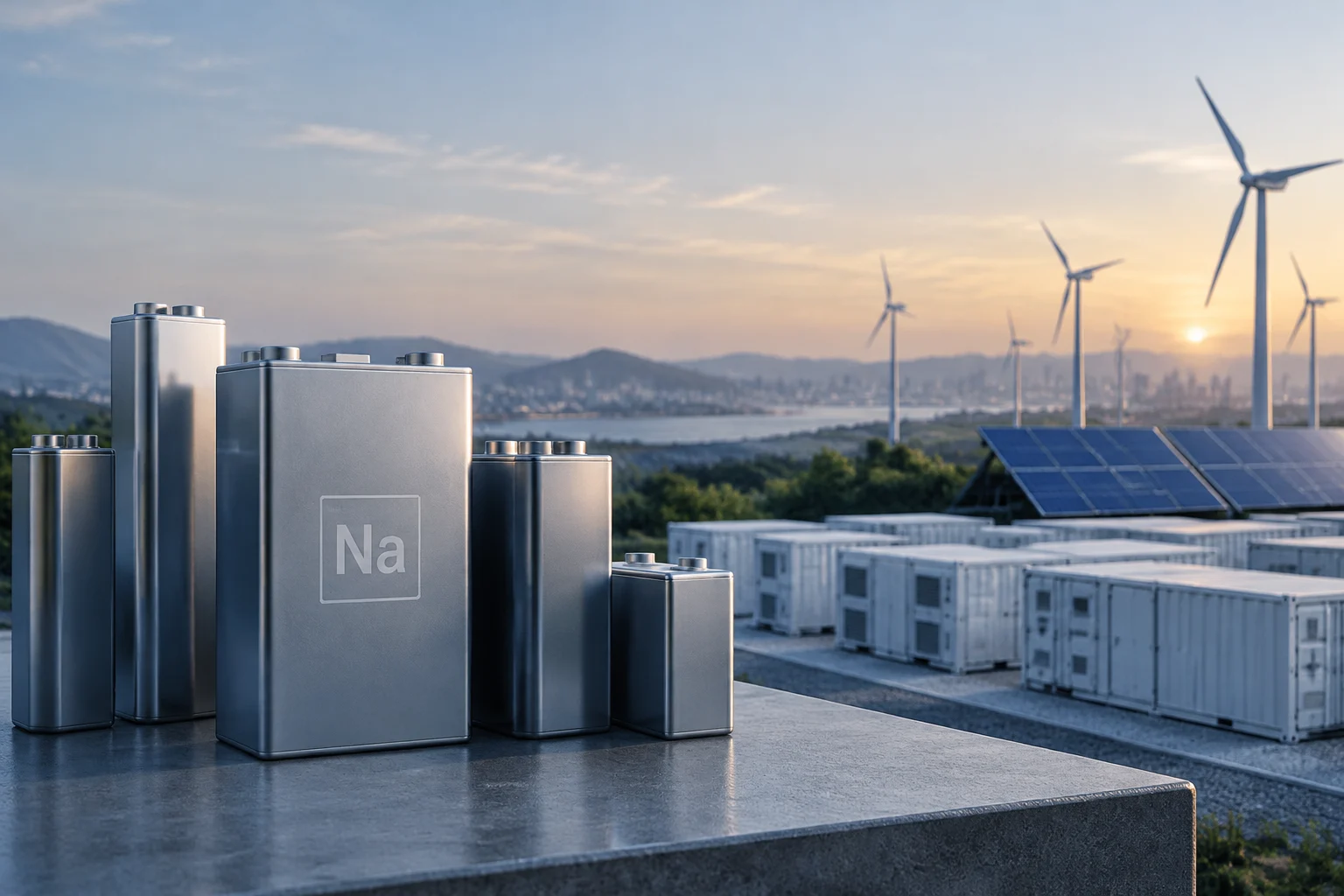
Sodium‑ion batteries store energy by moving sodium ions between their electrodes. The chemistry shares general principles with lithium‑ion batteries, but that does not mean the cells are interchangeable or that costs and performance are equivalent. To assess market arrival it is useful to separate three things: what a manufacturer announces, what a supplier agrees to supply, and what is already installed and operating.
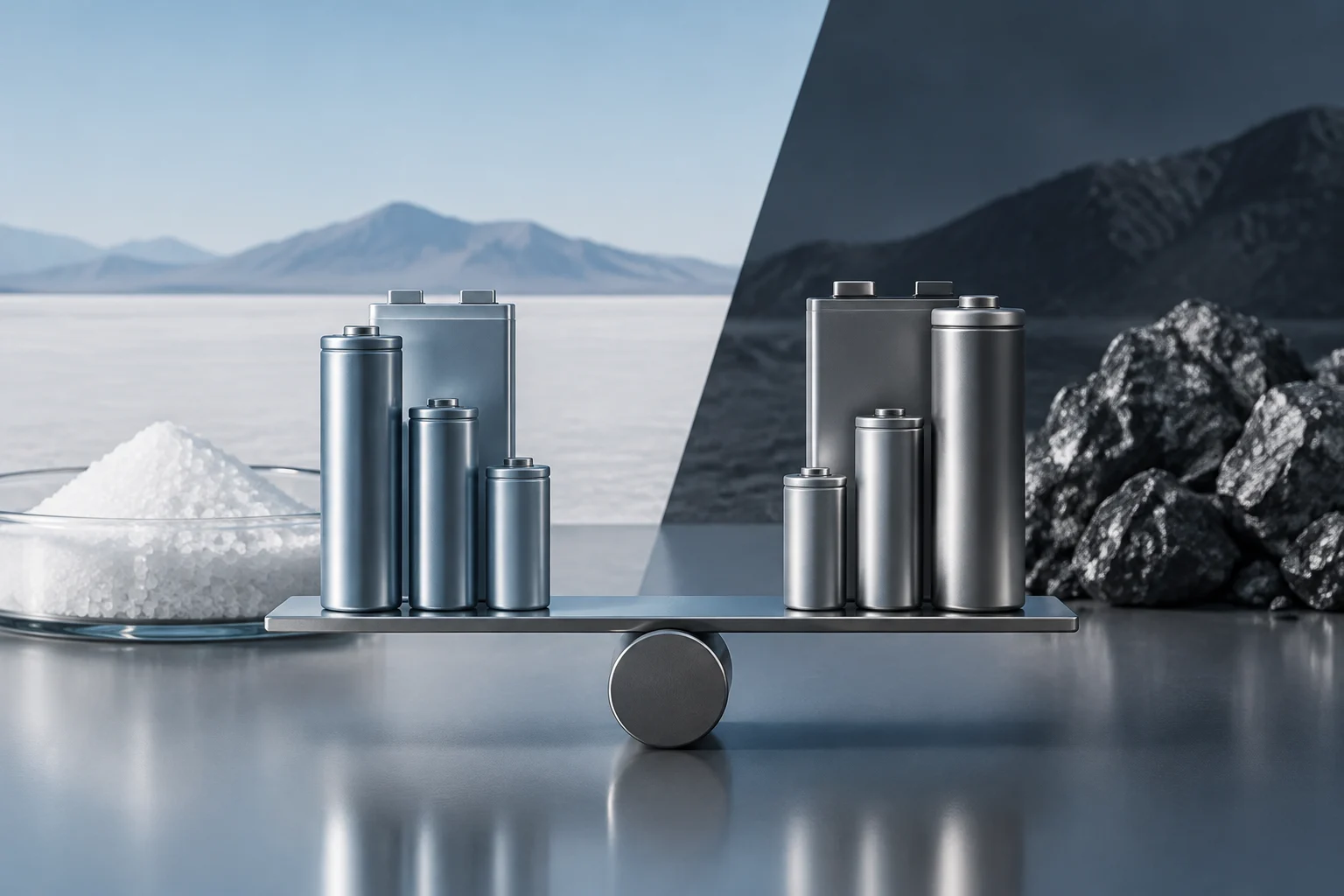
The strategic interest in sodium relates to diversifying storage chemistries, not an automatic guarantee of cheaper batteries. In Seplos’ comparison citing Wood Mackenzie data for 2025, sodium‑ion cells had a higher average cost than LFP. Therefore, the abundance of sodium as a raw material is insufficient to demonstrate an economic advantage in the final product: active materials, processes, scale and system cost also matter. The practical decision is to compare a specific application and offer, rather than transfer industrial quotes into general promises about the raw material.
What Is Confirmed and What Remains an Announcement
Available sources describe CATL as the manufacturer that presented the Naxtra sodium battery family and attribute large‑scale deployment plans to it. A coverage published on 29 December 2025 notes that CATL aimed to bring the technology to stationary storage and electric vehicles, and that the cells had obtained Chinese GB 38031‑2025 certification. Those data document an announcement and a reported certification; they do not alone prove actual production volume, deliveries made or number of installations in operation.
This distinction matters because earlier drafts treated several forecasts as already achieved results. The start‑up date, the number of vehicles that could incorporate the cells and specifications attributed to CATL appear in secondary coverage of the package, not in primary manufacturer documentation. It is not rigorous to assert that mass production began on a specific date or that safety has been validated without an accessible official source confirming those details. The reported certification should be understood as a regulatory milestone; it does not equal independent proof of superiority over other chemistries in all uses.
Costs: Data Do Not Prove General Parity with LFP
The clearest numerical comparison available refers to average cell cost in 2025: Seplos attributes Wood Mackenzie data of $52/kWh for LFP and $59/kWh for sodium‑ion, an approximate 13% difference. It is a reference published by a system provider, not a universal quote: it does not specify that those averages describe all markets, manufacturers or cell formats. Even with that caveat, it contradicts the idea that sodium would necessarily be cheaper than LFP due to lower active‑material cost.
A note from Híbridos y Eléctricos published in June 2026 cites an estimate attributed to Chinese consultancy ICC Xinchen Information: 0.35–0.40 yuan/Wh for CATL sodium cells during the first quarter of that year. The figure is an estimate attributed to a consultancy, not a contractual price published by CATL nor a homogeneous comparison with LFP price. It does not alone allow concluding that parity was reached, let alone that total storage installation cost would be equal. To budget a project, one must request comparable prices, capacity, delivery terms, warranties, integration and clear offer dates.
| Indicator Published | Cited Data | Scope & Caveat |
|---|---|---|
| Average LFP cell cost, 2025 | $52/kWh | Secondary reference citing Wood Mackenzie |
| Average sodium‑ion cell cost, 2025 | $59/kWh | Secondary reference citing Wood Mackenzie |
| CATL cell cost estimate, Q1 2026 | 0.35–0.40 yuan/Wh | Híbridos y Eléctricos attributes to ICC Xinchen Information |
Applications: European Agreements Are Market Signals, Not Proof of Operation
Stationary use is one application associated with sodium chemistry by sources. In July 2026, PV Magazine reported a supply agreement between CATL and Bulgarian Solarpro for 2 GWh destined to projects in Central and Eastern Europe. The note also mentioned an earlier agreement with Alfen for 5 GWh. A supply agreement expresses a reported commercial commitment, but it does not prove that all that capacity has been delivered, installed or connected to the grid; nor is it enough to know operational performance.
Therefore, the 7 GWh figure in the draft should not be presented as deployed capacity. It is an arithmetic sum of two volumes linked to agreements cited by a sectorial publication and must be described with that limit. For operators and buyers, the useful question is not just how many GWh appear in an announcement, but what schedule, sites, warranties, exact technology and commissioning results are published later. The package sources do not verify operational European projects with those cells, so they still cannot confirm real field performance.
In mobility, coverage attributes CATL plans for vehicle use and mentions possible urban or commercial segments. However, the material gathered does not identify a commercially confirmed car model with sodium battery via a primary source, nor document sales and deliveries sufficient to quantify effective adoption. There are also no comparable data in this package on range, lifespan or low‑temperature behavior measured in production vehicles. Thus, automotive application should be described as an announced goal or possibility, not a consolidated market.
Technical Comparison: What Can Be Said and What Data Are Missing
The draft assigned CATL sodium cells a density of 175 Wh/kg, but that figure comes from a secondary Motor16 news item and is not accompanied here by an official technical sheet or test document. It can be cited as a value attributed by that publication, not as independently verified specification nor as data applicable to all sodium‑ion cells. There is also no comparable series of energy densities, cycle lives and system efficiencies measured under the same conditions for sodium and LFP.
The same caution applies to cold resistance and safety. Notes describe those properties as highlighted advantages by the manufacturer, but the gathered information does not include protocols, temperatures, charge rates, cell configuration or independent test results that would quantify the difference. An announced advantage is still not a complete comparison. For a technical purchase, one must request performance curves per temperature, charge limits, capacity‑retention guarantee, cycle life and relevant safety data for the specific installation.
Comparison should also distinguish between cell and system. Cell cost per kWh does not automatically include power conversion, thermal management, electronics, integration, transport, installation and maintenance. Seplos cites installed storage system costs behind the meter of about $700–$800/kWh for both chemistries, but that reference is also a sectorial estimate and should not be treated as price applicable to any project. The more convenient chemistry depends on total cost and required service, not on an isolated density or raw‑material figure.
Evidence Limitations and How to Evaluate a Project
The source package mainly consists of journalistic coverage and sector company pages; it does not include official CATL announcements, full technical sheets, primary regulatory documents or academic results that would independently validate specifications and production plans. Therefore, cited agreements and values must retain their attribution and date. One cannot infer from a published forecast that it has been subsequently fulfilled. The limitation does not invalidate commercial signals, but it prevents presenting effective scale and general cost parity as proven facts.
For energy equipment, investors and procurement managers, an initial assessment can be organized around concrete checks:
- Request a cell and system offer with defined scope, currency, market and date.
- Compare sodium and LFP with the same storage duration, power, thermal conditions and warranties.
- Ask for manufacturer documentation on cycles, efficiency, safety and degradation, plus applicable certification.
- Verify if announced volume corresponds to a memorandum, contract, delivery or operating installation.
- Review spare‑part availability, technical service and anode material supply for the project horizon.
With what is available, it can be stated that CATL and commercial partners have been subject to announcements and agreements related to sodium‑ion batteries, including a 2 GWh agreement with Solarpro reported in Europe. It cannot be claimed that sodium has displaced LFP or is universally cheaper. The useful conclusion for 2026 is more circumscribed: there are commercialization signals worth following, but purchase decisions need product, contract and operation data that the gathered sources still do not provide.