
Regulatory Context and Official Coverage Data
The State Secretariat for Telecommunications and Digital Infrastructures (SETELECO) annually compiles broadband coverage data across Spain, including mobile networks in raster format. This methodology yields combined coverage provided by all operators for each technology platform, as well as speed‑by‑speed coverage across any territorial area. Since 2022, it also records peak‑load speeds, defined as the moment when network load reaches its maximum with 20 % of users connected simultaneously.
The 2024 Broadband Coverage Report, presented by the Ministry for Digital Transformation and Public Function, shows that 5G mobile coverage reaches 96 % of Spain’s population. A particularly relevant figure is the rise in rural areas, where 5G coverage has tripled over three years, jumping from 26 % of the rural population in 2021 to 80 % in 2024. This 11‑percentage‑point leap in a single year (June 2023 to June 2024) demonstrates accelerated deployment in less dense regions.
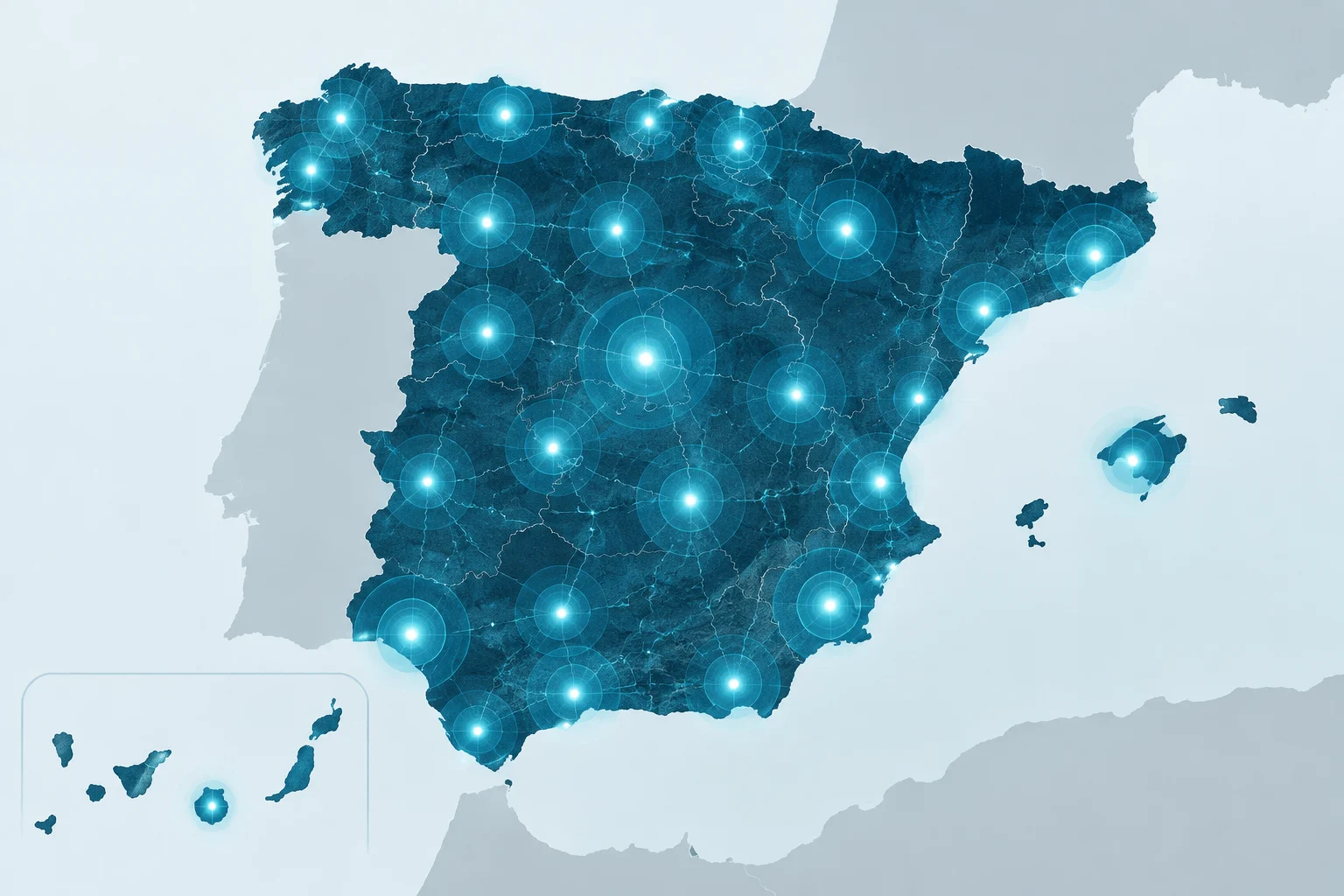
To better understand the landscape, SETELECO publishes coverage maps that display penetration by province and municipality, facilitating identification of low‑adoption zones or areas needing greater investment. These data are essential for operators when planning new towers and optimizing spectrum allocation.
The report also highlights the evolution of peak speeds achieved in each technology: 5G outpaces 4G tenfold, while 3G remains relevant only where coverage is limited. This information allows assessment of each operator’s return on investment and alignment with national universal connectivity goals.
Telefónica’s Strategy: Leadership in Nodes and 5G SA
Telefónica positions itself as the leader in 5G deployment across Spain, covering 5,700 municipalities—over 94 % of the population. The operator has deployed nodes in more than 5,000 towns, nearly 3,000 of which host 3,500 MHz band nodes, known as 5G+ or high‑performance units. Coverage is complemented by 700 MHz band nodes active in 5,000 municipalities, enabling broader indoor and rural penetration.
A differentiating feature of Telefónica’s network is its operation as 5G Stand Alone (5G SA), an architecture delivering peak performance especially valuable for the business fabric. By 2026, the operator intensified deployment, adding 65 new towns in Castilla y León alone in January. Additionally, Telefónica launched a summer plan with 500 infrastructure upgrades and 109 mobile units for events, ensuring connectivity at 440 events and preparing a special device for the August 12 solar eclipse.
The smart‑node strategy allows each tower to adapt dynamically to traffic demands, reducing latency and enhancing service quality. This approach is key to supporting critical applications such as telemedicine or Industry 4.0, where link stability is essential.
Sustainability commitments are reflected in low‑power technologies and renewable energy integration at towers, cutting the network’s total energy consumption.
Vodafone and Orange: City Focus and Energy Efficiency
Vodafone Spain concentrates its 5G rollout in 25 Spanish cities, where the network is active. The operator offers 4G coverage to 99 % of the population and is modernizing its networks, phasing out 3G throughout 2025 to optimize frequency use. This process is staged and does not affect users with 4G or 5G‑compatible devices, though those with older phones limited to 3G may need upgrades.
Orange, meanwhile, stands out for the energy efficiency of its 5G+ network, consuming 90 % less power than previous generations. The operator delivers speeds up to 1.6 Gb/s and improves indoor coverage through multi‑frequency deployment. Orange’s 5G+ incorporates advanced security mechanisms and is ready for low‑latency services such as virtual reality or autonomous driving.
The spectrum optimization plan includes relocating frequency bands to maximize coverage without increasing tower count, reducing operational costs and environmental footprint. Orange also runs a recycling program for obsolete equipment, contributing to the circular economy in telecoms.
Regarding user experience, Vodafone emphasizes added‑value services like IoT connectivity and intelligent network management, strengthening its corporate market position.
The 3G Shutdown: Impact and Transition
2026 marks the definitive end of Spain’s 3G network as major operators shut it down. This decision frees frequencies that are reallocated to 4G and 5G, improving call quality (VoLTE) and data speed. However, the shutdown affects users with legacy devices or first‑generation security systems relying solely on 3G.
Key points of the change include better data management for 5G terminals and higher voice quality, but also network issues for older devices and failures in outdated security systems. Users must check device compatibility before the cutover to avoid disconnection.
To mitigate impact, operators launched information campaigns explaining steps: firmware updates, device replacement, and use of alternative services such as VoWiFi. A transition period allows 3G to operate partially, ensuring service continuity.
The shutdown also opens opportunities for innovation in security, driving adoption of LTE‑based or 5G solutions offering greater reliability and lower response times. This evolution is part of a broader strategy to optimize mobile infrastructure across Spain.
Future Innovations: Satellite 5G and Agile Regulation
Telefónica and Sateliot announced a strategic partnership to deploy satellite 5G in Spain by 2026. The collaboration uses a low‑Earth orbit (LEO) satellite constellation to extend coverage to rural areas and defense sectors, creating what is called “5G SA bubbles.” This innovative approach extends terrestrial infrastructure into previously inaccessible environments, marking a milestone in Spanish mobile communication evolution.
The satellite project combines high 5G speeds with global LEO coverage, offering up to 1 Gb/s even in remote zones. Moreover, the SA architecture guarantees low latency and high availability, essential for critical applications such as smart agriculture or environmental monitoring.
In regulatory terms, Telefónica’s CEO Emilio Gayo defended a more agile telecom regulation at La Toja Forum 2026 to sustain network investment and reinforce European technological sovereignty. Gayo links network strength with Europe’s ability to gain tech autonomy, noting Spain’s infrastructure ranks among the most advanced in Europe but requires continued investment and a regulatory framework that facilitates financing.
The government announced plans to simplify spectrum tender processes and accelerate infrastructure approvals, enabling operators to deploy new towers and technologies faster. This initiative aligns with national universal connectivity strategy and Spain’s vision as a digital innovation leader.