
What is the GDPR and who it applies to
The General Data Protection Regulation (GDPR) is Regulation (EU) 2016/679, which sets the European framework for protecting natural persons when their personal data is processed and for regulating the flow of such data. It is a directly applicable law in Member States: it did not require a Spanish law to incorporate it into force. It has applied since May 25, 2018.
Its scope does not depend solely on where a company is incorporated. The Regulation can reach organizations located outside the European Union when they offer goods or services to persons located within it or monitor their behavior there. In practice, what matters is the activity performed and where the affected persons are, not just the provider's headquarters. Processing carried out by a person in a purely personal or household context falls outside its scope.
The GDPR refers to natural persons, not only EU citizens. Therefore, an organization must analyze whether it handles data of identified or identifiable persons in the regulated context, even if those persons have another nationality. There are also specific regimes for certain processing, such as data used by competent authorities for criminal purposes, which in the Union are regulated by other legislation.
Personal data, processing, and the roles of each organization
A personal data is any information relating to an identified or identifiable natural person. It can identify them directly, such as a name, or do so by combining information, such as an online identifier, location data, or a reference linked to a file. The practical question is whether a person can reasonably be distinguished from that data, alone or together with others.
Processing comprises operations performed on personal data, with or without automated means: collecting, organizing, consulting, using, communicating, storing, or deleting them. For example, a shop that collects an address to deliver an order, keeps the invoice, and allows a provider to manage the hosting of its database is performing different processing operations. There is no need for a complex database for the Regulation to apply.
The controller determines the purposes and essential means of processing. The processor processes data on behalf of the controller and following their instructions; it can be, for example, a hosting or payroll management provider. The contractual label does not by itself decide the role: what is relevant is who decides what the data is used for. The relationship between both parties must be regulated, and the controller must choose processors that offer sufficient guarantees.
There is information that receives enhanced protection, such as data revealing racial or ethnic origin, political opinions, religious or philosophical beliefs, trade union membership, genetic data, biometric data used for unique identification, health data, and data concerning sexual life or orientation. The GDPR also establishes specific rules for data relating to criminal convictions and offenses. These categories should not be treated as ordinary data: their processing is subject to additional conditions.
Principles: rules for designing each processing
Article 5 of the GDPR gathers the principles that must guide processing: lawfulness, fairness, and transparency; purpose limitation; data minimization; accuracy; storage limitation; integrity and confidentiality. It adds proactive accountability: the controller must not only comply but be able to demonstrate that they have applied these principles.
Lawfulness requires an appropriate legal basis for each purpose. Consent is one possibility, but not the only one: depending on the case, processing may be necessary to perform a contract, comply with a legal obligation, protect vital interests, carry out a task in the public interest, or satisfy a legitimate interest that does not override the person's rights. The organization must identify and document the relevant basis; it is not enough to add a checkbox to any form.
Purpose limitation means that data is collected for specific, explicit, and legitimate purposes, and is not reused without analyzing whether that further use is compatible or has another legal basis. Minimization requires collecting only adequate and necessary data. If an application needs an email address to send a receipt, asking for the date of birth in addition requires a justification linked to a specific purpose; accumulating information 'just in case' does not satisfy this principle.
Accuracy requires keeping data correct and rectifying or deleting without delay any that are inaccurate for the corresponding purpose. Storage limitation obliges setting criteria or deadlines: it does not mean automatically deleting all data when an interaction ends, because there may be legal storage obligations, but it does mean avoiding keeping them indefinitely without reason. Integrity and confidentiality require appropriate measures against unauthorized access, loss, destruction, or alteration.
| Principle | Example of compliance | Example that raises a problem |
|---|---|---|
| Purpose | Explain what the email collected in a purchase is used for | Reusing it for an incompatible purpose without a valid basis |
| Minimization | Asking only for the data necessary to provide the service | Collecting additional information without justified need |
| Accuracy | Correcting outdated data when detected | Keeping an incorrect address despite knowing the error |
| Storage | Defining when data is reviewed or deleted | Retaining it indefinitely without an applicable reason |
| Integrity and confidentiality | Restricting access according to staff functions | Allowing any user to consult all records |
The table illustrates design decisions, not an automatic list of infringements: the assessment depends on the purpose, context, legal basis, and measures adopted. The useful proof is being able to explain why each piece of data is needed, who accesses it, for how long, and what happens when processing closes.
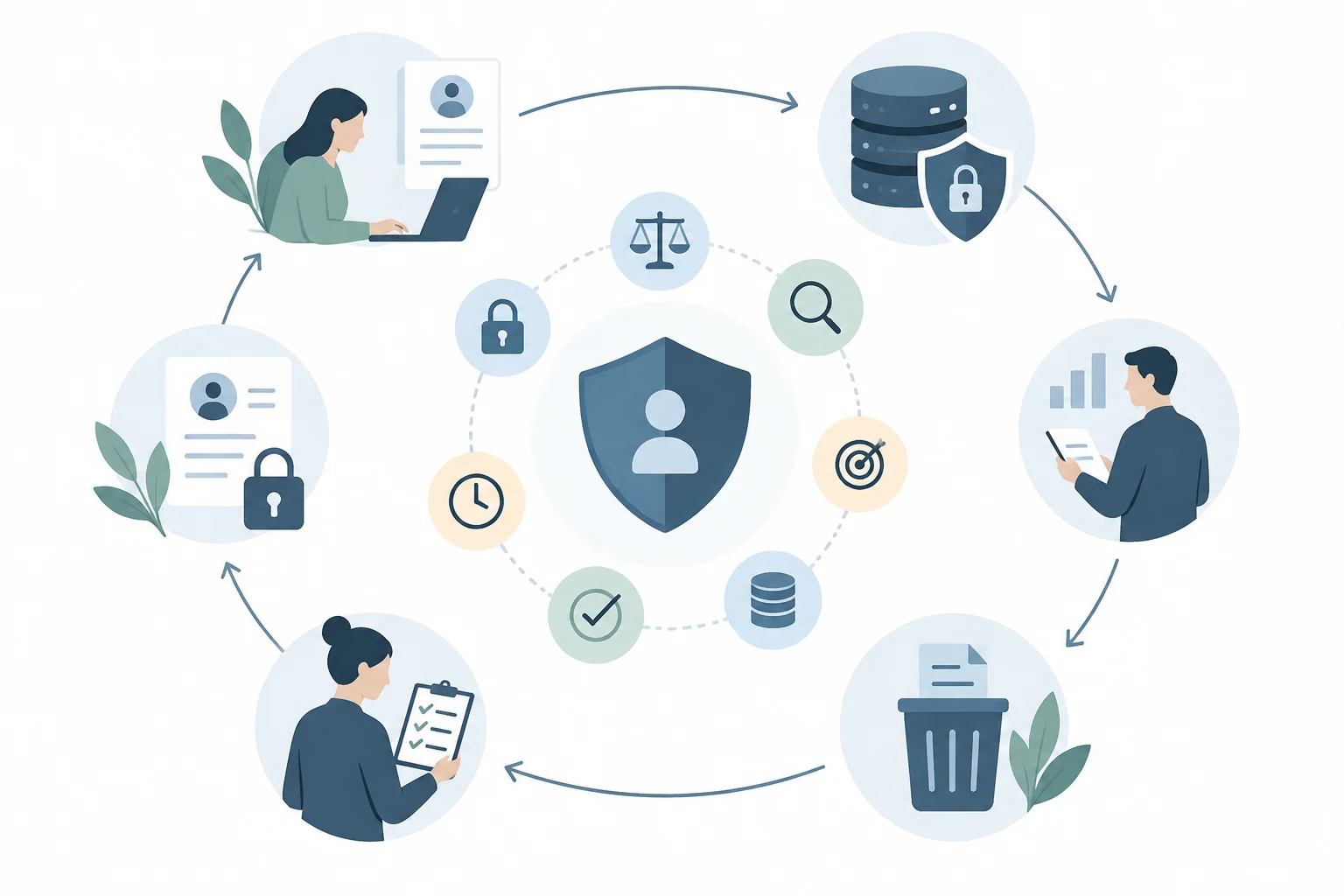
Rights of persons over their data
The GDPR allows persons to exercise rights against the controller. The right of access serves to know if one's own data is processed and to obtain it along with information on purposes, categories, recipients, and storage, among other aspects. Rectification allows correcting inaccurate data or completing incomplete data.
Erasure, often known as the right to be forgotten, allows requesting that data be deleted when any of the foreseen circumstances occur, such as it no longer being necessary for the purpose for which it was collected. It is not an absolute right: there may be legal reasons to keep them or related exceptions, for example, concerning freedom of expression, legal obligations, or claims. Requesting erasure does not guarantee deletion in all cases; the controller must assess and explain the response in accordance with the law.
Restriction of processing allows, in certain circumstances, temporarily restricting the use of data, for example while its accuracy is being checked. Opposition allows opposing certain processing; for direct marketing, opposition obliges to stop processing the data for that purpose. Portability allows receiving certain data provided by the person in a structured, commonly used, and machine-readable format, and transmitting them to another controller when the Regulation's conditions are met.
| Right | What it allows requesting | Reference in the GDPR |
|---|---|---|
| Access | Confirm processing and obtain data and associated information | Article 15 |
| Rectification | Correct inaccurate or incomplete data | Article 16 |
| Erasure | Delete data when a foreseen cause occurs | Article 17 |
| Restriction | Temporarily restrict certain uses | Article 18 |
| Portability | Receive and transmit certain provided data | Article 20 |
| Opposition | Oppose certain processing, with specific rules | Article 21 |
For portability, not every piece of data an organization possesses automatically falls under the right: the conditions of Article 20 apply, including the legal basis and how the data was obtained. It also does not equate to demanding that two services be technically compatible. In Spain, the request can be directed to the controller, and if the person considers their right has not been attended to, they can file a complaint with the competent supervisory authority.
Obligations: demonstrating compliance and managing risks
Obligations depend on the role of each entity, the nature of the processing, and the risks to persons. The controller must apply appropriate technical and organizational measures and maintain a documented view of the data lifecycle: what is collected, for what, where it is stored, who receives it, how long it is kept, and how it is deleted. The processor, for its part, must process data in accordance with the contract and the controller's documented instructions.
The record of processing activities documents, among other elements, the purposes, categories of data subjects and data, recipients, and planned deletion deadlines where possible. The GDPR contemplates a limited exception for organizations with fewer than 250 people, but it does not operate if the processing may entail a risk, is not occasional, or includes special categories or criminal data. Therefore, being an SME does not automatically equate to being exempt from documenting its processing.
A Data Protection Impact Assessment (DPIA) is necessary before starting a processing when it is likely to entail a high risk to rights and freedoms. The Regulation mentions, among other cases, systematic and extensive evaluation of personal aspects based on automated processing producing significant effects, large-scale processing of special categories of data, and systematic large-scale observation of publicly accessible areas. An initial risk analysis helps decide if a DPIA is required; not all processing requires the same assessment.
The Data Protection Officer (DPO) is mandatory in the cases of Article 37 of the GDPR, including public authorities or bodies—with the exception provided for courts exercising their judicial function—, main activities involving regular and systematic large-scale observation, or large-scale processing of special categories or criminal data. The LOPDGDD adds specific national cases. Appointing one does not transfer processing responsibility to the DPO: their function is to inform, advise, and supervise within the conditions established by the law.
If a personal data security breach may entail a risk to rights and freedoms, the controller must notify it to the supervisory authority without undue delay and, where possible, within 72 hours of becoming aware. If there is a high risk to persons, they must also be informed without undue delay, except for the provided exceptions. The deadline does not turn every IT incident into a notifiable breach: it must be a security breach affecting personal data and the risk must be assessed.

How the GDPR and the LOPDGDD complement each other in Spain
The LOPDGDD, Organic Law 3/2018, does not replace the GDPR nor turn it into a Spanish law. The European Regulation applies directly; the Spanish law specifies aspects that the European framework itself leaves to national law and regulates additional issues, including guarantees of fundamental rights and digital rights. To resolve a case in Spain, both laws usually have to be read jointly and attention paid to the corresponding sectoral legislation.
The Spanish law was published in the BOE on December 6, 2018, and entered into force the next day. The BOE offers an informative consolidated text, with modifications incorporated; for a formal legal consultation, attention must be paid to the corresponding official publications and the wording applicable to the case. The national law complements, not replaces, the European obligations on principles, rights, and accountability.
The LOPDGDD also establishes national rules on the consent of minors in processing based on consent: it sets 14 years as the age from which a minor can give it themselves, with the applicable legal conditions and exceptions. This does not mean that any processing of a minor's data always depends on consent: the organization must determine the specific legal basis and consider the relevant special rules.
In practical terms, an SME can start with four questions: what personal data it processes; for what and on what basis; which providers access it; and what measures and deadlines apply. Afterwards, it must enable channels to attend to rights, maintain adequate documentation, and review risks and contracts. Compliance is a continuous process, not a privacy template installed once and forgotten.
Supervision and sanctions: what the limits mean
Supervisory authorities oversee the application of the GDPR and can investigate complaints, order corrective measures, and, in the provided cases, impose administrative fines. In Spain, the Spanish Data Protection Agency (AEPD) exercises competences in its scope, along with regional authorities where appropriate. The supervisory function does not eliminate the right of persons to go to the courts or other mechanisms provided by law.
Article 83 establishes two general maximum levels of fines: up to 10 million euros or, in the case of an undertaking, up to 2% of the total worldwide annual turnover of the preceding financial year, for certain infringements; and up to 20 million euros or 4% for other more serious infringements. The higher amount between the fixed sum and the percentage is applied, within the corresponding level. They are legal maximums, not automatic fines.
When deciding whether to impose a fine and what its amount will be, the authority must consider the circumstances of the case, including the nature, gravity, and duration of the infringement, its intentional or negligent character, the measures adopted to mitigate damage, the degree of responsibility, and cooperation with the authority. It can also order other corrective measures. Therefore, citing the maximum without explaining the context gives an incomplete picture of the sanctioning regime.
This guide offers general orientation and does not determine the outcome of a specific situation. Application may vary depending on the processing, sector, type of organization, and relevant national or sectoral rules; for a legal decision or a complex investigation, it is advisable to turn to the current regulatory text and, where appropriate, specialized advice.