
What PingER measures and what it is for
PingER is a network monitoring project associated with the SLAC National Accelerator Laboratory. Its method is based mainly on sending ICMP Echo messages to remote hosts and measuring the response. The key idea for anyone reading its results is straightforward: it observes how test packets behave between two points. It does not certify the overall quality of a connection or describe the experience of every application using it.
The project was designed to track the performance of Internet paths between institutions and to study how that performance changes over time. Its main value is therefore observing trends: for example, whether a route’s response time worsens persistently or whether periods with more unanswered packets appear. A single measurement may offer a useful clue, but it is not enough to identify a cause or describe a person’s entire Internet access service. The result applies to the tested packets, endpoints, route, and measurement conditions; it should not be treated as a complete assessment of everything sharing that connection.
RTT is not one-way latency
Round-trip time, or RTT, is the time from when a test packet leaves until its response returns. In an ICMP Echo test, the measuring host sends a request and receives an echo message from the destination. The result combines the outbound journey, the return journey, and the time the remote host takes to respond. It does not separate delay in each direction, so an RTT value cannot be read as the latency from the source to the destination alone.
That distinction matters because Internet traffic does not always follow the same route in both directions. Even when the paths coincide, congestion can differ from one direction to the other. A high RTT therefore indicates that some part of the round trip or the response is taking longer, but it does not pinpoint the problem. Nor does it show that a particular application will experience exactly that delay: its protocol, server, and processing also contribute. RTT describes the complete measured exchange, rather than assigning responsibility to a specific link or service.
Packet loss: a meaningful signal, not a complete explanation
In this kind of test, a request that does not receive a response within the configured time limit is counted as a loss by the monitor. The definition therefore depends on a time threshold: a response arriving after the limit can be treated as lost even if the packet eventually reached its destination. The measurement describes what happened to those test packets under that rule, not necessarily to all traffic on the connection. A reported loss rate should be understood in relation to the test’s scope and settings.
PingER’s calibration documentation describes a configuration in which the client waits 20 seconds before treating a response as lost. That is a detail of the documented method, not a universal rule for every tool or a guarantee that every current installation uses the same value. A loss result needs context, including packet size and type, the interval between tests, the waiting period, and the route taken. If those conditions differ, measurements may not be directly comparable even when both are presented as packet-loss figures.
Variation and jitter: look at the distribution, not just the maximum
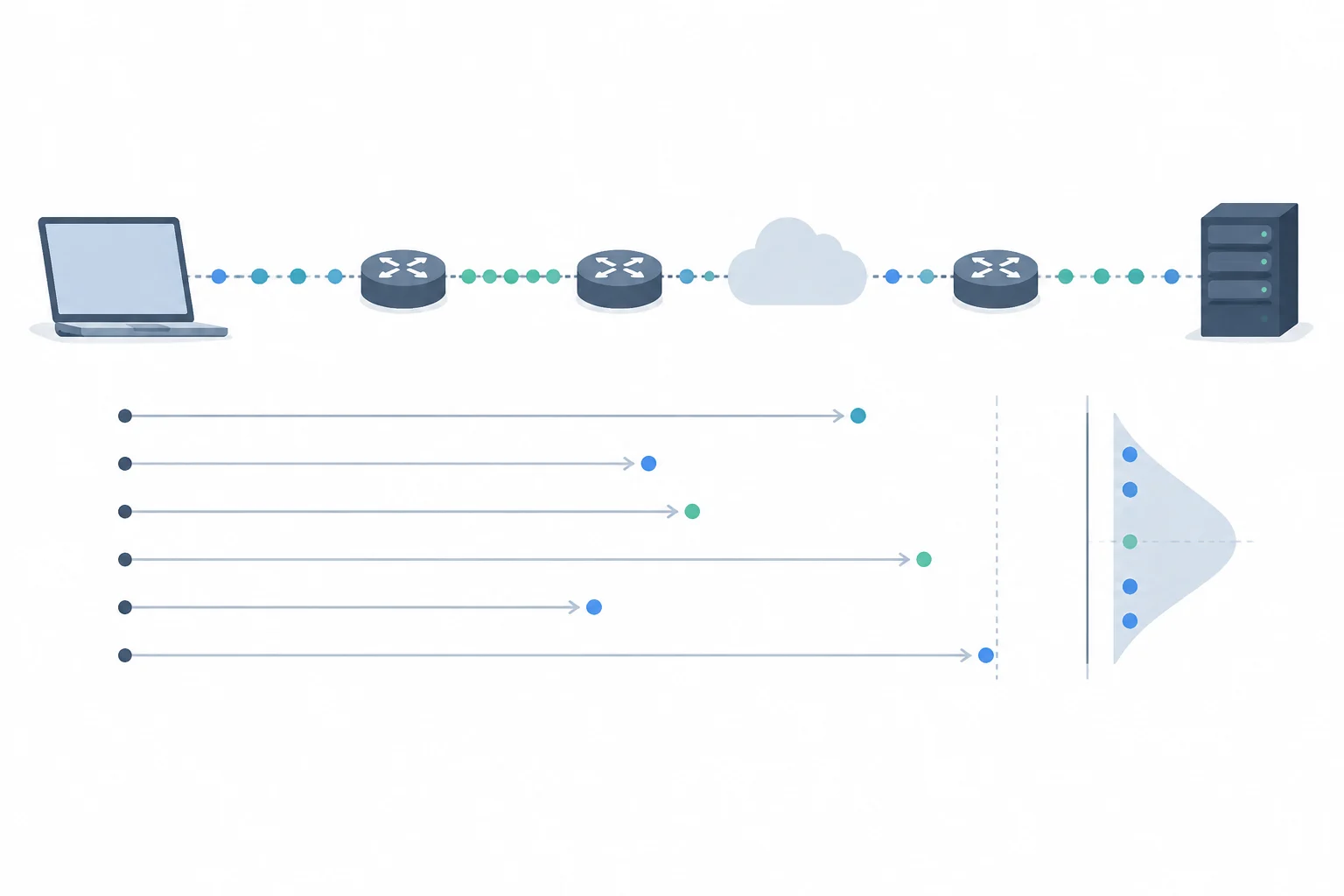
RTT does not have to remain constant. Variation between responses can show that a path is behaving irregularly, which can matter for interactive communications, voice, or video. PingER documentation describes several ways to measure jitter. One of them estimates variation by examining how the time spacing between responses changes when tests are sent at regular intervals. This is a way of characterizing the measurements; it does not, on its own, explain why the spacing changed.
It is therefore useful to compare compatible statistics and examine the full set of samples. The maximum may be dominated by one exceptional response; the median and percentiles help distinguish typical behavior from extremes, while a time series shows when changes occur. Variation is an observation, not a diagnosis: it may be associated with load, changing routes, or delay in the responding host, and an ICMP test alone cannot determine which factor was involved. Consistent test conditions make comparisons more meaningful, but they do not turn a measured pattern into proof of its cause.
Why PingER is not a speed test
An RTT test sends small packets and measures their responses; it does not try to fill a link with a sustained transfer. A low RTT therefore does not demonstrate that a large amount of throughput is available, and a high RTT does not by itself quantify how many megabits per second a connection can transfer. Delay and maximum capacity may be related under some conditions, but they are different metrics. A response-time measurement answers a different question from a sustained data-transfer measurement.
Tools such as iperf3 perform active measurements to estimate achievable bandwidth and report throughput; depending on the test, they can also report loss and other parameters. For a useful comparison, the endpoints need to participate in the test, and the protocol, duration, and load need to be clearly defined. PingER studies network delay and response; iperf3 tests throughput between configured endpoints.
How to interpret a result without overdiagnosing
Consider a fictional example: during a batch of tests, a destination usually responds in around 40 ms, but several responses take much longer and some do not arrive before the configured limit. That would be consistent with RTT variation and with loss under the waiting rule in use. It would not, by itself, prove that the Internet provider is congested. It would be necessary to check whether the pattern repeats, whether other destinations are affected, and whether it coincides with problems in the applications being used.
To turn metrics into a practical decision, record the destination and time, repeat observations at different times, and compare more than one route. If the problem appears only with one host, it may be at that host or along its path. If several destinations are affected and the pattern coincides with usage problems, further diagnosis becomes more useful, although it still does not identify the responsible component. Investigating throughput requires a test designed to transfer data and, where possible, a nearby, reliable test server.
Before interpreting the result, check the following:
- What was measured: ICMP Echo, packet size, and number of samples.
- How it was measured: interval, waiting limit, and reported statistics.
- Where it was measured: source host, destination, and route in each direction.
- What decision is needed: whether to investigate delay, loss, variation, or transfer capacity.
Limits on ICMP responses can affect ping measurements. The reverse can also happen: a small test may get good responses while a sustained transfer performs poorly. The strongest conclusion combines PingER with the observed symptom and a measurement suited to the problem, without mistaking a network signal for a definitive explanation.