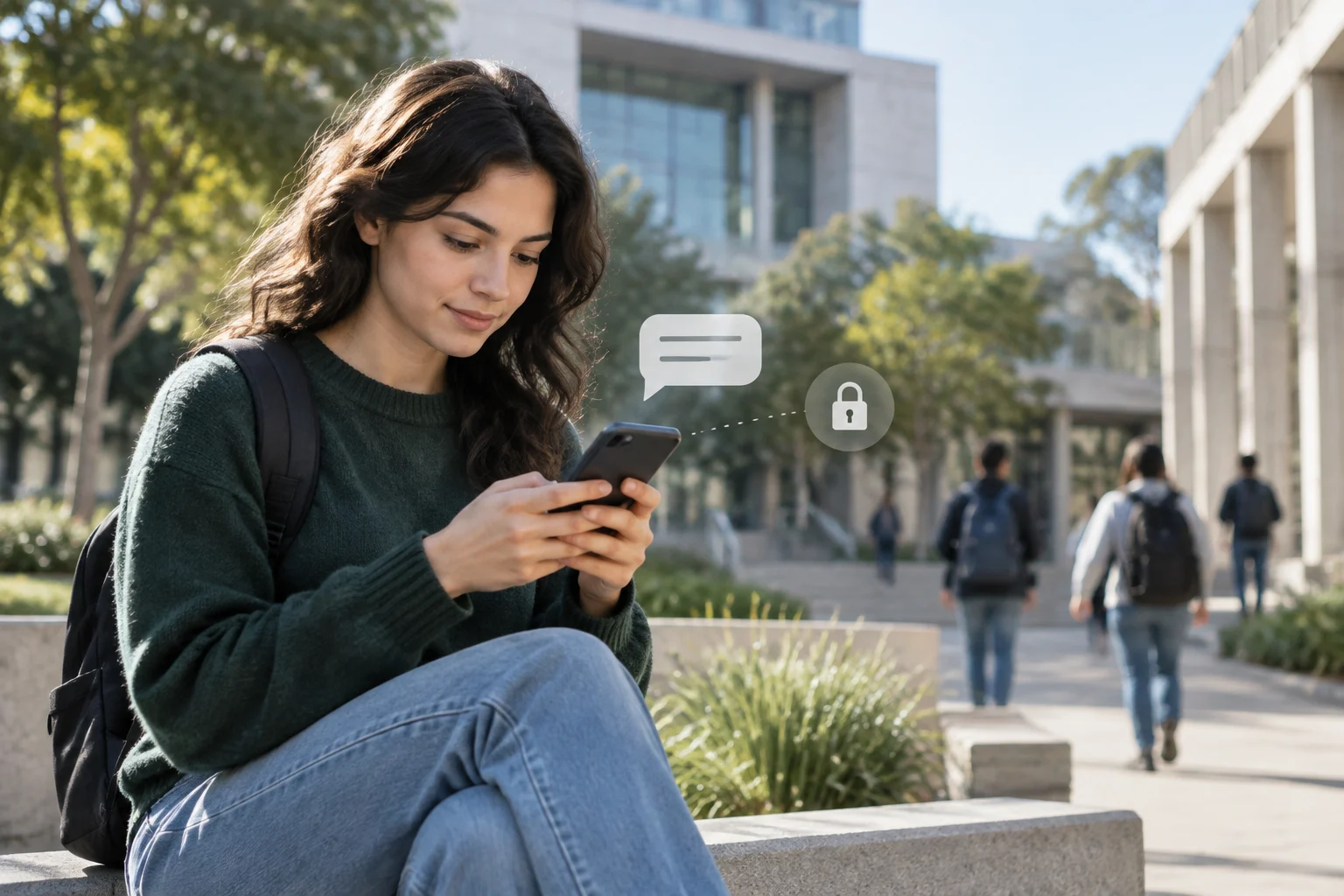
What SMS can help a university do
SMS is useful when an institution needs to deliver a brief, timely notice: reminding someone of an enrolment date, confirming an advising appointment or flagging a change to a timetable. In these situations, a message can make the next step easier without requiring someone to search through long emails or pages full of information. But SMS cannot, by itself, turn unclear communication into effective communication; the purpose needs to be immediately understandable.
Potential recipients include applicants, enrolled students and, where there is a clear reason and appropriate permission, family members or alumni. Set a specific purpose for each group, such as supporting an application, pointing out a deadline or answering a straightforward question. The channel should not determine who receives a message: selection should reflect the person’s relationship with the institution and the subject being communicated. Heymarket describes recruitment, student notices and enquiry handling as educational messaging use cases; these are examples from a provider, not a guarantee of results.
Choose tasks, not campaigns by default
Before enabling bulk messaging, identify a task that SMS could make easier and the cost of not completing it on time. A notification about an imminent appointment may be useful; a stream of general reminders can wear down attention. For ongoing guidance, save the channel for useful moments and provide a clear way to find more information or ask for help.
SMS should not be the only way to communicate a complex academic instruction, a notice requiring documents or a critical situation. Keep an accessible alternative, such as email or an institutional portal, and explain where the full information can be found.
Specific messages and limits on information
A good message identifies the institution, explains why it is contacting the recipient and suggests a simple action. Usually, it is enough to include the relevant deadline and a link or reply route that leads to more context. Brevity should reduce friction, not leave out who is writing, what the recipient is expected to do or how to stop receiving messages.
The examples below are fictional and adaptable; replace the names, links and deadlines with real information before using them:
- “River University: your advising appointment is Tuesday at 10:00. To reschedule, visit [institutional link]. Reply STOP to stop receiving SMS.”
- “River University: the deadline to confirm your enrolment is August 20. See the steps at [institutional link] or reply to this message if you need help.”
- “River University: the support centre closes at 16:00 today. Hours and alternatives: [institutional link].”
Review each text to catch expired dates, incorrect links and incorrectly inserted personalization fields. If a message uses details such as a name or campus, check that the platform fills them from the correct record.
Avoid sending information by SMS that would unnecessarily expose someone: grades, detailed balances, credentials, identification numbers or explanations of a personal situation. For financial, health or academic matters that require detail, use an appropriate channel and suitable authentication. The US Department of Education publishes FERPA, the federal law on the privacy of education records; its scope depends on the requirements applicable to each institution and it is not a general authorization to disclose data by text.
A practical editorial test is to ask whether the content would still be acceptable if someone else saw the phone’s lock screen. If not, reduce the detail and direct the recipient to a more protected environment. SMS can alert someone that there is something to check; it does not need to reproduce a record or reveal the sensitive reason for the enquiry.
SMS and email: assign each task to the right channel
SMS and email do not have to compete for a single role. The first can be suitable for a short notice or deadline reminder; email can carry fuller instructions and attachments. Heymarket, a messaging provider, recommends combining the two and reserving email for long or confidential communications. That is an operational recommendation, not a rule every university must follow.
Consider urgency, how much context is needed, privacy and available alternatives. An SMS linking to an official page may be clearer than compressing several steps into one message. If someone needs a full explanation, however, send it by email or host it in a portal and use SMS only as a notice, provided the recipient has consented.
| Need | Potentially suitable channel | Practical criterion |
|---|---|---|
| Brief appointment reminder | SMS | Include date, time and a way to reschedule |
| Detailed enrolment instructions | Email or portal | Provide complete steps and keep the information accessible |
| Notice that an important email has arrived | SMS plus email | Do not repeat sensitive details by SMS |
| Simple advising enquiry | SMS or email | Offer an institutional response and an alternative |
Authenticity matters too: recipients should be able to recognize the institution and find the same content through an official channel. Use identifiable institutional links, never request passwords by text, and provide a known contact route. If an SMS makes an unexpected request for data or payment, the recipient should be able to verify it without relying on the link in that message.
Consent, opt-outs and responsibilities
Before sending messages, an institution needs to decide who authorizes contact, which subjects are covered and how that authorization will be recorded. A clearly worded checkbox in an application can identify the sender, the types of notice, the approximate frequency and how to opt out. Providing a phone number for an academic task should not be treated as agreement to any future communication.
Twilio’s messaging policies require prior consent for messages sent through its services, in line with laws applicable in the recipient’s jurisdiction and connected to the sender and subject of the messages. They also call for keeping proof of consent and explaining how it can be withdrawn. These are a provider’s conditions, in addition to any applicable legal requirements: they do not replace local legal review or, on their own, guarantee an institution’s compliance.
Keep a record that supports action
Maintain an operational record that, as appropriate, captures the person, number, date and method of authorization, accepted purpose, channel, frequency preferences and any opt-out. Decide who can access that information and who will handle opt-out requests, incorrect numbers and changes in responsibility. Heymarket’s acceptable-use policy also prohibits unsolicited messages and the use of purchased lists on its services.
The first message should explain who is writing and how to stop receiving messages; the exact method and requirements may depend on the provider, country and type of communication. Twilio, for example, specifies opt-out instructions for messages sent through its services and distinguishes informational from promotional messages. Do not generalize one platform’s conditions to every jurisdiction: check current rules where recipients are located and the configuration of each service.

Measure delivery, replies and actions without confusing them
Before starting a send, define the action the communication is meant to support and choose an indicator related to it. For example, if the objective is to confirm an appointment, count the confirmations received. Do not treat one metric as a substitute for the communication’s goal.
For a pilot, useful measures may include the share of messages with a delivery status, replies received, completed actions and opt-outs. Pair each figure with its denominator and time period: for example, replies within seven days among messages delivered during that same window. If the aim was appointment confirmation, record confirmations consistently and state which population and dates the calculation covers.
Interpret results cautiously
Compare the pilot with a baseline or a comparable group when the design and conditions allow. Account for other factors that may affect the result, such as email reminders, deadline changes or differences between groups. An observed change does not, by itself, show that SMS caused it; explain what was measured, for how long and with what limitations.
Avoid relying on a general marketing statistic to predict student behaviour. Measure an action tied to the university’s objective, not just activity that is easy to count. If opt-outs rise or enquiries reveal confusion, review the message before increasing its frequency.
Start with a small, reviewable pilot
A limited pilot can show whether a specific communication is clear and useful before it is expanded. Choose one use case—for example, reminders for advising appointments—a defined population and enough time to observe the process. Set the main indicator in advance, along with signals that would prompt a pause, such as wrong-recipient errors, complaints or opt-out problems.
Before the first send, review the text on a phone, confirm links, check that the list matches the authorized purpose and make sure someone will respond to enquiries. Provide an alternative channel for people who cannot or do not want to use SMS. At the end of the pilot, report the number of eligible recipients, how many received the message, the time window and the method used to count replies or actions.
When deciding whether to continue, consider student usefulness, staff workload, accessibility, privacy and opt-out requests together. A favourable indicator does not make up for intrusive communication or poor handling of replies. Scale only when the process is sustainable and reviewable, with clear responsibility and a justified frequency.
Requirements depend on the jurisdiction and the subject of the messages. Before launching or changing a programme, review the rules where recipients are located and the provider’s conditions, especially if the subject, sender or platform changes.