Two smart displays from different generations
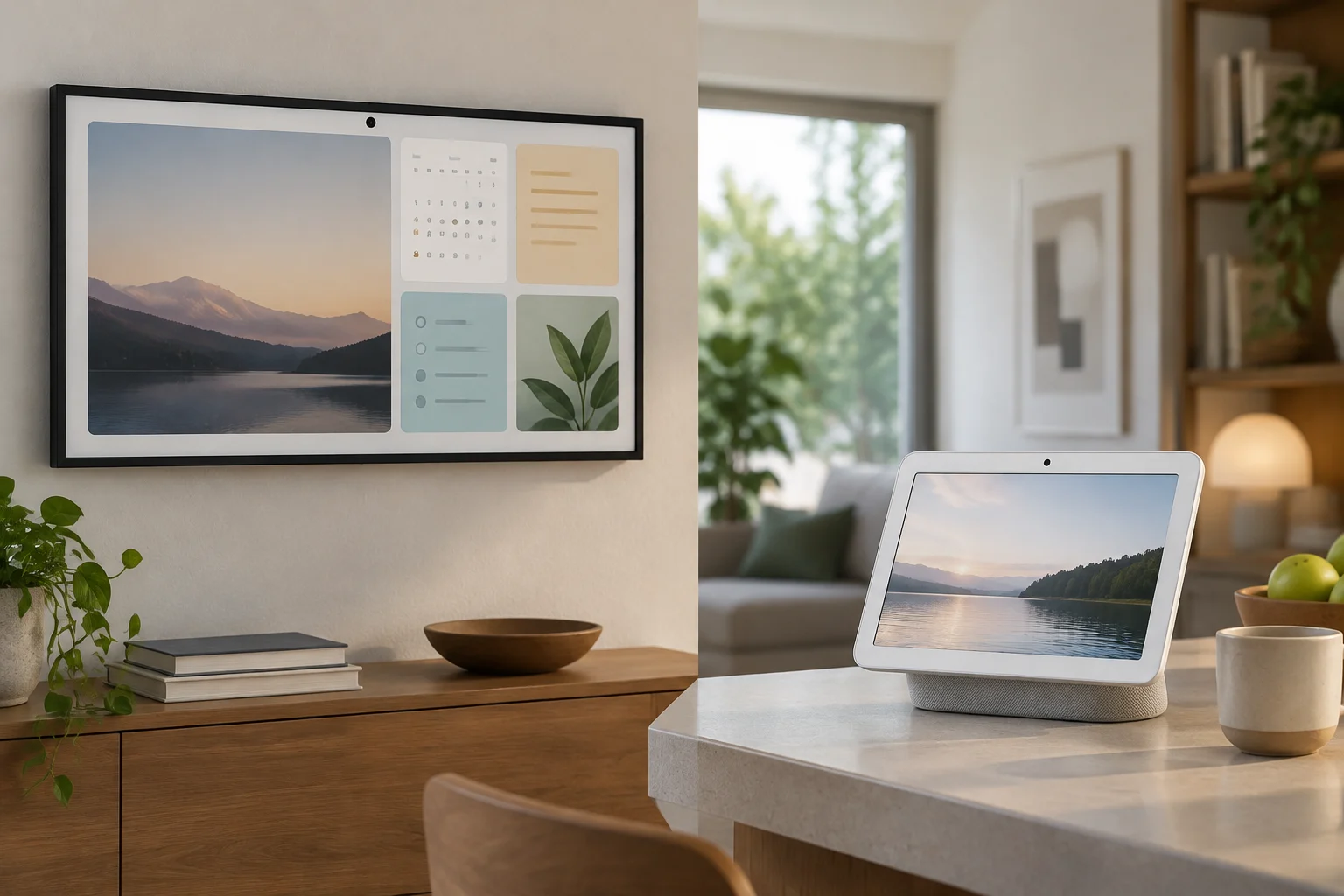
The Amazon Echo Show 15 and Google Nest Hub Max combine a display, voice assistant, and connected-home features, but they are built around different physical ideas. The Echo Show 15 was designed as a large display for wall mounting; the Nest Hub Max brings together a display and camera in a countertop device. The practical decision starts with where it will be installed and what information you want to view from a distance.
This is not a comparison of two models from the same period: the Nest Hub Max was announced in 2019, and the Echo Show 15 appeared in 2021. The available material also includes information about a later generation of the Echo Show 15, announced alongside the Echo Show 21 in 2024. So before comparing figures, check which generation a product listing or offer refers to: the same product-family name can identify different devices.
This analysis is limited to features supported by the supplied sources. There is not enough information to substantiate comparisons of processors, audio quality, connectivity protocols, privacy, or specific device compatibility. No hands-on tests or measurements are claimed: recommendations follow from the described form factors and functions, not from direct evaluation.
What the generations and dates mean
The chronology affects how any comparison should be read. The Nest Hub Max announcement reported by Xataka dates from May 2019. The original Echo Show 15 was covered in September 2021 and arrived in Spain in 2022, according to El Androide Libre’s publication date. These are historical references, not new launches in 2026.
Amazon announced an Echo Show 15 update alongside the Echo Show 21 on November 20, 2024. Amazon’s developer documentation explicitly distinguishes the Echo Show 15 (2021) from the second-generation Echo Show 15 (2024). Specifications should not automatically be carried over from one generation to another: accessories, camera, software, and capabilities may vary, and the material collected here does not provide a complete, consistent specification sheet for both models.
The Vodafone page included in the research describes a recent version with a 15.6-inch Full HD screen, Fire TV built in, and Alexa. It is a seller listing and, on its own, does not establish that all those details apply to the original 2021 model. Before buying, identify the exact generation in the product name and check the model number and official specifications before assuming a feature is included.
Display and placement: the clearest difference
The original Echo Show 15 was described as having a 15.6-inch Full HD display and a design suitable for wall mounting. Coverage of its announcement also says it could be used in portrait or landscape orientation. That size can be useful if you plan to view the screen from some distance or dedicate a wall to family information and visual content; in return, it requires space and installation planning.
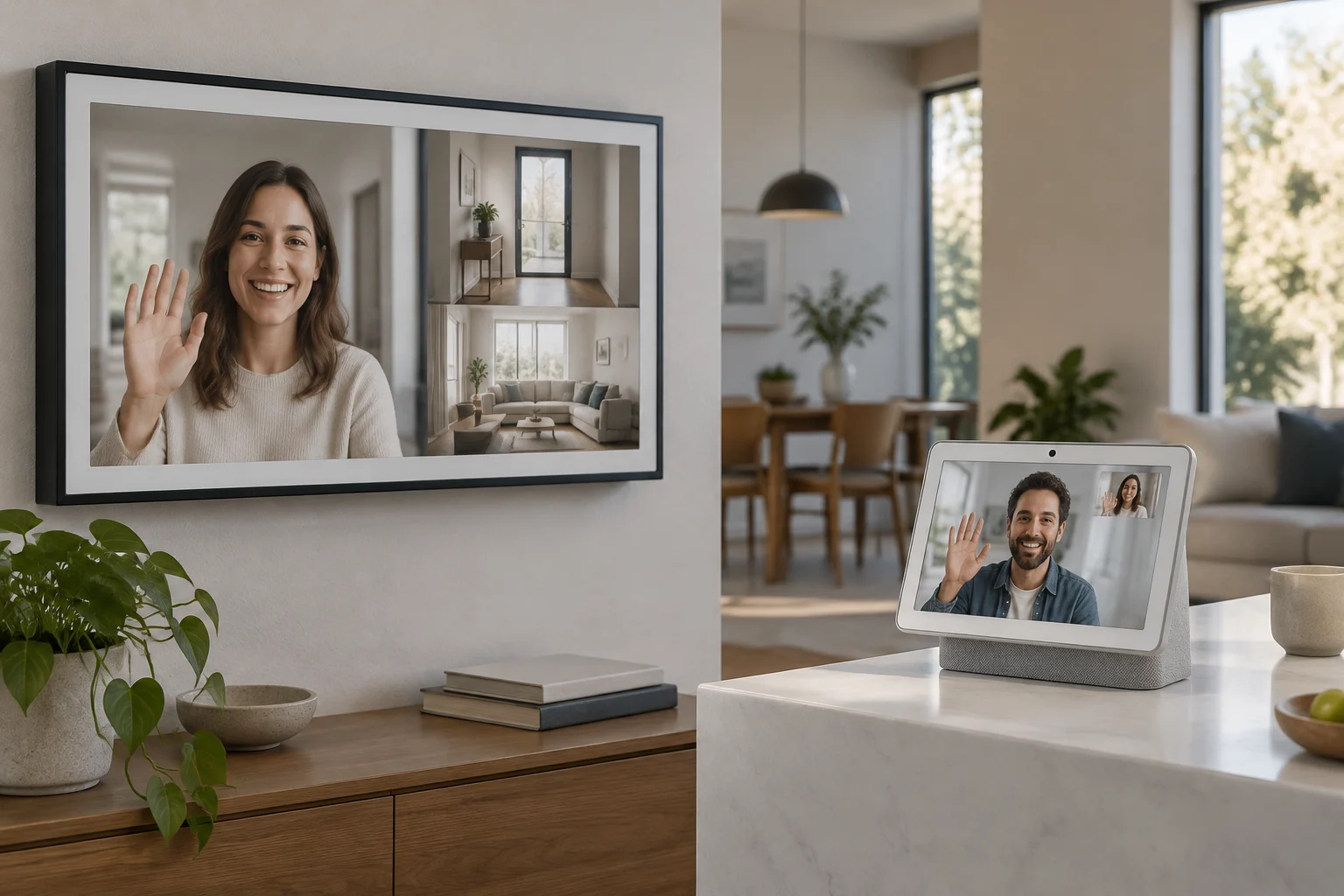
The Nest Hub Max was introduced as a 10-inch smart display with a front-facing camera. Its format is designed for a surface, so it may make more sense if you do not want to attach a panel to the wall or would rather place the device on a counter or shelf. The available source also describes video calls and use of the camera as an indoor security camera; this source package does not document a comparison of image quality or camera performance against the Echo Show 15.
The diagonal measurements cited come from launch coverage and are not the result of a side-by-side visual test. Nor are verified measurements of the Nest Hub Max’s brightness, viewing angles, or resolution available here. It would therefore be inaccurate to conclude that one offers better image quality overall. The difference in size and form factor is supported, and is often enough to rule out a device that does not suit the available space.
Camera and everyday uses: what the evidence supports
Information about the Nest Hub Max attributes two specific uses to its front-facing camera: video calls and indoor monitoring. In principle, this makes it an option that combines a screen and camera in a device intended to sit on a surface. The source does not specify service requirements, the current availability of each feature, or detailed image-handling practices; check Google’s current documentation before basing a decision on those points.
For the Echo Show 15, the sources support the wall-mounted design and its role as a smart display, but the evidence package does not provide a verifiable comparison between the original model’s camera and the Nest Hub Max’s. The page for the newer-generation Echo Show 15 mentions features of that version, but it would be unwise to use it to describe the 2021 hardware without qualification. The exact generation matters more than the shortened product name when comparing cameras and software features.
For everyday use, the useful question is not which device can do more in the abstract, but where it will go and what you expect it to do. If the priority is a large wall-mounted display, the Echo Show 15 has a form-factor advantage. If you want a countertop device whose camera is described for video calls and indoor monitoring, the available description of the Nest Hub Max is more specific. Neither observation amounts to a recommendation about image quality, sound, or reliability.
Connectivity, processor, and audio: limits of this comparison
The supplied documentation does not allow a reliable comparison of the wireless connections in the two models or confirmation of a common set of protocols across both generations. In particular, the provided sources do not sufficiently support attributing native Zigbee or Z-Wave compatibility to the Echo Show 15, or claiming that the Nest Hub Max includes Matter or Thread. Do not buy a hub based on a protocol list without checking the exact model and the requirements of the smart-home devices you already own.
Nor is there verifiable documentation here for comparing the processors in the two devices. The authorized material for this correction does not support claiming that the Echo Show 15 uses AZ2: the URL accompanying that assertion is not in the verified source package. Similarly, the general Google Home specifications included in the research are not a Nest Hub Max specification sheet and should not be used to assign it another device’s processor.
Claims about superior audio, microphone count, noise cancellation, and local processing are also not supported by suitable sources for both models. No performance or sound tests have been conducted, and there are no comparable measurements. To evaluate these areas, consult the official specifications for the exact generation and, if the result matters—for example, for music or video calls—look for independent tests that explain their methods and conditions.
Comparison table: supported facts only
This table brings together the points that can be compared using the supplied sources. The date refers to the generation or announcement context, not current retail availability. Processors, protocols, and prices are omitted because the available evidence does not support a sufficiently robust comparison.
| Detail | Amazon Echo Show 15 | Google Nest Hub Max |
|---|---|---|
| Documented generation | Original announced in 2021; second generation identified in 2024 | Introduced in 2019 |
| Display described | 15.6 inches, Full HD in coverage of the original model | 10 inches in launch coverage |
| Form factor described | Wall-mounted; portrait or landscape orientation according to coverage | Countertop device |
| Camera and video calls | No verifiable comparison is established here for the specific generation | Front-facing camera described for video calls and indoor monitoring |
The table does not provide an overall score because the available differences concern form factor and described features, not results from shared tests. A larger screen does not automatically mean a better purchase: it may be less suitable if there is no available wall or if you want a discreet device. Likewise, a camera’s presence alone says nothing about privacy, quality, or compatibility with current services.
What to check before choosing
For an informed purchase, confirm the generation first. Amazon’s developer catalogue separates the 2021 Echo Show 15 from the second-generation 2024 model; listings may omit that distinction in the shortened title. Review the official specification page for the exact model, and do not mix details from one generation with another.
Next, check your home’s requirements and the intended location. Confirm the physical dimensions, mounting method, power requirements, and whether the camera or video-calling service you want is available in your region. For automation, verify compatibility model by model with your existing accessories: do not assume a device supports a protocol simply because it belongs to a particular assistant family.
As guidance based only on what can be verified, the Echo Show 15 makes sense if you prioritize a large wall-mounted display; the Nest Hub Max is a better fit if you want a countertop device whose camera is described for video calls and indoor monitoring. The recommendation is deliberately limited: the sources do not establish an overall winner for performance, privacy, audio, or connectivity. Your final decision should rest on the exact generation, placement, and features confirmed in current documentation.