The Problem with Marketing Specifications
In the 2026 television market, the proliferation of technical labels like HDMI 2.1 or 120Hz has created a barrier for the average consumer. Many manufacturers use these terms as general quality seals without detailing the specific limitations of each port or operating mode. This lack of transparency forces users to conduct deep research to determine if the TV truly meets performance expectations for gaming or high-quality multimedia consumption.
Confusion is aggravated when regional specifications differ. A TV labeled as 100Hz in Europe may have different input capabilities than one labeled 120Hz in the Americas, depending on the exact model and region. Therefore, it is crucial not to rely solely on the product's commercial name, but on the detailed technical documentation of each specific SKU.
The goal of this guide is to provide a practical verification framework. By understanding the difference between panel capability, HDMI interface capability, and software certifications, buyers can make informed decisions that avoid the frustration of discovering limitations incompatible with their console or PC.
HDMI 2.1: Beyond Bandwidth
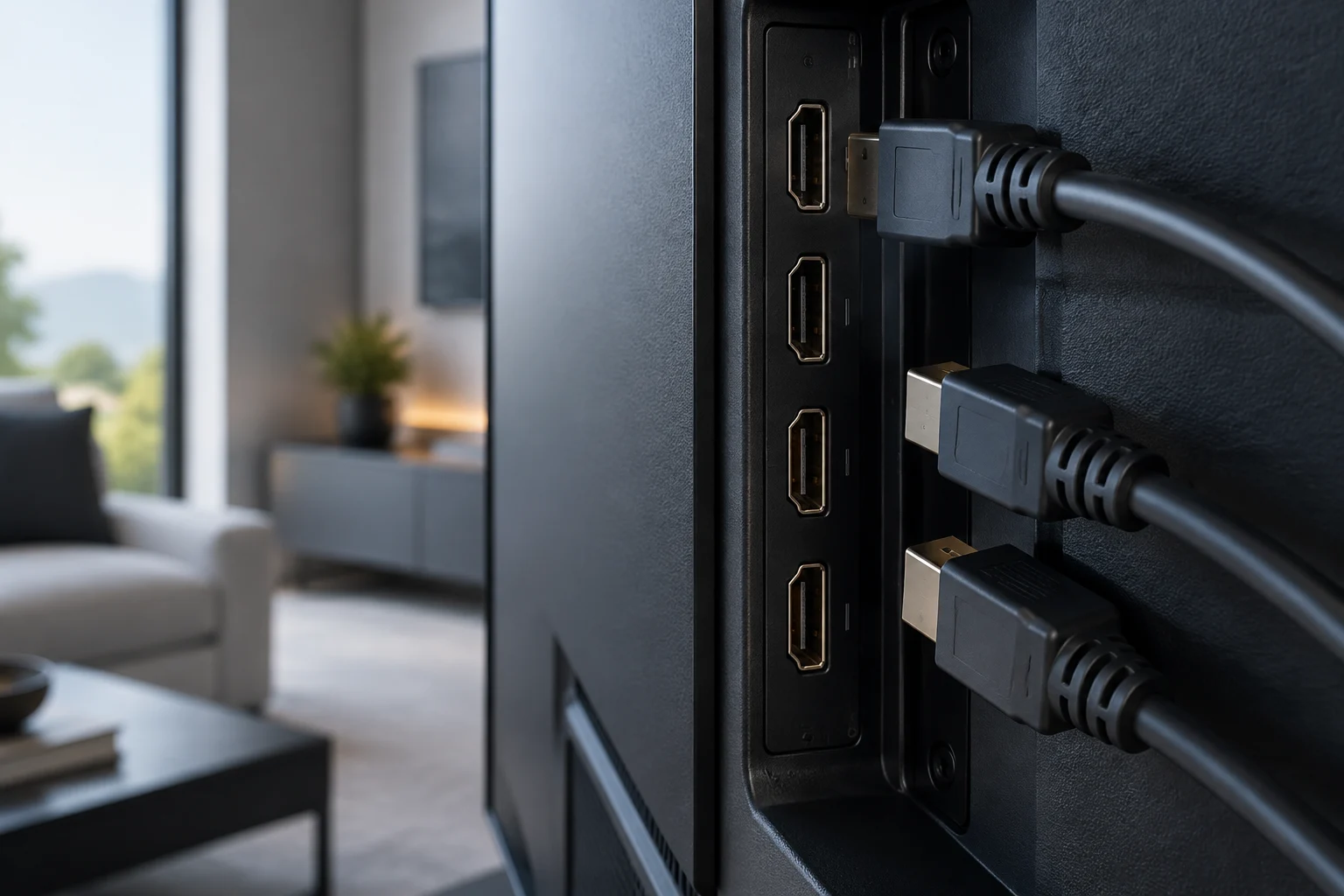
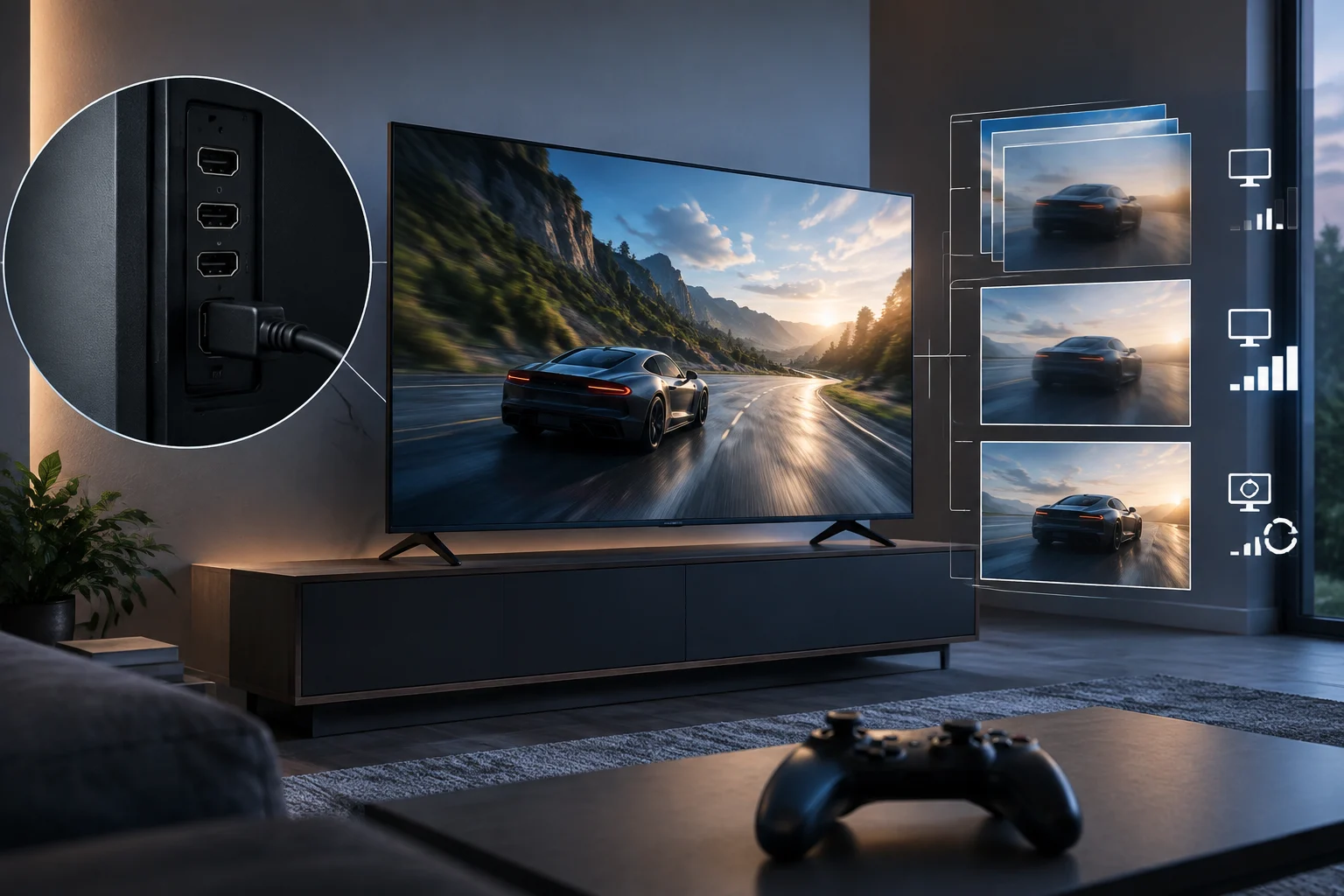
The HDMI 2.1 standard introduces a significant increase in bandwidth, moving from 18 Gbps in version 2.0 to 48 Gbps. This increase is the technical basis that allows transmitting 4K signals at 120 Hz or 8K at 60 Hz without excessive compression. However, the mere presence of an HDMI 2.1 port does not guarantee that the TV can process all functions associated with this standard, such as VRR or eARC, if the video processor is not designed for it.
It is fundamental to verify if the TV supports eARC (Enhanced Audio Return Channel), which allows high-quality audio return without compression, such as Dolby Atmos or DTS:X, from the TV to the soundbar. Unlike traditional ARC, eARC requires a certified Ultra High Speed cable to ensure signal stability over long distances or with multiple connected devices.
For console users like PS5 or Xbox Series X, compatibility with ALLM (Auto Low Latency Mode) is another key aspect of HDMI 2.1. This function allows the TV to automatically detect when gaming is occurring and switch to a low-latency mode without manual intervention, optimizing the real-time gaming experience.
VRR: The Key to Smooth Gaming
Variable Refresh Rate (VRR) is the technology that synchronizes the monitor's refresh rate with the frame rate generated by the GPU, eliminating tearing (image cutting) and stuttering. In TVs, VRR implementation varies according to certifications: AMD's FreeSync, NVIDIA's G-Sync Compatible, or VESA's open standard Adaptive-Sync.
A critical point often ignored is that a TV may support VRR via DisplayPort (in the case of monitors) but not via HDMI, or vice versa. For consoles, HDMI VRR is the indispensable requirement. Therefore, when buying a TV for console gaming, it is essential to confirm that the VRR certification specifically includes the HDMI interface, not just the PC one.
Certifications like FreeSync Premium and G-Sync Compatible imply quality tests that guarantee a wide VRR range and low input latency. However, the presence of a logo does not always indicate that the TV has passed all brand validation tests, so reviewing the manufacturer's official technical specifications is the final verification step.
120 Hz and 144 Hz: Native vs. Supported
The distinction between the native panel frequency and the supported input frequency is one of the most important in TV purchasing. A native 120 Hz panel can accept 120 Hz inputs, but a 60 Hz panel can use techniques like DLG (Double Line Gate) to simulate 120 Hz, sacrificing vertical resolution in the process. This technique is not equivalent to a native high-frequency panel.
In 2026, some high-end TVs offer frequencies up to 144 Hz or even 240 Hz for PC. These frequencies above 120 Hz are usually limited to lower resolutions (such as 2K) or require a high-performance graphics card. It is important to read the footnotes in the specifications, which often indicate that these maximum frequencies are only available in specific modes or with certain connection types.
For most console users, 120 Hz is the current maximum standard. However, for competitive PC gamers, the ability to support 144 Hz or more can be a key differentiator. Verification of compatibility with these frequencies must be done in the technical sheet of the exact model, as capabilities can vary between screen sizes of the same series.
How to Verify Specifications Before Buying
The first source of information should be the manufacturer's official technical sheet, not the marketing page. Look for the connectivity and video specifications section to confirm the number of HDMI 2.1 ports, VRR compatibility via HDMI, and the maximum supported input frequency at each resolution.
If the information is not clear, consult the official certifications from VESA, AMD, or NVIDIA. These organizations publish lists of compatible products that have passed validation tests. The presence of a TV in these lists is a guarantee that VRR functionality is correctly implemented and is not just a marketing label.
Finally, consider the input latency (input lag) measured in milliseconds. A TV with VRR and 120 Hz may have high latency if not optimized for gaming. Look for values under 20 ms in game mode for a competitive experience. The combination of these three verifications (HDMI 2.1, certified VRR, and low latency) defines the true gaming capability of a TV.
Conclusion: Which Specifications Really Matter
In summary, buying a TV for gaming or high-quality multimedia in 2026 requires a critical look beyond shiny labels. Real compatibility is determined by the interaction between the panel, the HDMI interface, and the video management software. A TV may have all marketing logos, but if it does not support VRR via HDMI or has high input latency, its value for gaming is drastically reduced.
The practical decision for the buyer is to prioritize technical verification over the commercial promise. By understanding the differences between HDMI 2.0 and 2.1, the nature of VRR, and the limitations of refresh rates, users can avoid impulsive purchases based on incomplete specifications. The result is a more satisfying user experience and a more profitable long-term investment.
The 2026 market offers excellent options, but only for those who know what to look for. Technical transparency is the most powerful tool to navigate the complexity of modern specifications and choose the TV that truly meets each user's needs.