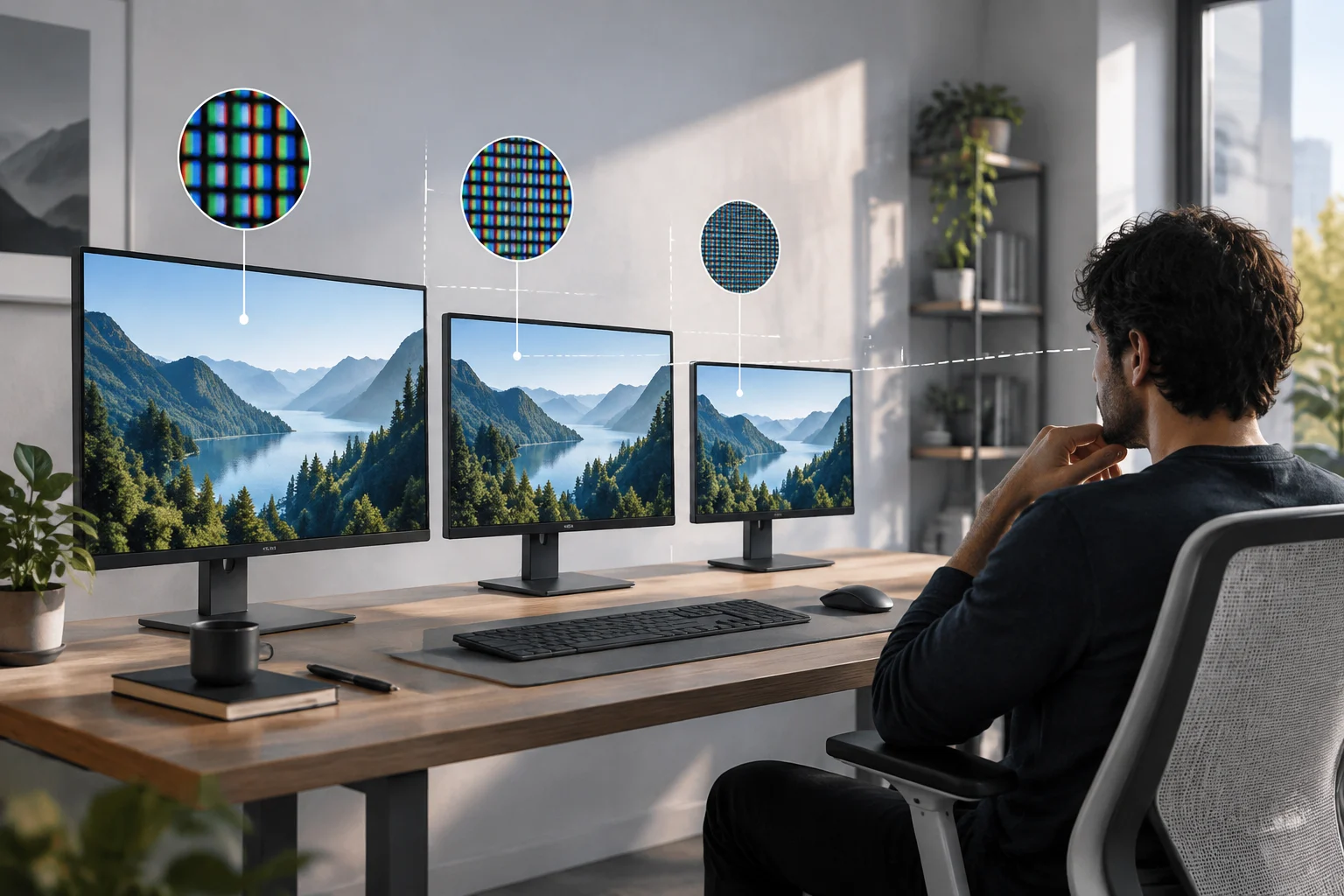
The first filter: do not confuse technologies
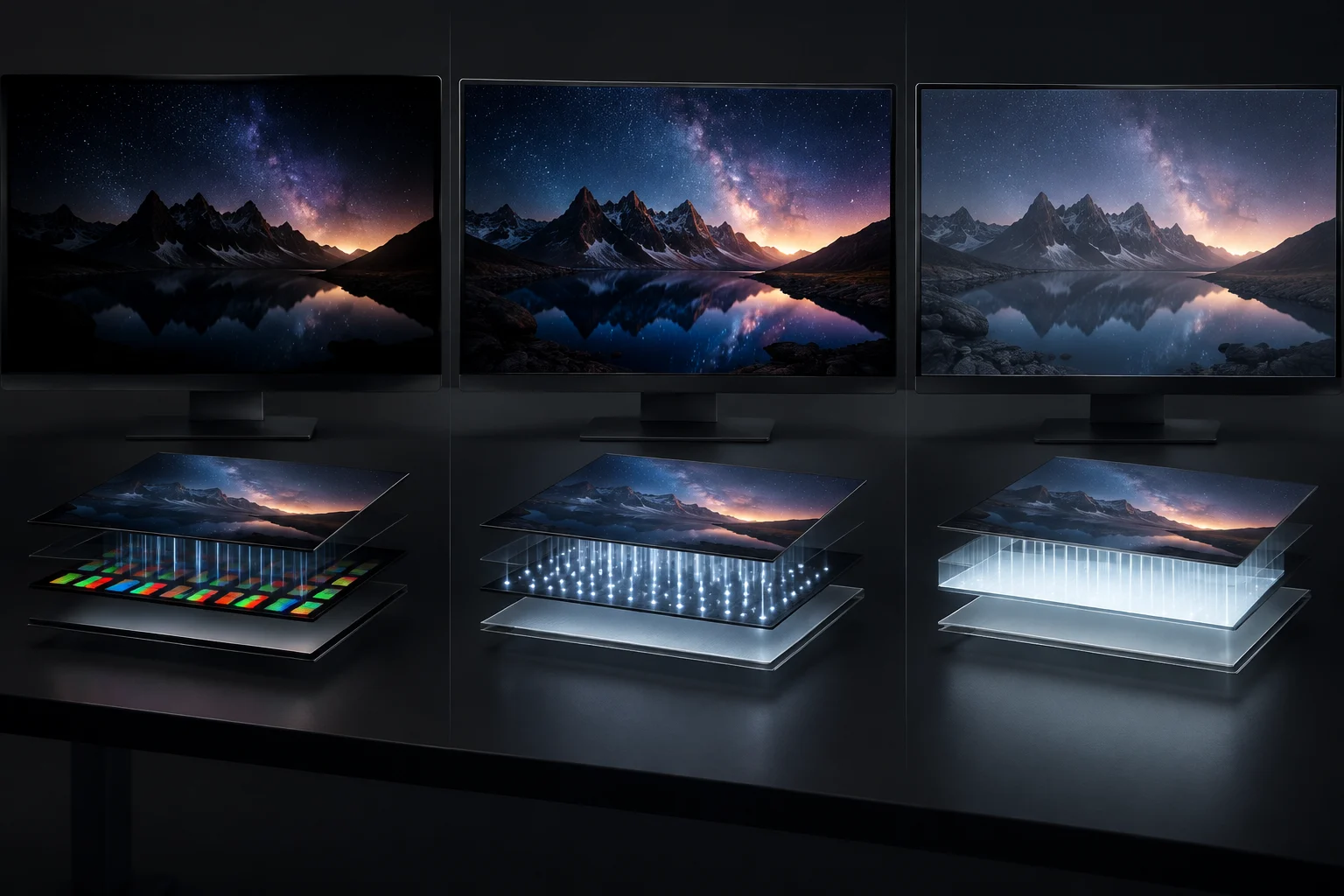
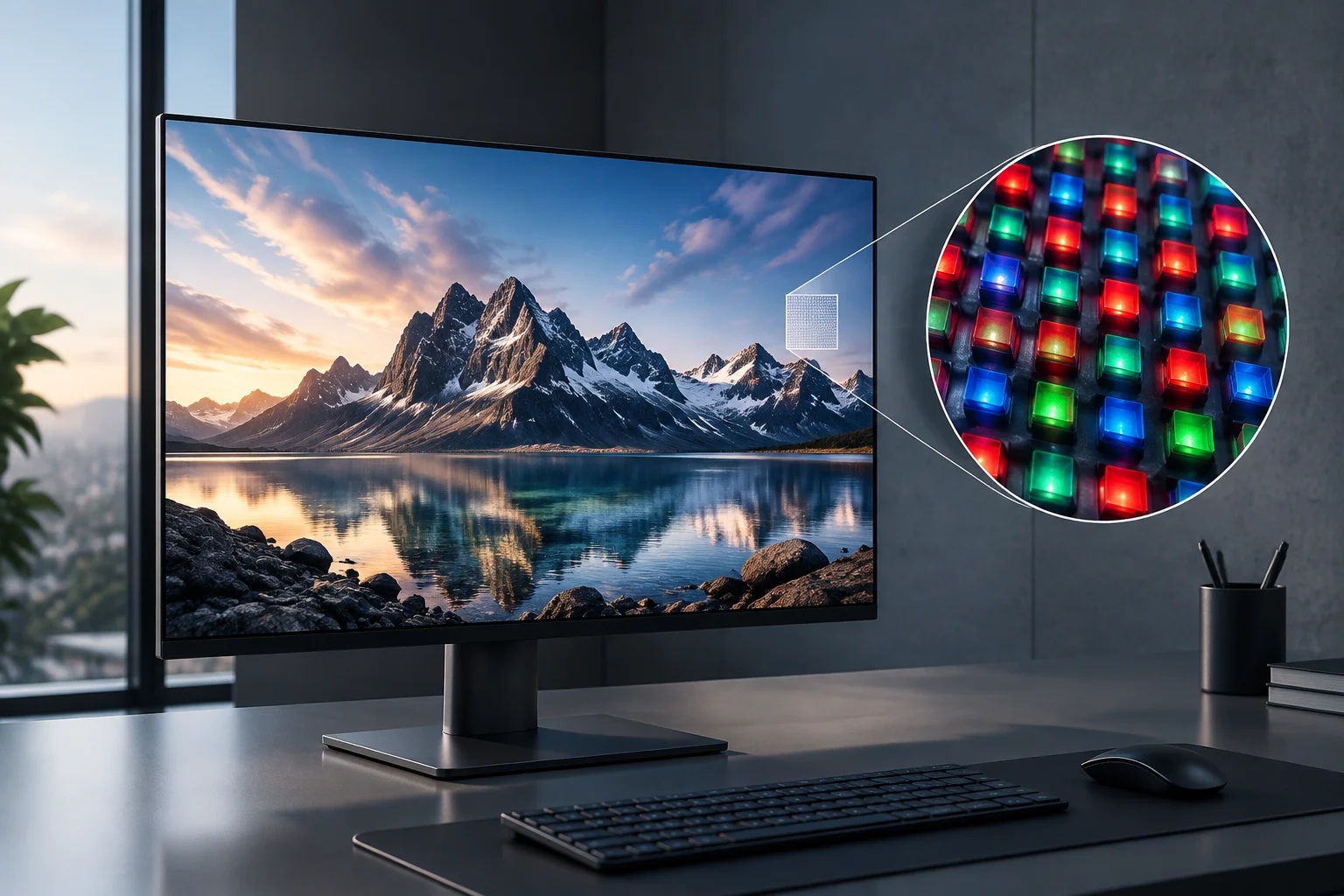
MicroLED, Micro-OLED, and Mini LED are not interchangeable names. MicroLED designates a self-emissive screen made of inorganic diodes; Micro-OLED is an OLED microdisplay, usually associated with near-eye devices; Mini LED describes a backlight for LCD panels. The word "LED" in all three names is not enough to identify how the image is produced.
The practical difference matters when reading ads and technical sheets. A Mini LED screen keeps an LCD matrix and dims the backlight by zones; that is why the number of zones influences local contrast control. In a self-emissive screen, each pixel produces its own light. A label like "RGB Mini LED" does not by itself prove the product is MicroLED: you must check the panel's technical description, not infer it from the commercial name.
What the technical description allows us to state
The most useful distinction for the buyer is self-emission versus backlighting. The available technical description of Micro-OLED characterizes it as self-emissive and built on a silicon wafer, while explaining that Mini LED remains an LCD technology with a matrix of small LEDs in the backlight. This is a comparison between Micro-OLED and Mini LED, not a complete MicroLED spec sheet for monitors.
Therefore, it is advisable to avoid automatically transferring brightness, lifespan, or burn-in resistance figures attributed to the technology in general to MicroLED. The available research does not provide verified specifications for a desktop MicroLED monitor, nor a comparable set of measurements between MicroLED, OLED, and Mini LED. An explanation of possible theoretical advantages does not replace a product spec sheet or an independent test.
Market predictions and available products are different things
A forecast published in 2019, attributed to IHS Markit, anticipated that MicroLED screen shipments could reach 16 million units in 2026, although it estimated they would represent only 0.4% of the global flat-screen market. It was a market estimate, not a promise of PC monitors, and it did not identify sizes, models, or retail availability. It does not serve to conclude that a desktop monitor has reached stores.
In the sources examined, there is no official spec sheet or verifiable announcement of a desktop MicroLED monitor with a commercial model, complete specifications, and confirmed availability. That absence in the consulted package does not prove that no product exists anywhere in the world; it does prevent presenting as fact that there is a standard commercial offer. The limited conclusion is that a PC MicroLED monitor available for purchase cannot be substantiated here.
How to interpret desktop alternatives
The documented examples from 2026 in the consulted material correspond to OLED and Mini LED, not MicroLED. TFTCentral reported the announcement of the TCL 32X3A, a 31.5-inch OLED monitor with 3840 × 2160 resolution and 240 Hz frequency. The same coverage described other TCL Mini LED monitors, some still marked as upcoming; therefore, announcement, pre-sale, and effective availability must be treated as distinct states.
DisplayNinja, in an October 2026 update, listed the HKC 25Q360B as an IPS monitor with Mini LED FALD backlight, 24.5 inches, 1440p resolution, 360 Hz, and 1152 zones. This information allows identifying the category and some reported specifications, but it does not by itself establish availability in all countries nor offer a verified price comparison. It is incorrect to use these models as evidence that MicroLED is already sold: they illustrate alternatives with different technologies.
A useful comparison without invented figures
The evidence in the package does not allow building a reliable table of maximum brightness, contrast, lifespan, and price for the three technologies. Equivalent measurements are missing, and above all, a specific MicroLED monitor with a verifiable spec sheet. Theoretical values or figures from products in different categories would produce a misleading comparison. To decide, it is more useful to separate what is documented and what remains incomparable:
| Technology or reference | What can be stated with the consulted sources | What is not substantiated |
|---|---|---|
| MicroLED in desktop monitor | No verifiable model with confirmed availability is provided | Price, measured brightness, contrast, and ports of a commercial product |
| Mini LED | It is an LCD backlight; monitor models with dimming zones are described | That its figures are comparable to a specific MicroLED product |
| OLED | Monitor announcements with specified size, resolution, and frequency exist | That an isolated figure represents the performance of the entire category |
| Micro-OLED | Described as self-emissive and associated with microdisplays | That it is equivalent to MicroLED or a desktop monitor |
For a real purchase, request the spec sheet of the exact model and check the panel type, resolution, frequency, brightness with its measurement condition, video inputs, and availability date in your market. Do not compare "peak HDR" with full-screen brightness nor a marketing figure without conditions with an independent measurement: they may describe different scenarios.
Cost, formats, and connectivity: limits of what we know
Complex manufacturing and high cost are cited as general obstacles for MicroLED expansion. However, the OneDisplay price guide included in the research deals with large-format LED screens and prices per square meter, not consumer MicroLED monitors. Its figures should not be transferred to a 27 or 32-inch monitor nor presented as MicroLED price: there is no comparable quote for that product in the consulted sources.
It is also not possible to confirm what ports a commercial desktop MicroLED monitor would have: without a final model and its manual or official spec sheet, asserting compatibility with HDMI or DisplayPort would be speculative. For the buyer, that limitation changes the practical check: in addition to asking about the panel technology, one must require the model number and manufacturer documentation confirming inputs, resolution modes, and frequency.
What decision can be made today
For those looking to buy a monitor now, the prudent conclusion is not to treat MicroLED as a substantiated purchase option based on these sources. OLED and Mini LED appear in 2026 monitor announcements and listings with specific specifications, but each model requires verification of local availability, price, and warranty conditions. The preference between them will depend on use and confirmed data for the product, not a universal superiority that the evidence here does not demonstrate.
If an ad calls a screen "MicroLED", check before reserving: exact model and manufacturer; whether the panel is MicroLED, Micro-OLED, or LCD with Mini LED; sale date and market; brightness and connectivity specifications; and an official source or technical documentation. If there is no purchasable model nor verifiable spec sheet, consider it a prototype or a pending claim, not an equivalent alternative to monitors that already have public data. Available sources also do not justify dating a massive arrival to 2028, 2030, or any other year.