What is inspected and what it means to automate a task
Energy robotics is not a single technology or a uniform promise. It can include drones that capture images of components, mobile vehicles that travel around facilities, tracked equipment for difficult surfaces, or underwater vehicles used to inspect submerged assets. What they share is an operational goal: bringing sensors or tools to places where inspection is difficult, repetitive, or subject to special safety measures. The mode of movement, sensor and degree of human intervention vary considerably from one case to another.
At a hydroelectric plant, an inspection may concern buildings, galleries, auxiliary equipment or structures exposed to water; at a wind farm, it may concern blades, towers or offshore components. But naming a facility does not prove that a specific task there has been robotized. Enel Green Power’s source points to the use of drones and robots in the operation and maintenance of renewable plants in several countries, although the information on its page does not identify each machine, mission, protocol or result in detail. The general statement is evidence of reported use, not a technical record of a verifiable operation.
To assess an application, it helps to distinguish four levels: the robot exists; it can perform a function under controlled conditions; it has been tested in the relevant environment; and the operation is repeated with measured results. A news report about a trial may substantiate the first two and, if it explains the setting, part of the third. It does not automatically establish commercial availability, routine use or lower costs. In this article, “documented” means that an identifiable source describes a task or demonstration; it does not mean that performance has been independently validated.
Published cases: from blade inspection to renewable plants
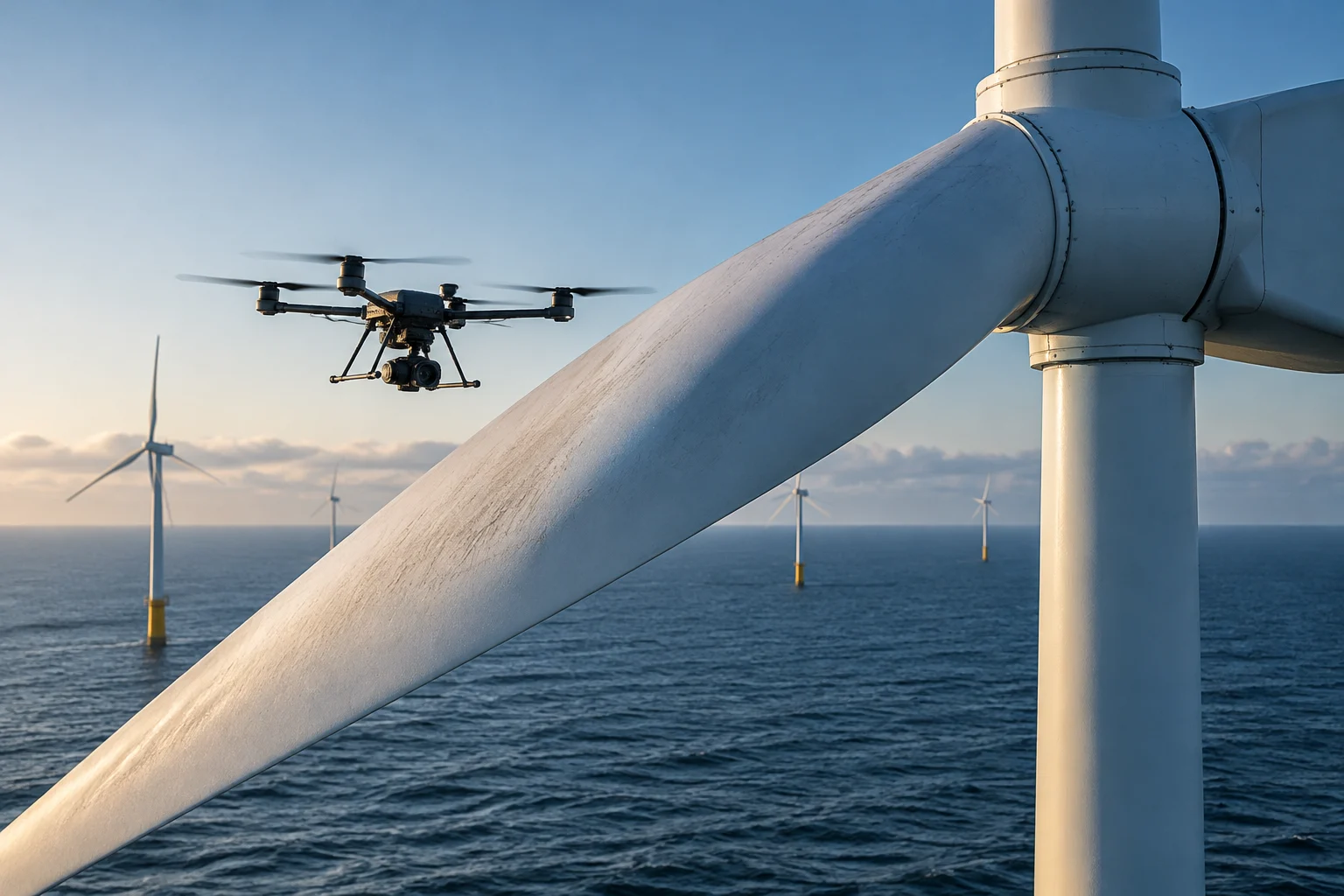
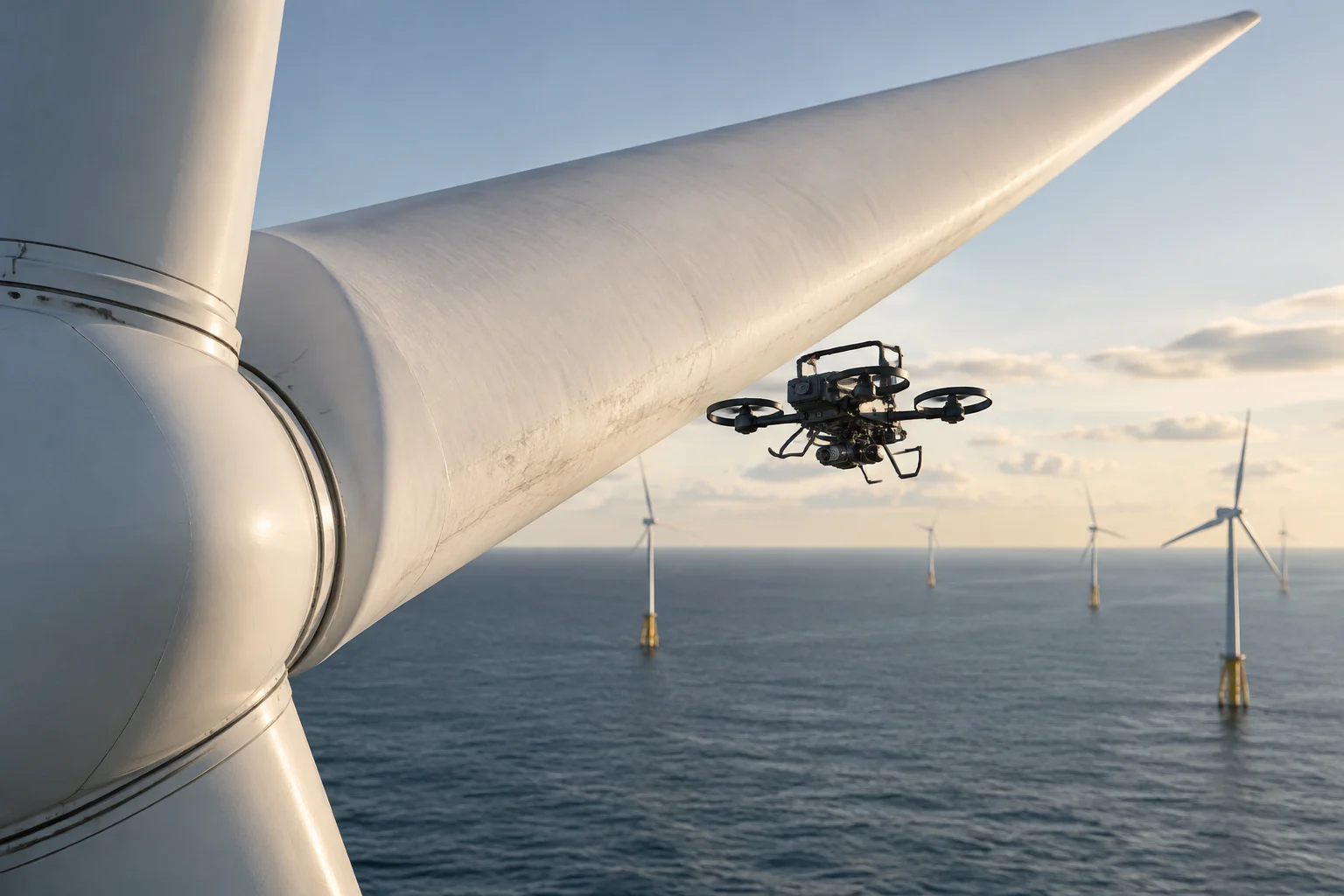
One case with a more specific operational sequence is MIMRee, a British robotics project for offshore wind farms. According to Energy Global’s coverage of the project’s conclusion, the concept combined an autonomous vessel from Thales, an inspection system able to examine blades while they were turning, a drone, and a six-legged robot that could move along a blade to carry out a repair. The article states that the project team had demonstrated its core technologies; this supports the conclusion that a demonstration took place, but does not show that a fleet provided routine service at a commercial wind farm.
The distinction matters because the MIMRee account includes both tested capabilities and a vision of the future. The same coverage reports that ORE Catapult considered a semiautonomous scenario potentially feasible within a decade, and presents more advanced autonomy as a later prospect. Those dates were expectations expressed in the project’s context, not observed outcomes or deployment guarantees. Editorially, the solid fact is the reported demonstration of the project’s technologies; the future timetable and scale must be attributed as forecasts by its participants.
Enel Green Power describes more broadly the use of drones and robots at wind, solar and hydroelectric plants for operation and maintenance tasks. However, the available page does not provide enough detail to reconstruct a specific mission: it does not identify the inspected asset, robot model, sensor, duration, acceptance criteria or comparative indicator. The text therefore supports the statement that the company reports applications of these tools, but not the attribution of a specific level of autonomy or quantified savings. The lack of detail does not disprove use; it limits the conclusions that can be drawn from the source.
Robotics manufacturer Robotnik lists potential energy-sector applications such as inspection and monitoring, as well as other tasks in oil and gas. This information is useful for mapping categories of equipment and work, but a commercial list is not a record of operational installations and does not prove benefits. In particular, saying that robots “can” inspect describes a capability or potential application; to claim that an operation took place requires project, facility or operator data explaining what happened.
What evidence distinguishes a trial from a real operation
Sources on robotics often mix levels of evidence: a product description, a laboratory test, a demonstration at a site, a test under operating conditions, and recurring deployment. Each level answers a different question. A video may show that a robot moves or that a sensor produces images, but may not reveal whether the test was representative, how much human support it required, or how the result was verified. Visual evidence confirms an observed action, not necessarily repeatable industrial performance.
In the MIMRee case, the coverage identifies the elements in the sequence and attributes the demonstration of core technologies to the project. This is more informative than a generic claim because it indicates what the project set out to do: detect defects, stop blades, transport a robot and carry out repairs. Even so, the cited source is journalistic coverage of the project, not a complete technical protocol. The available extract provides no detection rates, false positives, percentage of inspection completed, system availability or controlled comparison with a human team.
To increase confidence in a case, the documentation should make it possible to answer verifiable questions: At what facility and on what date did the work take place? Which asset and defect were inspected? Which sensors and robot were used? Which parts were autonomous and which were teleoperated? How many missions were completed? What human intervention was needed? Who confirmed the diagnosis? If the goal was repair, the acceptable-repair criterion should also be specified, as well as whether the asset returned to operation after the intervention.
A product sheet or corporate statement can be a primary source for what a company says about its product or activity, but it is not necessarily a neutral assessment of effectiveness. Conversely, an independent article can provide context, although its quality depends on whether it details the methodology and refers to accessible results. Source independence and methodological quality are different questions: a well-described study may be more useful for measuring an outcome than a promotional claim, without removing the need to identify its context.
How to measure coverage, time, safety and performance
The word “efficiency” is too broad to assess a robotic application without indicators and a comparator. In an inspection, the first measure may be coverage: what proportion of the asset was examined with sufficient quality and which areas remained unobserved. Total mission time, preparation and recovery time, the number of repeat inspections, the rate of confirmed findings and false positives also matter. Reported results should include units, working conditions and a definition of the denominator.
Comparison with conventional methods requires both alternatives to undertake equivalent tasks. If a robot inspects an accessible area while a crew checks a different or more complex section, comparing raw times may be misleading. A robust analysis would explain the asset’s condition, weather, distance, interruptions, staff experience and auxiliary equipment. Without a comparable scenario, “faster” does not identify which part of the process improved or at what cost.
Safety must be evaluated using more than the presence of a robot. Reducing human exposure to heights, water, confined spaces or hazardous environments is a plausible design hypothesis, but its effect depends on how missions are prepared and how many interventions remain necessary. Relevant records include exposure, incidents and near misses, together with the supervisory workload and the tasks retained by staff. The absence of incidents during a brief trial is not enough to infer a general reduction in risk.
Assessing economic performance requires accounting for the complete system: purchase or rental, integration, training, maintenance, batteries, communications, data analysis, permits and support staff. It should then be compared with the cost and quality of the alternative, including asset shutdowns or unavailability where relevant. The available material for the cases cited does not provide a common cost basis or sufficient quantitative results to calculate returns. Therefore, it is not possible here to substantiate general cost savings or a percentage improvement in productivity.
Field constraints and the role of people
The environment determines which robot may be suitable. Outdoors, wind, rain, temperature, lighting and dust may matter; at hydroelectric facilities, humidity, access to galleries or proximity to water; and in marine operations, waves, corrosion and the logistics of reaching an asset. Mobility also does not guarantee that a sensor can see what is needed: geometry, reflections, vibration, dirt and distance can degrade observations. For this reason, a demonstration in a controlled area does not automatically represent all plant conditions.
Autonomy is also a matter of degree. A vehicle may follow a route by itself while still relying on a person to plan the mission, confirm a detection, avoid obstacles or decide whether an asset can return to service. The sequence described for MIMRee includes several technological components, but does not justify assuming that the entire operation was autonomous end to end. It is more precise to ask which decisions the system makes, under what supervision, and what the recovery procedure is in the event of a failure.
Connectivity and power are operational constraints, not minor details. An inspection may require live image transmission, but metal structures, distance or underground facilities can limit the signal. If the system stores data onboard, some of the analysis shifts to a later stage; if it needs continuous communication, the mission depends on coverage and latency. The documentation reviewed does not provide comparable values for battery endurance, communications range or continuity of service for the cases described, so no figures should be assigned to them.
In every scenario, staff responsible for the asset are still needed to define the inspection, validate findings, coordinate permits and decide on maintenance actions. A robot’s potential value may lie in improving access to data or reducing exposure during a particular phase, not in replacing technical judgment. Automating data capture is not the same as automating diagnosis or authorizing a repair.
Conclusion: what the available evidence allows us to say
The documentation reviewed supports the conclusion that robotics applications and projects are associated with energy inspection and maintenance. The MIMRee example is described through a sequence of equipment and tasks and presented as a demonstration of core technologies; Enel Green Power reports broader use of drones and robots at renewable plants, although the cited page provides insufficient technical detail. Robotnik lists possible applications, but a manufacturer’s source is not, by itself, an evaluation of results.
The evidence reviewed does not allow a consistent comparison between hydroelectric plants, wind farms and other facilities, or a general quantification of improvements in safety, time or cost. Nor does it show that the MIMRee concept was deployed as a routine service at commercial scale. These are limitations of the evidence found, not proof that robotics has no value. Changing that conclusion would require field reports with context, methodology, measured results and a comparable reference.
For readers, the useful rule is straightforward: distinguish capability from deployment, a demonstration from repeated operation, and a future promise from a published result. A claim of efficiency should provide an indicator, period, conditions and comparator. Without those elements, the responsible approach is to describe the task the technology set out to automate and what was observed, without turning robotics’ potential into a benefit already proven.