Model and Data: What System You Are Using
Model and Application
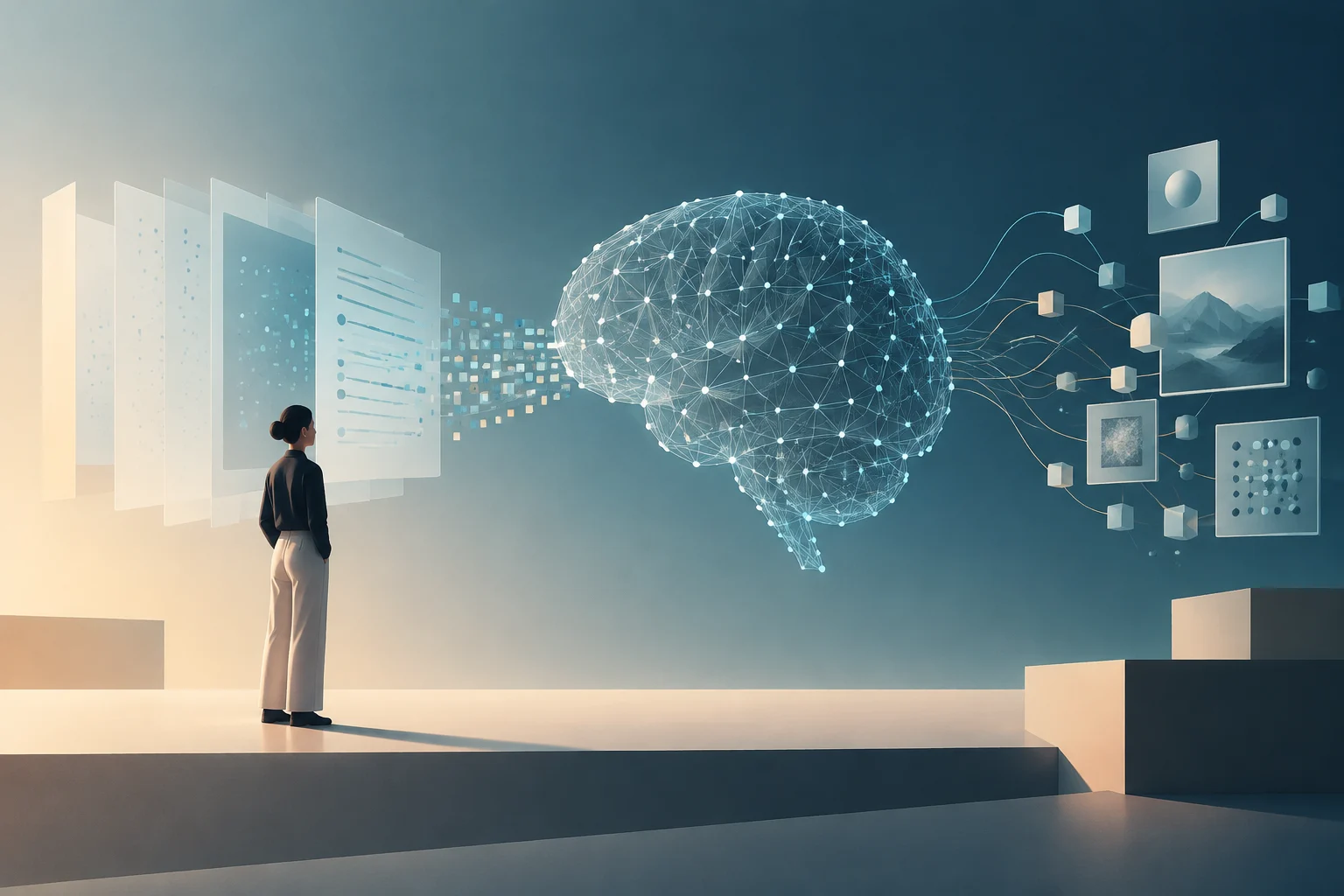
A machine learning model is a computational system trained with data to make predictions or generate content. It is not a piece of hardware; it is the system that performs these tasks.
Parameters and Training Data
Parameters are numerical values that form part of a machine learning model. In language models, the system uses these values to estimate the probabilities of token sequences and produce predictions or text.
A model can produce coherent responses by leveraging learned statistical patterns, but this capability does not prove it has consciousness or human-like understanding. It is important to distinguish convincing linguistic behavior from verified knowledge: a well-written response may still contain errors.
Training, Inference, and Fine-Tuning
Training and Inference
Training is the process of adjusting a model with data. Inference is the generation of an output or prediction by a trained model based on an input. When a person asks a chatbot a question, they are using the model to obtain an answer; fine-tuning, by contrast, requires additional training.
What Does Fine-Tuning Mean?
Fine-tuning is additional training that adapts a model to a specific task or type of data. It is not the same as adding an instruction to a conversation. Writing "summarize this text" changes the request the system receives; instructions can customize the output without changing the model's parameters.
This distinction also matters when evaluating privacy: inference describes how an output is obtained, not what the provider will do with the submitted data afterward. Query usage and post-processing are distinct questions; to know if inputs or logs are stored, you must review the specific service's terms, settings, and policies.
LLMs, Tokens, Context, and Memory
LLM and Tokenizer
LLM is the English acronym for Large Language Model, or large language model: a model that estimates the probability of tokens or token sequences and can be used to generate text. A token can be a word, a part of a word, or a character, depending on the segmentation method. The tokenizer converts text into tokens and then into numerical identifiers that the model can process. There is no universal equivalence between token, word, and character; segmentation also varies by language.
Context Window and Memory
The context window is the limited set of tokens included when a language model generates an output. It can gather instructions, message history, tools, and external data. Managing this context involves selecting the information provided to the model; with extensive contexts, its ability to retrieve data accurately may decrease.
Memory can be an added capability to a model, along with tools or information retrieval; its operation depends on the system that incorporates it. Present context does not equal permanent recall, and retrieving information is not the same as retraining the model.
Prompt: Requesting a Task with Context
A prompt is an input that can include instructions and examples to guide a model's response. For example: "Summarize this fictional text in three bullet points and point out what data remains unclear." It is a way to customize the output, not a formula that guarantees a correct result.
Instructions help specify the task and guide the response, but they do not ensure it is correct. Including examples can also help show the expected type of output. Quality depends on how the context is organized and the model's ability to perform the task.
Embeddings, Semantic Search, and RAG
Embeddings and Semantic Search
An embedding is a numerical representation of data. In semantic search, embeddings can represent elements to compare them based on learned relationships, such as similarity between concepts.
RAG: Retrieve Before Responding
RAG stands for Retrieval-Augmented Generation, or retrieval-augmented generation. The system retrieves information from an external source and adds it to the context the model receives to generate a response. This allows it to incorporate external data without retraining it. Retrieval can use various methods, including semantic search.
RAG can provide documents that were not part of the model's original context without retraining it or changing its parameters. This distinguishes it from fine-tuning. However, retrieving a passage does not ensure it is interpreted correctly: the response may still summarize it incorrectly, omit a condition, or combine it with information not in the document. Checking the reference and the relevant fragment remains useful.
Agents, Tools, and Workflows
Tools and Agents
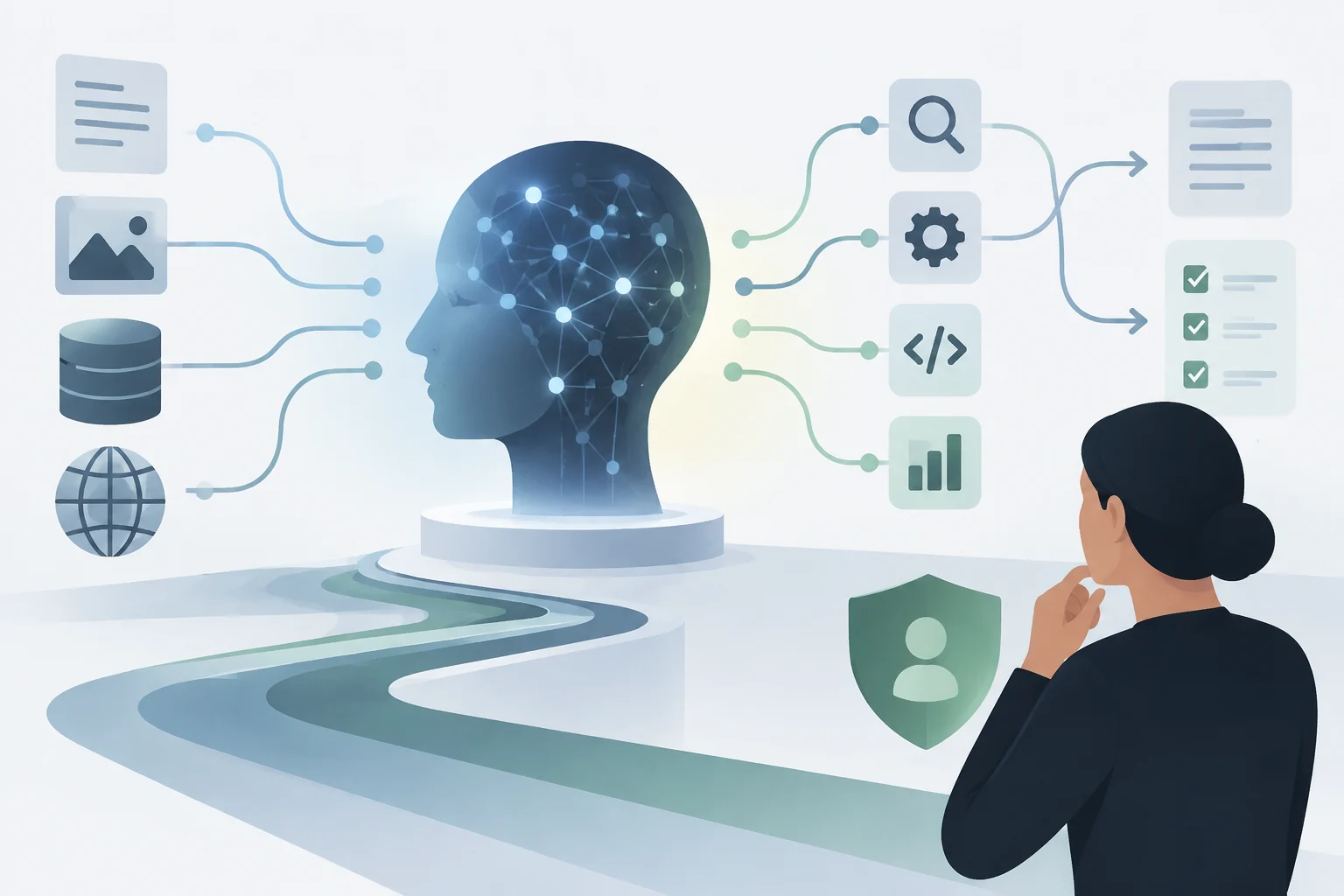
A tool expands a model's capabilities, for example, by allowing it to retrieve information or execute an action. An agent usually refers to a system in which a model dynamically directs its steps and the use of tools to fulfill a task. The term is also applied to systems with predefined flows, so its meaning can vary by context.
Workflow and Autonomy
A workflow organizes models and tools through predefined steps. In an agent, the model can dynamically decide which actions to take and which tools to use. The practical difference lies in who determines the steps; possible actions depend on the tools and permissions integrated into the system.
The more action capability a system has, the more important it is to review its permissions and control points. For sensitive operations, it is advisable to restrict access to accounts and data and request confirmation before sending, publishing, buying, or deleting something. An agent can make mistakes or chain errors; the label does not certify reliable autonomy or replace supervision.
Generative AI and Multimodal Systems
Generative AI produces content —for example, text, images, audio, or video— based on patterns learned from data and an input. Other machine learning systems may focus on classifying something or predicting a value, such as determining if an image belongs to a category.
A multimodal system can process more than one type of content, such as text and images. For example, some models accept an image along with a written question. Supported formats depend on the model: Transformers documentation describes models that receive text and images, and also some that support video.
Multimodality is about input and output formats, not whether a system can perform multiple tasks or access the internet. To assess a function, check which formats it accepts, what results it generates, and which external services, if any, it can query.
Hallucinations, Biases, and Evaluation
Hallucination or Confabulation
Hallucination —also confabulation— refers to an erroneous or false response that the system presents with confidence, or that is not supported by the provided context. A hypothetical example would be attributing a statement to a non-existent reference. Fluency is not proof of accuracy; it is advisable to verify citations, names, dates, and important claims.
Bias, Evaluation, and Benchmark
A bias is a systematic tendency that can affect outputs or their consequences. In AI systems, it can manifest as performance differences between groups or in results that reproduce biases present in the data. Therefore, it is not enough to test a general query: it is important to observe how the system responds to relevant cases and groups for the intended use.
A benchmark allows measuring and comparing model performance through metrics applied to tasks or datasets. Appropriate metrics depend on the task and the data evaluated.
To value a tool, use representative examples of your task and check accuracy, errors, limits, accessibility, and cost as appropriate. Separate measured result in a test from performance in everyday use: the former describes specific conditions, not guaranteeing the latter. No isolated check eliminates all risks.
Privacy, Data, Copyright, and Licenses
Data and Privacy
Inference describes how a model produces an output from an input, but it does not by itself determine the processing of personal data. Before sharing information, check what data the service requests and what controls it offers.
As a precaution, avoid including personal or sensitive data when not necessary and use fictional examples when testing features.
Copyright and License
The US Copyright Office report examines copyrightability of generative AI outputs under US law. It says that whether human contributions are sufficient for authorship must be assessed case by case; prompts alone do not provide sufficient control under current generally available technology. This analysis concerns US copyright law.
In the United States, the Copyright Office concludes that the protection of AI-generated results depends on human contribution and must be analyzed case by case. Its report notes that instructions, by themselves, are not sufficient to determine authorship. This analysis corresponds to the US legal framework, not a global rule.
Essential Differences at a Glance
| Concepts | Practical Difference |
|---|---|
| Model / Application | The model is a system trained with data to make predictions or generate content; an application can use its predictions. |
| Training / Inference | Training adjusts the model; inference uses it to generate an output. |
| Token / Word | The token is a unit of the tokenizer and can be a word, part of it, or another fragment. |
| Context / Memory | Context gathers information included for the model to generate an output; memory can be an additional system capability. |
| RAG / Fine-tuning | RAG retrieves information to add to the context; fine-tuning retrains the model to adapt it. |
| Agent / Workflow | An agent can decide steps and tools; a workflow follows predefined steps. |
| Multimodal / Multitask | Multimodal refers to data types; multitask, to different tasks. |
| Benchmark / Real Result | A benchmark measures under specific conditions; it does not guarantee performance in any use. |
To decide if a tool serves you, clarify what model or functions it uses, what data you need to send, what documents or services it can query, what actions it has permission to execute, and what privacy and copyright conditions apply. If a response affects an important decision, verify the information in an appropriate source instead of taking its confidence or fluency as a guarantee.