
What the KEV Catalog Is and What It Indicates
The Known Exploited Vulnerabilities Catalog (KEV) is maintained by the U.S. Cybersecurity and Infrastructure Security Agency (CISA). It brings together vulnerabilities that have been exploited in the real world and provides a useful signal for guiding vulnerability management. CISA describes it as a source of exploited vulnerabilities and recommends using it as an input when prioritizing management work.
Inclusion indicates that reliable evidence of exploitation exists, but it does not confirm that an organization’s own asset is affected or that CISA is observing attacks at that moment. To assess the risk to an installation, identify the deployed product and version, then check the conditions for impact and the vendor’s instructions.
CISA identifies four inclusion criteria: the vulnerability must have a CVE identifier, reliable evidence of active exploitation, a clear remediation or mitigation action, and significant risk to U.S. government information systems. The catalog is not an inventory of each organization’s equipment.
The catalog is available in CSV and JSON, and its page allows users to subscribe to alerts about new additions. Comparing its entries with an organization’s own environment requires an up-to-date inventory of products and versions; the catalog does not replace asset discovery or checks of individual installations.
KEV and CVSS: Two Different Signals
CVSS is a system for describing vulnerability characteristics and producing a numerical score that reflects severity. That score can be translated into qualitative categories such as low, medium, high, or critical to support assessment and prioritization.
The CVSS base score does not indicate real-world exploitation. CISA explains that the score does not account for whether a vulnerability is actually being used to attack systems. A high rating therefore does not prove that attacks are underway, and a lower rating does not invalidate the known-exploitation signal represented by a KEV entry.
KEV and CVSS answer different questions: KEV provides information about known exploitation, while CVSS expresses severity based on a vulnerability’s characteristics. Considering them together helps avoid decisions based on a single measure, but neither one on its own confirms whether a specific device is vulnerable or exposed.
When organizing remediation work, also consider which assets are affected, their exposure, potential impact, and applicable requirements. Priority depends on context: an isolated score or presence in the catalog does not replace an assessment of the environment or consultation of vendor instructions.
BOD 26-04 and the Scope of Its Requirements
BOD 26-04 establishes vulnerability-management requirements for U.S. federal civilian executive branch agencies, known as FCEB agencies. CISA says the directive applies only to those agencies and encourages other organizations to adopt risk-based management and prioritize remediation of vulnerabilities included in KEV. That recommendation does not automatically make federal requirements binding on private companies.
The previous directive, BOD 22-01, has been revoked and replaced by BOD 26-04. The archived text of BOD 22-01 should therefore not be presented as the current framework. Organizations subject to BOD 26-04 should consult the current directive and implementation guidance to determine the actions required for each asset.
The KEV JSON schema distinguishes dateAdded, the date a vulnerability was added; requiredAction, the action required to address it; and dueDate, the deadline for that action. These fields help readers interpret an entry, but the addition date does not indicate when an attack began or prove that an incident occurred in an organization’s own environment.
The BOD 26-04 guidance explains that agencies determine the exposure of their assets and that deadlines depend on the information available and the assessment applicable to each asset. Do not apply a federal deadline to every system or to organizations outside the directive’s scope. Also review the contracts, standards, and policies that do apply to your environment.
How to Integrate KEV into a Vulnerability-Management Process
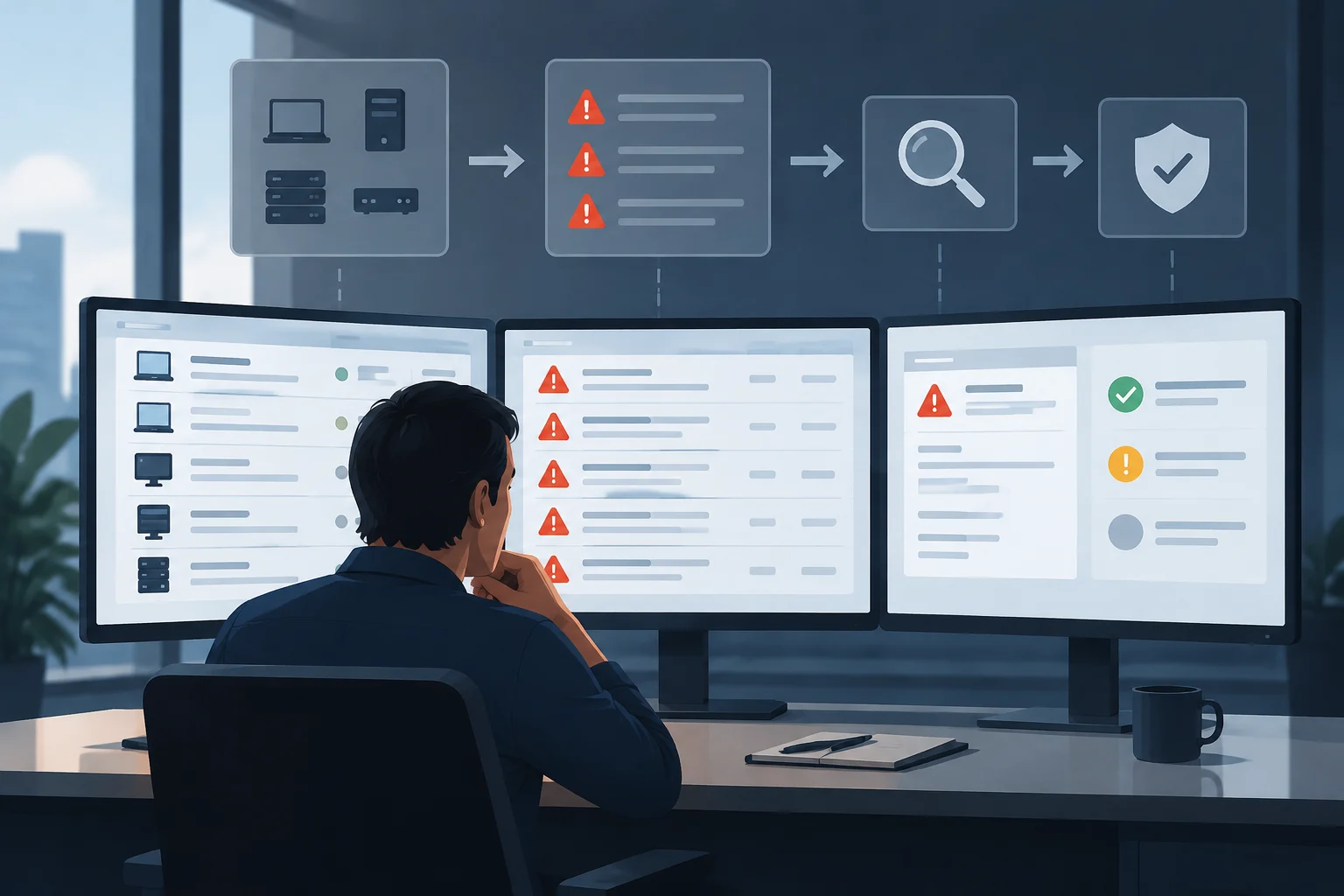
Start by maintaining a reliable inventory of assets, products, and versions. Then compare that information with KEV entries and review the required action and vendor instructions. Validate every match: finding a product name is not enough to conclude that a particular installation is affected.
A practical sequence is to identify the product and version, check whether the vulnerability and its conditions apply to the asset, consult the recommended measures, and prioritize action according to exposure and impact. After applying an update or mitigation, record what was done and verify the result on the assets reviewed.
Automated tools can help match CVE identifiers against inventories, but product, version, and impact conditions still need to be checked. An automated match requires validation: record the asset assessed, the measure applied, and how the result was verified. Keep completed tasks, justified exceptions, and outstanding issues distinct.
CISA recommends maintaining up-to-date asset-inventory information to identify which products and KEV vulnerabilities directly affect an organization. Clear records make follow-up easier and help prevent teams from treating unreviewed devices as remediated.
When You Cannot Update or a Product Is Unsupported
If an update cannot be applied, consult the vendor’s specific instructions and the rules that apply to your organization. Do not assume that a mitigation is equivalent to a patch: a measure may reduce exposure without fixing the vulnerability. Distinguish updates, mitigations, and retirement, and document the remaining risk and who must decide on next steps.
For agencies subject to BOD 26-04, the guidance provides for removing an asset from the network when required actions cannot be completed within the applicable deadline. This is a condition of that federal framework, not a universal instruction to disconnect any device at a private company. The response should take service continuity and the environment’s obligations and responsibilities into account.
CISA cautions that it does not assume all legacy products that remain in use are fully updated or that all end-of-life products have been retired. An inventory should therefore include unsupported hardware and software so organizations can determine which assets might be affected by KEV vulnerabilities.
When urgent measures could affect critical systems, coordinate the response with technical and operational leads. Within BOD 26-04, the federal guidance provides for assessing the asset and planning actions; outside that scope, decisions should follow the organization’s own policies and obligations.
How to Interpret an Entry and Understand KEV’s Limits
A KEV entry reports known exploitation based on evidence CISA considers reliable, but it is not a real-time indicator that CISA is observing attacks at that moment. The implementation guidance expressly notes that adding a vulnerability does not necessarily mean current exploitation is being observed. An older vulnerability can also be added if it meets the criteria.
A vulnerability’s absence from KEV does not prove that a product is safe. Inclusion requires a CVE, reliable evidence of exploitation, and a clear remediation or mitigation action, as well as the risk criteria described by CISA. KEV is a relevant signal, not a comprehensive list of every flaw that needs attention.
According to the schema, an entry may include the vendor or project, product, CVE identifier, name and description, date added, required action, and due date. It may also contain notes and information about known use in ransomware campaigns. Read the fields alongside vendor instructions to identify affected versions and relevant measures.
An inclusion alone does not determine whether your systems were compromised or which assets are exposed. Answering those questions requires information about the environment and, where appropriate, a technical assessment. Use KEV to guide attention without confusing an exploitation signal with confirmation of local impact.