Inspection is not a single task
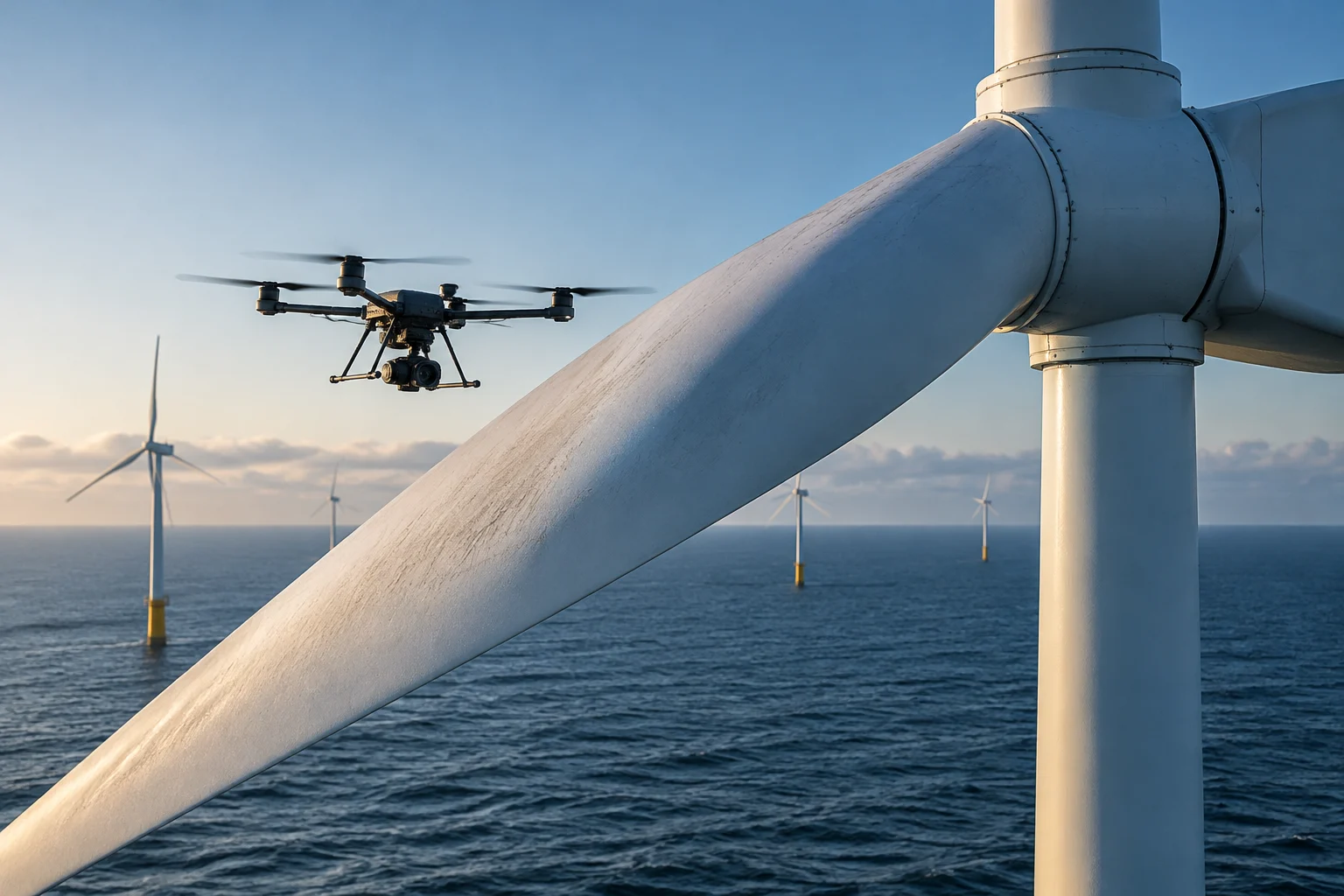
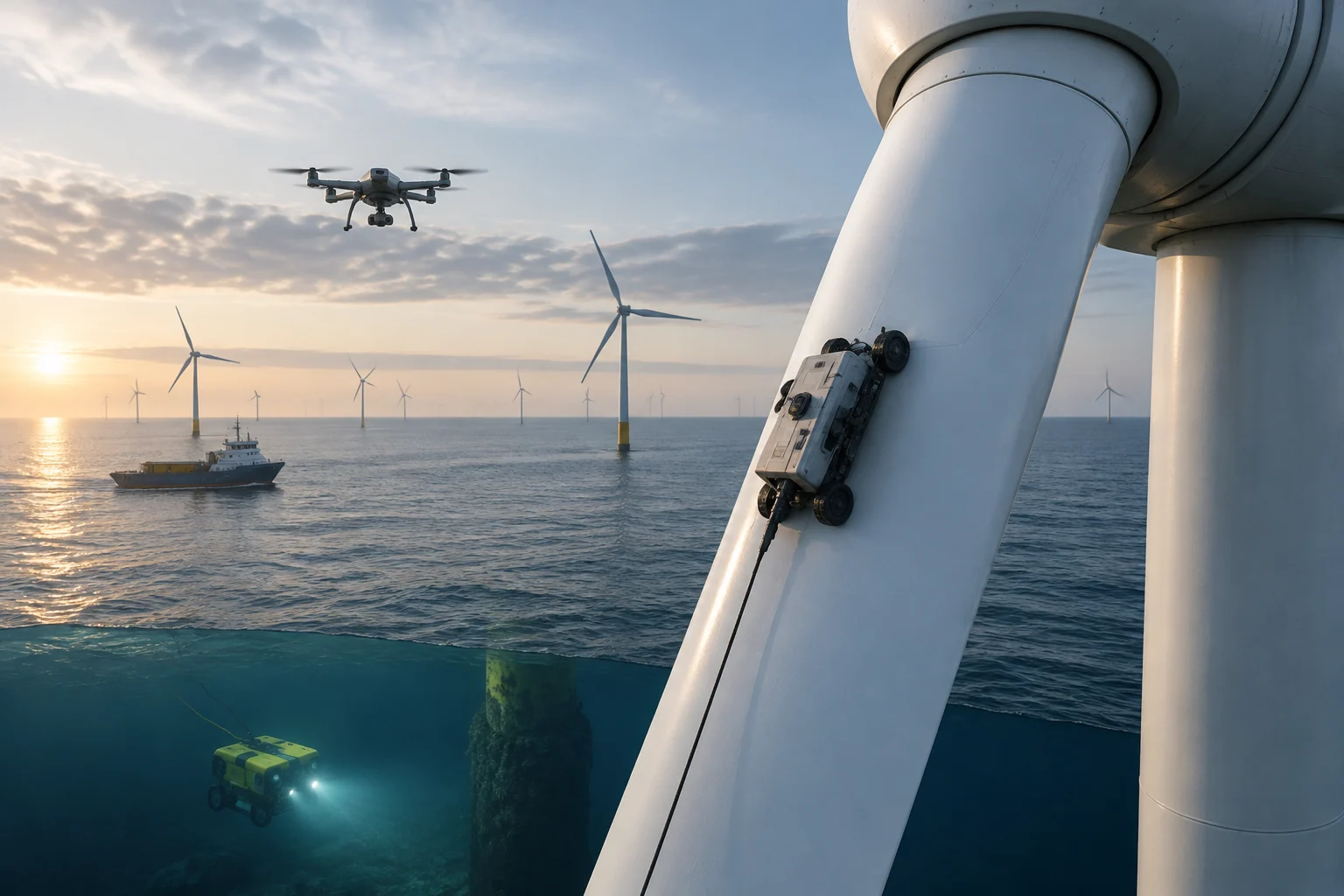
Robotics for wind farms includes equipment with different roles: aerial drones to examine blades and structures, climbing platforms that move across surfaces, and underwater vehicles that inspect foundations. Each system covers a different area, and its usefulness depends on the defect being sought, access and operating conditions.
On blades, a camera can locate visible damage from a safe distance; detecting internal defects requires nondestructive testing. ARROW, developed with support from the U.S. Department of Energy, used phased-array ultrasound to inspect inside blades and detect subsurface damage during validation. This is not equivalent to a visual drone inspection: the depth and types of defects each method can detect differ.
Some systems are designed to position sensors without requiring a person to traverse the turbine. The European DASHWIN project integrated a climbing platform with an optical technique called shearography to examine installed blades, with remote control from the ground. Its report records laboratory testing and a field test on a Vestas V47 turbine in Greece; that documents an integrated demonstration, not routine use at commercial wind farms.
Offshore inspections can include a turbine’s submerged base and the blades above the water. The ATLANTIS project tested a combination of aerial drones and underwater vehicles equipped with imaging, sonar and infrared sensors. The idea is to combine equipment with different vantage points; it does not mean one robot can inspect an entire installation or replace every specialist inspection.
From testing to routine maintenance
A technical test answers a limited question: whether equipment can move, collect data or identify a defect under certain conditions. A pilot adds operation at a real site and can reveal challenges involving access, weather, communications and coordination. Neither stage alone demonstrates sustained use or net savings for a wind farm.
The U.S. Department of Energy’s account of ARROW’s validation showed that the robot could inspect through a blade’s thickness and detect internal damage. The same announcement described working with potential partners as the next step toward more routine field use. The distinction matters: demonstrated capability is not the same as a service contract, a deployed fleet or a procedure incorporated into regular maintenance.
DASHWIN’s test provides another example of a verifiable scope: system integration, remote control, data acquisition and processing, and a field test. The project developed a climbing platform and a shearography system to inspect installed blades, and conducted laboratory and field testing. Evidence that a system works and evidence that it saves money are separate questions.
To assess an implementation, an operator should specify which task is automated and how often, which method it replaces or complements, what decisions staff make from the data, and which inspections remain necessary. This distinguishes an occasional tool from a capability built into the maintenance plan, without mistaking technical novelty for a proven economic improvement.
What to compare with a conventional inspection
The comparison should use an equivalent unit of work: for example, a blade inspection with a defined detection objective on turbines with comparable characteristics and weather conditions. Measuring only a drone’s flight time or a climbing robot’s travel time leaves out preparation, permits, equipment transport, data analysis and any follow-up by specialists. Mission time is not the total inspection cost.
For an offshore installation, record vessel and crew hours, the time from departure to return, usable weather windows, and occasions when a visit is canceled or cannot be completed. The ATLANTIS project reported that its robotic technologies could increase by around 35% the time maintenance vessels can work at wind farms. This is a project-attributed estimate concerning vessel operating time, not a universal measurement of energy or cost savings.
Inspection quality should be compared against independent references: confirmed defects found, false positives, areas left uncovered, useful resolution and repeatability between inspections. Timing matters too. Finding a hidden defect before it becomes visible could allow a repair to be planned, but the benefit depends on a reliable signal, an appropriate intervention and whether the defect would otherwise have caused a failure.
A practical comparison sheet should record at least the following:
- Scope: component and surface inspected, share covered, and defects the method can detect.
- Operations: hours for preparation, inspection, transport, analysis and human confirmation.
- Interruptions: turbine downtime and reasons for waiting or repeating work.
- Quality: confirmed detections, false alarms and defects missed.
- Resources: vessel, vehicle, staff, batteries, consumables and data processing.
How to calculate an energy and operational balance
To claim energy savings, compare the energy consumed by the entire process, not just the robot’s motors. The balance should include battery charging, the vehicle or vessel transporting the equipment, energy for stations and sensors, communications, and the processing needed to turn measurements into a maintenance decision. The result depends on the system being replaced: a drone that avoids a vessel trip may have a different effect from one that adds an inspection to an already scheduled visit.
One useful way to normalize the result is to express energy consumed per valid inspection or per unit of confirmed coverage. If the automated method detects fewer defects, requires more repeat inspections or leaves areas unchecked, comparing only kilowatt-hours per mission can reward an incomplete inspection. The denominator should therefore represent useful, verifiable work, such as an accepted inspection covering the planned area.
The effect on generation requires a separate calculation. Fewer inspection hours do not automatically mean more electricity: the turbine may not have been shut down, or the inspection may take place during a window that does not limit production. Estimating additional energy attributable to robotics would require documenting failures avoided or interventions brought forward, the duration of the outages that would otherwise have occurred, and expected production during those hours. Machine availability and energy generated are related, but not interchangeable, metrics.
A robust evaluation can compare periods or groups of similar turbines, adjusting for relevant differences such as age, design, accessibility, weather severity, defect history and maintenance method. It should report sample size and variability as well as the average. If the only evidence comes from a short test, the result describes that test; it cannot simply be projected to an entire wind farm over several years.
Limits differ on land and offshore
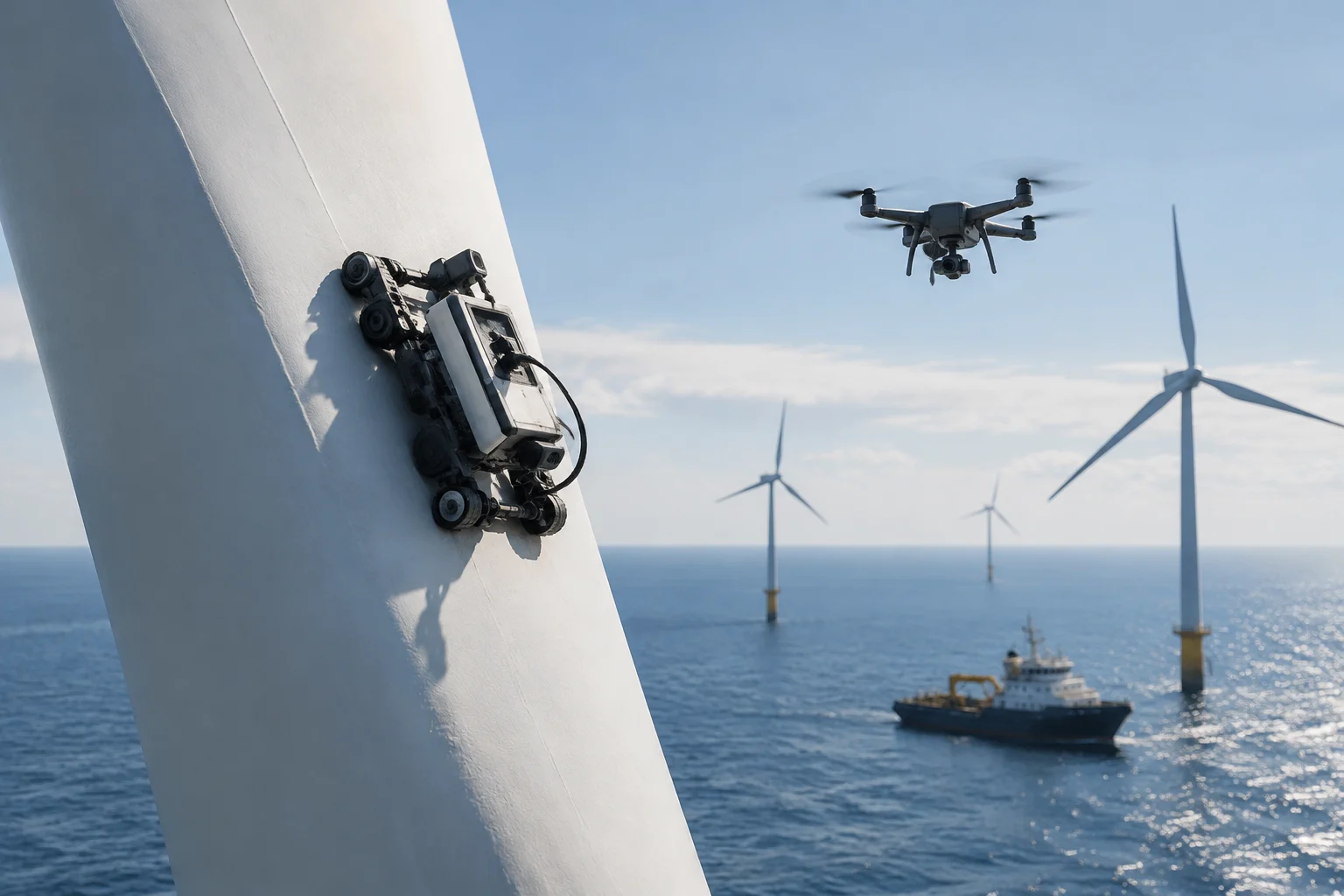
On land, inspection projects can combine climbing platforms with optical techniques to examine installed blades. DASHWIN integrated a robotic platform that deploys shearography without contacting the blade and can be operated remotely from the ground. Each inspection technique has a specific scope.
Offshore, ATLANTIS tested a combination of aerial drones and underwater vehicles equipped with imaging, sonar and infrared sensors to inspect different parts of wind installations. The project reported that its robotic technologies could increase by around 35% the time maintenance vessels can work at wind farms. That estimate concerns vessel operating time, not a universal measure of energy or cost savings.
DASHWIN developed a remote system to control the platform, acquire and transfer data, process images, and interpret and store results. The system combines data capture and processing; the project conducted laboratory tests and a field test on a Vestas V47 turbine in Greece.
The projects described combine robotic equipment with remotely operated inspection and control systems. DASHWIN, for example, developed a climbing platform that deploys shearography without contacting the blade and can be controlled from the ground. The demonstration took place on a specific turbine, in a field test in Greece.
What can be concluded about savings
There are documented examples of robots inspecting blades and projects combining aerial and underwater platforms at wind installations. ARROW demonstrated the ability to detect subsurface damage using ultrasound; DASHWIN integrated a climbing platform with shearography and completed a field test; ATLANTIS tested vehicles and drones to inspect different parts of an offshore wind farm. These are development and demonstration results with defined scopes.
Those cases support exploring automation where access is difficult, inspection puts workers at risk, or early detection could change maintenance. They do not, by themselves, prove that all wind farms will save energy, that inspections will be cheaper in every context, or that annual generation will increase. The roughly 35% figure associated with ATLANTIS concerns potential vessel working time, while ARROW’s result concerns inspection capability; neither directly measures additional net electricity.
To decide whether to adopt a system, an operator can require a task-by-task comparison covering inspection coverage and detection quality, total duration, travel avoided, downtime, energy used by equipment and logistics, and the cost of reviewing data. Those results should then be weighed against the cost of failures or inspections the method actually prevents. Savings are established by measuring the entire process, not simply by showing that a robot can complete a mission.
The practical question, then, is not whether robots can inspect turbines—there is evidence that some can perform specific tasks—but where they replace or improve an existing procedure and what measured results follow. An evaluation that distinguishes demonstration, pilot and sustained operation can assess the potential without turning technical capability into a promise of electricity generated.