The Energy Challenge of Modern Electronics
The information, communication, and technology sector accounts for between 5% and 9% of global electricity consumption, according to an estimate cited by the U.S. National Science Foundation. Reducing the energy required by components can help contain the impact of an expanding digital infrastructure, although a chip's efficiency does not solely determine the total consumption of that infrastructure.
In this context, memories and materials different from those usually used in semiconductors are being explored. The Japanese company Semiconductor Energy Laboratory (SEL) works on oxide semiconductor technologies and presents next-generation memory as a possible way to reduce energy use. The World Intellectual Property Organization (WIPO) described this work in an article published on June 19, 2022, based on interviews and company information.
The practical question is not just whether a material has promising properties, but whether those properties translate into lower consumption of the complete device. To answer this, comparable measurements are needed: same operations, operating conditions, and, where applicable, equivalent capacity. The promise of efficiency does not replace experimental comparison.
What is the CAAC Structure and Why It Matters
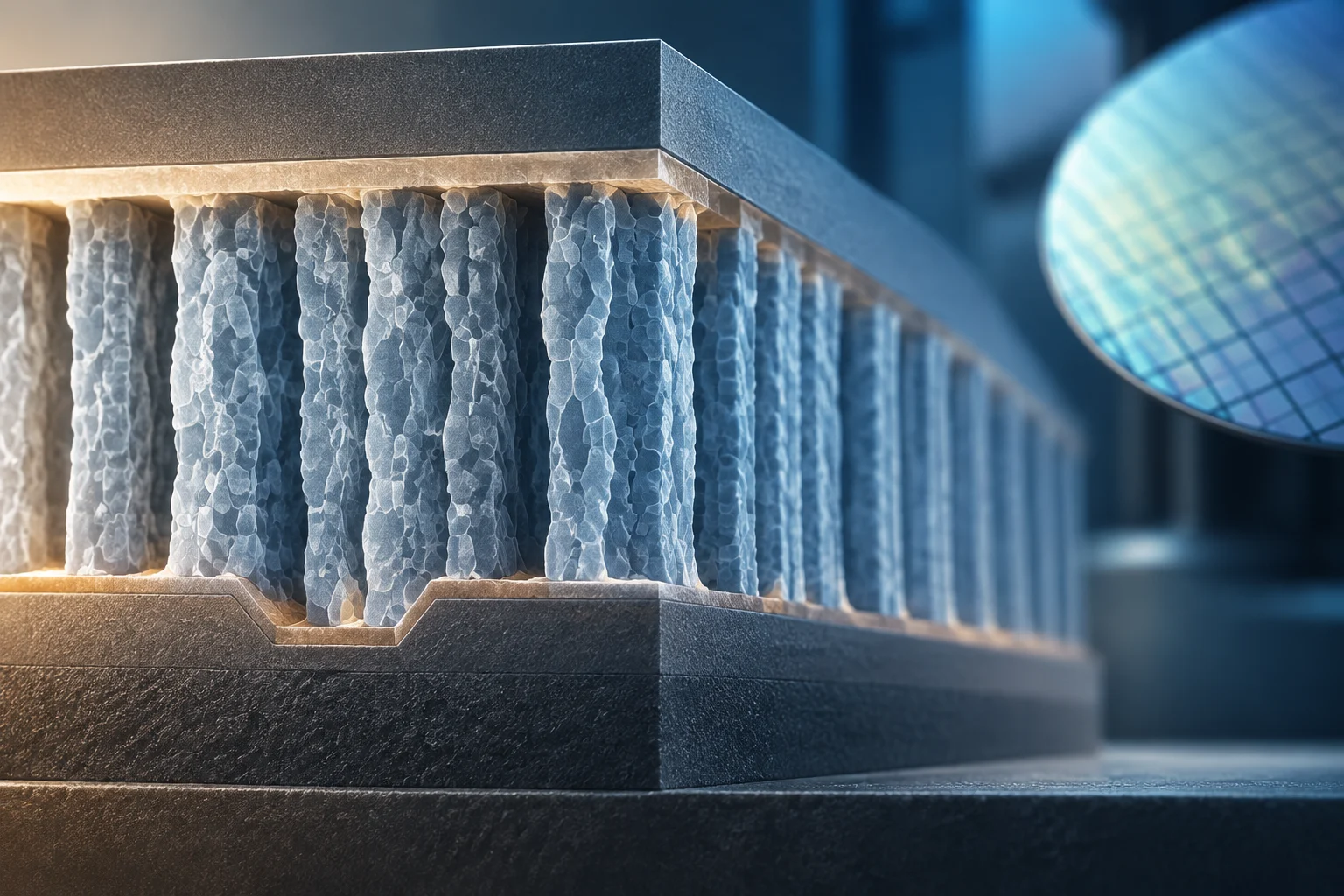
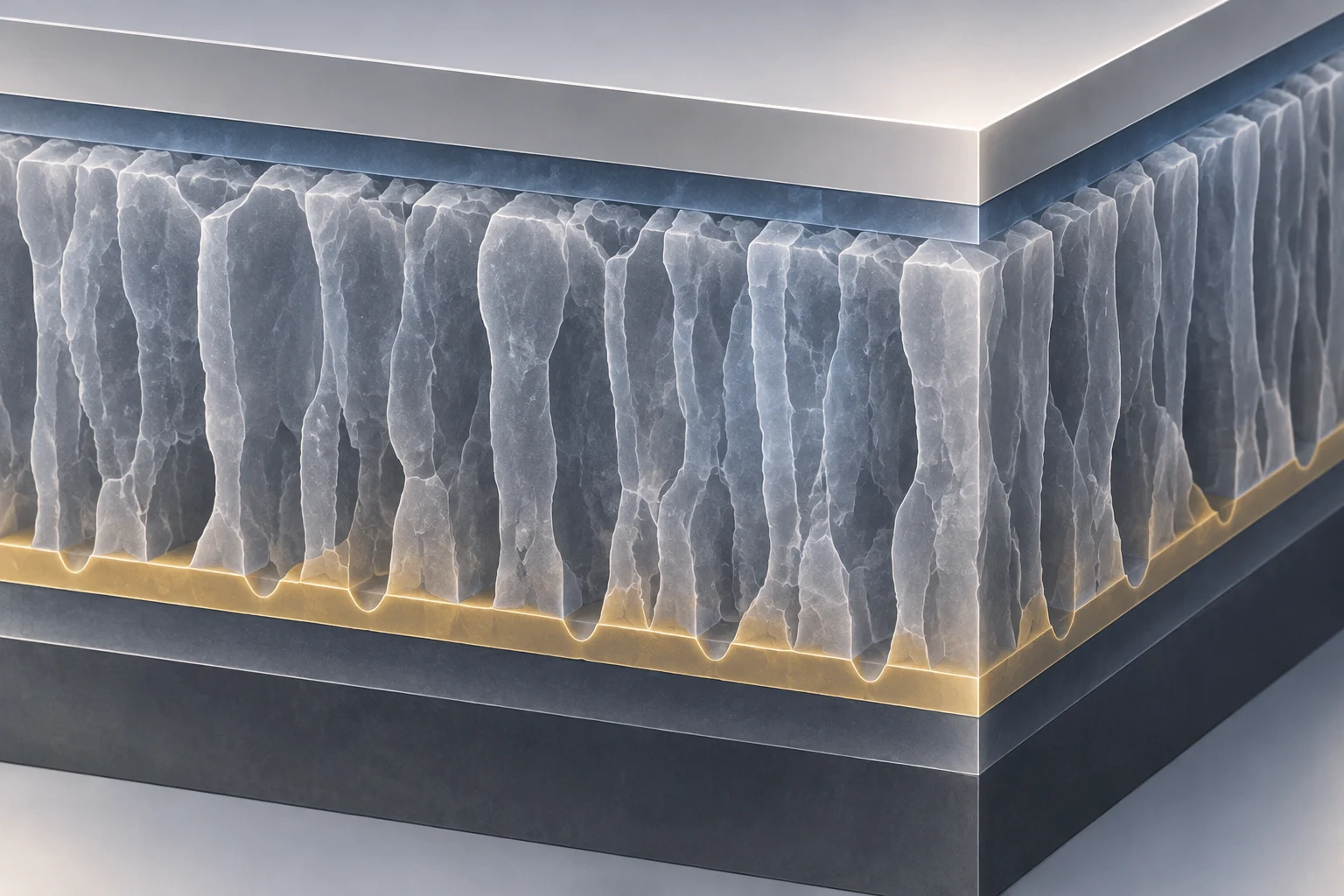
CAAC stands for Columnar Amorphous Oxide. The term refers to a semiconductor oxide structure with a columnar organization, distinct from the long-range periodicity of a conventional crystal. This architecture is investigated for its potential electrical and fabrication properties; the name alone does not identify a commercial memory or prove an energy improvement.
The internal organization of a material can influence charge transport and component characteristics. However, one must separate the properties of a material from those of the device that incorporates it: final consumption also depends on design, operations performed, and how information is moved. A favorable physical characteristic does not automatically equal measured savings in an operational memory.
Oxides and amorphous materials appear in research lines with different objectives. For example, a study published in Nature Communications analyzed a hafnium-based amorphous oxide for energy storage in capacitors and reported an energy density of approximately 155 J/cm³, with an efficiency of 87%. These results describe a dielectric material for capacitive storage; they are not a measurement of CAAC memory consumption nor a direct validation of that technology.
Therefore, it is important not to group results on "amorphous oxides" as if they were interchangeable. The hafnium study provides context on materials, but it does not credit SEL's CAAC chips with achieving a specific saving. To support that conclusion, CAAC device data and a comparison with reference memories under equivalent conditions would be needed.
What the WIPO Source Allows Us to Affirm
The 2022 WIPO article presents SEL's activity and collects statements from its founder, Shunpei Yamazaki, about the company's direction, environmental goals, and the role of intellectual property. It is useful as context on how SEL describes its work, but its format is an interview, not a technical report of energy tests.
The source does not present a quantitative comparison of CAAC memory consumption versus DRAM, NAND, or another standard technology. It does not include measurements per read or write operation, consumption per stored bit, or independent test results that allow calculating a saving. Consequently, the article does not allow establishing how much a CAAC memory would consume compared to a specific alternative.
The date also matters: the piece was published in June 2022. It should not be presented as a recent announcement or as evidence of subsequent commercialization. In the available material, there are no independent comparative results that turn the general promise of consumption reduction into a quantified conclusion about CAAC products.
The prudent reading is that WIPO documents an innovation line and company statements, not that it certifies its performance. The absence of figures does not prove the technology does not work; it limits what can be sustained regarding its energy efficiency.
What the Literature Teaches About Memory Consumption
An experimental analysis of real HBM2 DRAM chips examined how consumption changes according to operations and data patterns. The work's abstract reports that reads consumed more current than other operations and that toggling all internal bus signals during a burst produced a power consumption 29.4% higher than keeping them constant. The access pattern can change the measurement even when evaluating the same class of memory.
This result is not a proof about CAAC: it studies HBM2. Its utility here is methodological. It shows why a comparison between technologies must control which operations are performed and how data is transferred; otherwise, usage differences can be confused with differences attributable to the material or chip design.
Research on leakage power in CMOS circuits also offers context: a 2013 technical article describes the increase in leaks as manufacturing processes move to finer nodes, associating it with factors such as transistor density and component dimensions. This is a general explanation of a design challenge, not a measurement of leakage power in a CAAC device.
Together, these works help define what would need to be measured, but they do not fill the evidence gap on CAAC. To demonstrate an energy advantage, specific device results would need to be published, test conditions specified, and a comparison made with an appropriate conventional memory. Evidence on other technologies cannot be directly attributed to CAAC.
Implications for AI Infrastructure
In AI systems, part of the consumption may be associated with data movement between memory and processor, in addition to the energy used in calculations. The U.S. National Science Foundation described research on integrating compute and memory in the same chip as a possible way to reduce energy associated with transfers. This approach is distinct from proving that a memory material, by itself, consumes less.
The difference matters for choosing a solution: bringing processing closer to data seeks to reduce transfers; a memory with lower consumption during operation would address another part of the problem. They are related strategies, but not equivalent. An architecture can combine several improvements, although the final benefit depends on the complete design and must be measured in the system where it is used.
The National Science Foundation article was published on February 15, 2023, and describes research efforts on ferroelectric materials and the integration of memory and compute. It does not prove that CAAC is used in that architecture or that there is an integration of CAAC with processing within the memory. Linking both lines as if they were a single product or development would exceed the available evidence.
For infrastructure managers, the practical consequence is clear: it is not advisable to estimate energy or emission savings based on a promise about the material. The decision requires figures from the complete system, including operations, capacity, performance, and load conditions. Without those figures, CAAC should be treated as a technological proposal whose energy advantage is not yet publicly quantified in the reviewed sources.
Conclusion: Technological Promise and Available Evidence
The information consulted supports that there is interest in oxide materials and alternatives to improve electronics efficiency. It also offers examples of how material structure and access patterns can matter in different devices. But the available sources do not contain an independent consumption comparison between a CAAC memory and a conventional memory.
Therefore, it is not possible to confirm with this data how much CAAC would save, nor to affirm that commercial chips based on that structure already reduce consumption at an industrial scale. The WIPO piece is from 2022 and describes the company and its work; studies on HBM2, CMOS leaks, and hafnium oxides refer to other devices or materials and do not constitute a validation of CAAC.
To evaluate a future efficiency claim, it is advisable to look for at least: consumption per read and write operation; idle consumption; comparable capacity and performance; temperature and load conditions; and reproducible or independently reviewed results. If it is a data center application, measuring the behavior of the complete system and not just a material property is also important.
The adjusted conclusion is limited but useful: CAAC is a research line linked to next-generation memories, while its specific energy advantage remains undemonstrated by the available sources. Until adequate comparisons are available, professionals and buyers should not turn the general promise into a saving figure or an expectation of emission reduction.