
What It Means to Protect Personal Data
Data protection is a framework of principles, obligations, and rights that governs the handling of personal information. It is not merely about preventing database theft; it also concerns what data are collected, for what purpose they are used, how long they are kept, and who can access them. In the European Union, the GDPR places the protection of individuals in relation to the processing of their data within fundamental rights.
The term processing has a broad meaning: it includes operations on personal data, not just storing them on a server. To understand a digital service, one should follow the entire journey of information, from the moment a person provides or the system generates it until it is deleted or no longer used. This avoids reducing the issue to a consent box or an isolated security function.
In Spain, Organic Law 3/2018 complements the European framework and also addresses guarantees for digital rights. The law does not make all data uses illegal nor prohibit organizations from processing them; it sets rules so that each processing is subject to conditions and safeguards. Protecting data does not mean not processing them, but doing so within a framework that recognizes people's rights.
What Information Is Involved
A personal data point is information related to an identified or identifiable natural person. Names and email addresses are easy examples, but the assessment does not depend solely on a name appearing on a screen: it also counts if the information can reasonably be linked to someone. Thus, data that seem innocuous alone may acquire another meaning when combined or related to an account.
The context of use matters. An identifier assigned to a device, for instance, can allow distinguishing activity associated with a person even if the record does not show their name. The definition must be understood considering available information and the possibility of identifying someone, not as a closed list of personal fields. Classifying a case concretely requires examining its circumstances, not just the technical name of the data.
There are categories of data for which the GDPR foresees specific conditions, such as certain sensitive data. But not all seemingly private information automatically falls into a special category, nor is removing names enough to ensure that a set can no longer be linked to people. Pseudonymizing does not necessarily equal anonymizing: if it is possible to re‑associate the data with a person using additional information, there may still be an identification risk.
The Processing Cycle, From Start to Finish
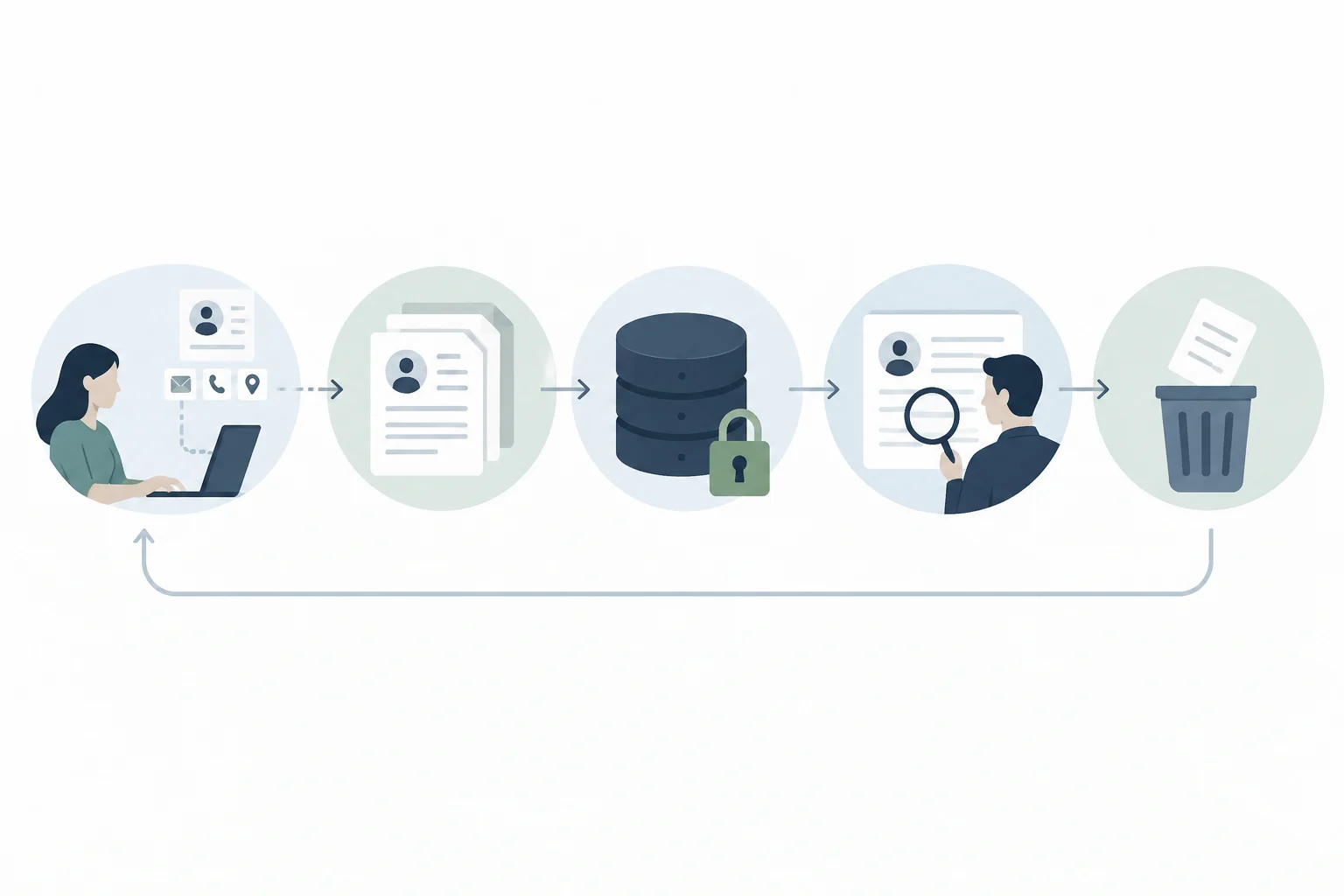
A practical way to analyze a service is to walk through the processing stages: collection, use, retention, access, and deletion. Each stage has different questions. In collection: Is this field necessary? In use: Is it used for an explained purpose? In retention: Is it still needed? In access: Who needs to see it? And at the end: Is it deleted when appropriate or retained in copies and linked systems?
Minimization helps turn those questions into design decisions. The AEPD explains that default data protection seeks to limit the amount of data processed, the extent of processing, the retention period, and accessibility, based on defined purposes. The obligation is not reduced to changing a software option: it also affects process design and how information access is organized.
What to Look For in a Form or Application
A form that requests data to create an account can be evaluated by distinguishing fields necessary for that function from those collected for other uses. If additional information is requested, the useful question is not only whether the form is secure but also what it will be used for and whether the user can understand it. Default protection focuses on ensuring the initial configuration already limits processing, without requiring each person to find and activate all restrictive options.
In an application, the same questions apply to permissions, activity logs, and preferences. One cannot claim without reviewing the case that any permission is unnecessary or that there is a single mandatory setting; it depends on purpose and specific processing. What is useful for the user is checking what function activates a permission, whether they can disable it, and what consequences the provider describes.
Principles, Rights, and Responsibilities
The GDPR organizes processing through principles such as lawfulness, purpose limitation, minimization, accuracy, and storage limitation. Together, they guide different decisions: having a valid basis for processing does not alone resolve whether too much is collected, reused for another purpose, or stored longer than needed. Compliance is not a single checkbox, but an assessment of the treatment in its context.
Individuals have rights related to their data, including access, rectification, and deletion, and exercising other rights when conditions are met. Not all operate identically, nor does deletion mean any data must disappear immediately upon any request: the response depends on circumstances and applicable rules. The so‑called right to be forgotten usually refers to specific scenarios related to deletion or dissemination of information, not a universal erasure of any content online.
Responsibilities fall on those who determine or execute processing, according to their functions and duties. In practice, an organization must be able to explain what data it uses, for what purpose, and what measures it adopts; moreover, security must match the risk. For a user, a reasonable decision is to consult the privacy notice and use the indicated channels to exercise rights, keeping necessary information to identify the account or request. This is not legal advice for a particular case.
Data Protection vs IT Security: Relationship and Difference
Information security seeks to preserve properties such as confidentiality, integrity, and availability. In personal data, this translates, for example, into limiting access, preventing unauthorized changes, and ensuring systems are available when needed. The European Data Protection Board explains that technical and organizational measures must be adequate to the risk and adapted to the processing context.
Data protection has a broader scope. A service might protect its systems well against intrusions yet still process excessive information or use it for an inappropriate purpose. Conversely, a carefully designed process may not be protected against a breach if it lacks adequate security controls. Security and data protection overlap but are not synonymous: the former helps protect information; the latter also regulates what, why, and under what conditions it is processed.
The distinction serves to read product and service promises more accurately. If a company advertises encryption or enhanced authentication, that describes a security measure, but does not by itself demonstrate minimal data collection, clear purposes, or adequate retention periods. To assess the whole, one must look at both technical safeguards and processing practices.
Everyday Examples to Apply the Concept
In a form, start by separating what is essential to complete the operation from information requested for other purposes. Read the explanation about data use and check who requests it. If a box covers multiple purposes or the explanation is unclear, consider asking for clarification before assuming that submitting the form meets all expectations.
In an app, review permissions when they appear and consider whether they seem related to the function you want to use. Also look at available settings and information about account retention or deletion. These steps help understand processing but do not prove compliance: evaluating circumstances and real service operation is required for that.
On an online account, an access request can help know what information the provider keeps, while a rectification or deletion request should be directed through the channels they enable. The scope of the response depends on the exercised right and context; therefore do not promise automatic results nor confuse closing an account with confirming every related copy or record has been removed.
Limits and Where to Find Reliable Information
Data protection does not guarantee that incidents never occur, that all information can be anonymized without risk, or that any individual request must be granted as asked. It offers a framework of principles and rights, along with duties for those who process data; it does not eliminate all risks nor replace case‑by‑case analysis. Security may reduce certain risks, but no general formulation guarantees a service is infallible.
In Spain, the text of Organic Law 3/2018 is available in the BOE, and the AEPD offers practical explanations on default data protection. For the European framework, the GDPR text allows consulting applicable principles, rights, and obligations. It is useful to distinguish official law from an explanatory guide: the latter helps understand and apply the framework but does not replace legal text or specific situation assessment.
As an initial check, a person can identify which entity processes their data, what purpose it declares, what information it requests, and what channel it offers for inquiries or rights. An organization, in turn, can walk through the entire process, review whether each data point and access is necessary, and adapt security measures to risk. The most useful criterion is to look at the whole treatment, not just the privacy notice, accept button, or a technical promise.