Two Generations and Two Ecosystems
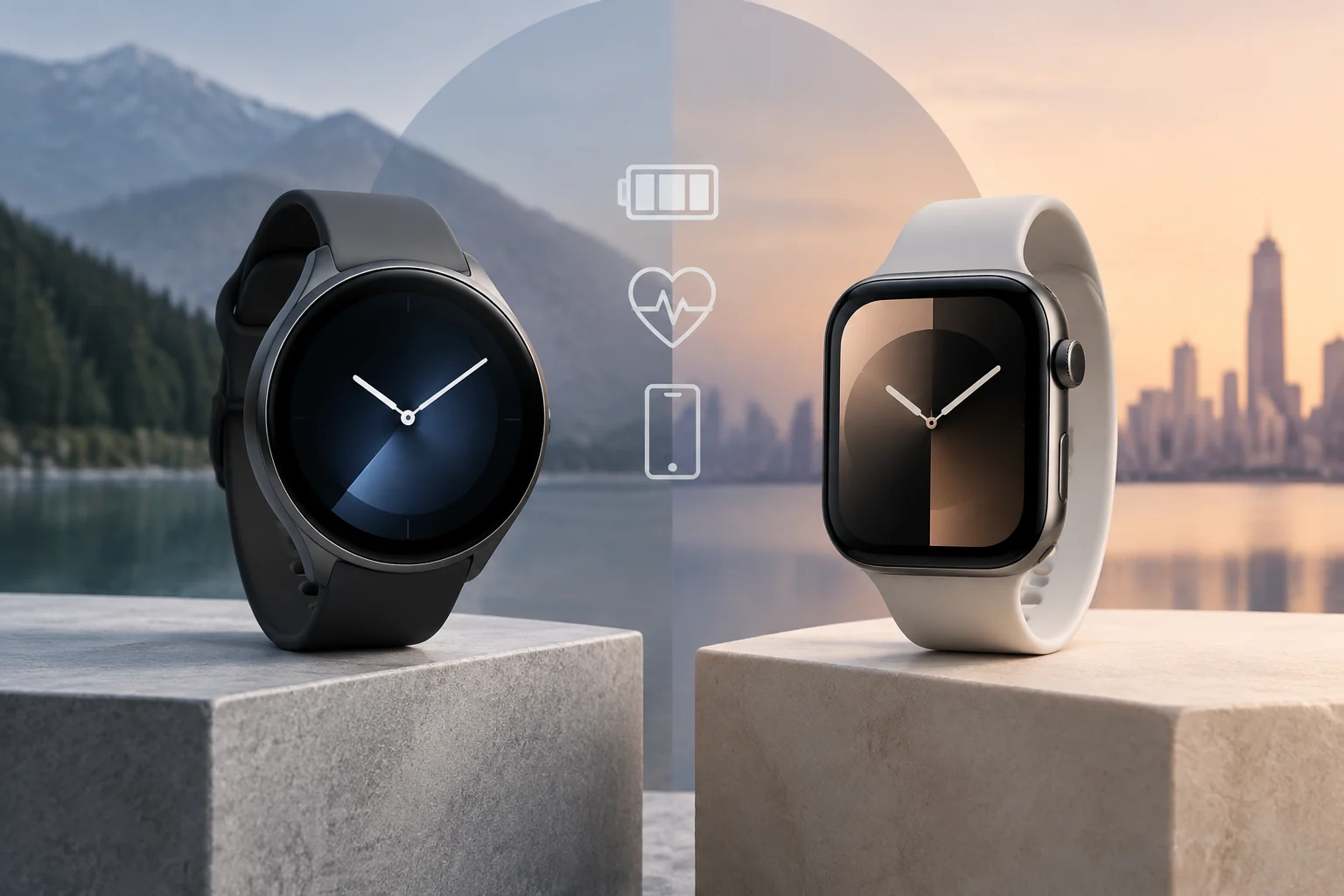
Comparing the Samsung Galaxy Watch 8 with the Apple Watch Series 10 remains useful for guiding a purchase, but it is not a comparison between two watches released in the same season. Apple announced the Series 10 on September 9, 2024, and set its availability for September 20 of that year; the Galaxy Watch 8 arrived later, in 2025. The generational difference matters because features and platforms evolve on different calendars.
The initial practical filter is the phone you already use. Apple specifies that the Series 10 requires an iPhone XS or later with iOS 18 or later. For the Galaxy Watch 8, an independent comparison published by Hipertextual indicates Android 12 or later and more than 1.5 GB of RAM; as this is a secondary source, it is advisable to confirm the specific configuration requirement before buying. Compatibility conditions the choice from the start: it is not enough for a watch to seem better on paper if it does not work with your mobile phone.
Nor do all figures respond to the same class of evidence. Apple describes the conditions of its battery test, while the Galaxy Watch 8 battery life is presented as an estimate in independent coverage. This difference does not invalidate the comparison, but it does limit what can be concluded: the announced hours orient towards specific scenarios and do not equate to a common test with both watches, the same phone, and the same settings.
Display, Size, and Durability in Daily Use
The Apple Watch Series 10 is available in 42 and 46 mm cases. Its always-on LTPO OLED display reaches, according to Apple, up to 2,000 nits; the surface area is 989 mm² in the 42 mm version and 1,220 mm² in the 46 mm version. Hipertextual's comparative coverage describes the Galaxy Watch 8 in 40 and 44 mm sizes, with a Super AMOLED display and a maximum of 3,000 nits. Samsung's brightness figure comes from independent coverage, not from an official spec sheet included in this comparison.
Shapes also propose different ways to check information: Apple uses a rectangular case and Samsung a round dial. The Series 10 is 9.7 mm thick in both sizes. Hipertextual attributes 8.6 mm to both versions of the Watch 8. These dimensions help get an idea of the volume, but they do not determine comfort on their own: fit, strap, wrist size, and personal preferences also count. If comfort is a priority, trying the specific size offers more information than comparing only the case diameter.
In terms of durability, Apple specifies IP6X dust protection and 50-meter water resistance according to ISO 22810:2010 for the Series 10. The company indicates that it can be used in shallow water activities, such as swimming, but not for diving or deep immersion; furthermore, it warns that water resistance can decrease over time. Hipertextual's coverage attributes 5 ATM and IP68 ratings and MIL-STD-810H tests to the Galaxy Watch 8. To decide on a specific activity, follow the manufacturer's warnings applicable to the model and use: a rating does not automatically turn a watch into diving equipment.
Battery Life: Hours Need Context
Apple announces up to 18 hours of normal use and up to 36 hours in low power mode for the Series 10. Its normal use test lasts 18 hours and includes checking the time, notifications, app usage, and a 60-minute workout with Bluetooth music playback. In the cellular variant, the scenario contemplates four hours of LTE and the rest of the period connected to the iPhone via Bluetooth. It is a figure tied to a defined protocol, not a guarantee that any user will get exactly that duration.
For the Galaxy Watch 8, Hipertextual estimates between 30 and 40 hours and publishes battery capacities of 325 mAh for the 40 mm model and 435 mAh for the 44 mm model. These figures are attributed to independent coverage and not to a shared test with Apple. The capacity in mAh, by itself, does not allow calculating how long a watch will last: the display, GPS, connections, notifications, sensors, and power-saving features also influence it. The estimate should not be read as an equivalent measurement to the detailed test by Apple.
The useful decision is to ask what the watch must cover between charges: a day with GPS training, sleep tracking, or an outing where you will not carry a charger. Apple explains that its results may vary depending on use, configuration, mobile network, and signal strength. For the Watch 8, the published estimate does not establish a comparable test with Apple's. There is no universal real battery life: if the battery weighs heavily in your decision, compare tests that indicate size, phone, connectivity, and enabled features, and do not extrapolate data from a different size or generation.
Battery figures and their basis
Apple's figures come with a defined usage protocol; the Galaxy Watch 8 duration is an estimate reported in independent coverage, not a directly comparable test.
| Apple Watch Series 10 · normal use | Up to 18 h · defined test scenario |
|---|---|
| Apple Watch Series 10 · Low Power Mode | Up to 36 h · defined test scenario |
| Galaxy Watch 8 · independent estimate | 30–40 h · not a shared test |
The devices were not tested under a shared protocol; actual battery life varies with use and configuration.
Health Sensors: Features and Limits
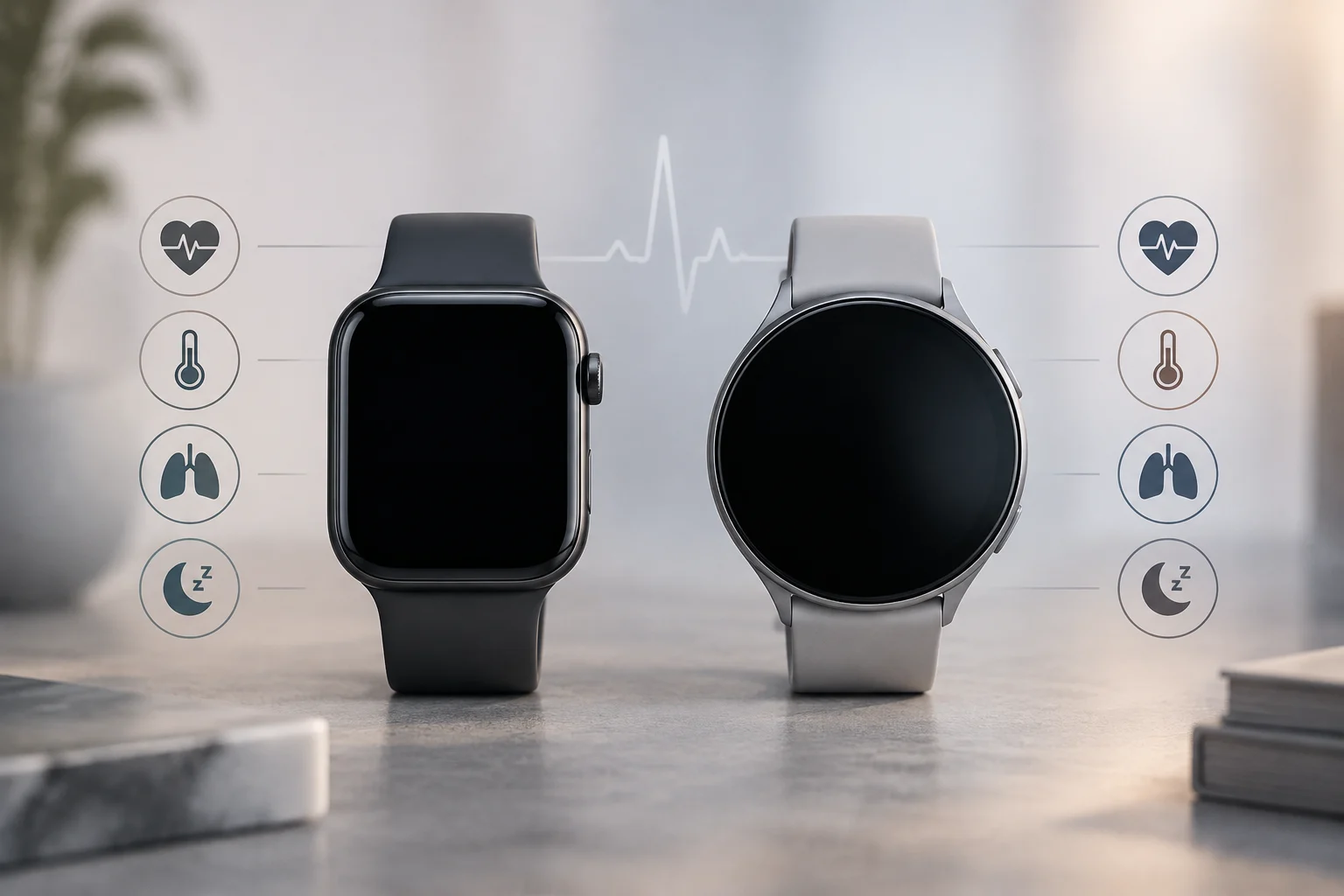
Apple lists heart rate and temperature sensors, an ECG app, and sleep tracking features for the Series 10, in addition to sleep apnea notifications subject to conditions. The company explains that the ECG can produce a record similar to a lead I and points out that the temperature sensor is not intended for medical use. A sensor does not equate to a diagnosis: the watch offers measurements and alerts delimited by the manufacturer, not a substitute for clinical evaluation.
Hipertextual attributes the BioActive 3.0 sensor and features such as ECG and body composition analysis to the Galaxy Watch 8. The presence of a feature in a description does not guarantee that it is enabled for each user: country, compatible phone, and the app used may influence it. For health features subject to authorization or regional availability, check the local conditions of the specific model before basing a purchase on them.
The features of both watches cover different metrics, such as heart rate, temperature, sleep, and body composition, and are not directly interchangeable. If a result worries you, do not use it as the sole basis for a medical decision: consult the manufacturer's instructions and a healthcare professional.
Software and Long-Term Support
Apple specifies that the Series 10 runs on watchOS and requires an iPhone XS or later with iOS 18 or later. Hipertextual identifies Wear OS 6 and One UI Watch 8 for the Galaxy Watch 8. They are different platforms, with their own apps and relationship with the phone; the described software version does not by itself indicate how long each model will continue to receive updates.
It is advisable to distinguish between a major system update, a security patch, and the incorporation of new features. A watch running a specific version does not constitute a promise of future support. Before buying, check the current update conditions for the specific model and the market where it is sold.
To keep a watch for several years, in addition to the software calendar, it matters that it remains compatible with the phone you plan to use. Before buying, review the manufacturer's current policy and separate present compatibility from guaranteed support.
Which Model Fits Your Phone and Routine
If you have a compatible iPhone, the Apple Watch Series 10 is the option in this comparison designed for that environment. It offers 42 and 46 mm sizes, an always-on display, health features, and the announced battery life of up to 18 hours in normal use or 36 hours in low power mode. The practical point is the charging routine: Apple documents a specific test, but the result will depend on each person's use, configuration, and connectivity.
If you use Android, the Galaxy Watch 8 corresponds to the ecosystem of this comparison. Hipertextual reports 40 and 44 mm sizes and estimates a battery life of 30 to 40 hours, but that duration is a coverage estimate, not a test comparable to Apple's. Confirm the phone requirements and regional availability of the features you are interested in; do not assume that all features will be active in any combination of phone and country.
A reasonable decision can follow this order: first, rule out the model that is not compatible with your phone; then, choose the size and shape that suit you; finally, evaluate the charging and health features you will actually use. If you need nighttime tracking, consider how charging fits into your routine. If you are interested in health measurements, review their conditions and limits. Compatibility is the first filter; battery life and specific features determine the personal fit.