The Thermal Challenge of AI Data Centers
The increase in computing capacity in data centers forces an evaluation of how heat is extracted from accelerators. However, it is not enough for a technology to cool a chip better: to certify its real adoption, one must differentiate a laboratory test, a deployed system, and an offer available to customers. This distinction matters to those planning expansions, as each level implies different needs for compatibility, operation, and evidence.
In 2025, AWS stated that it had deployed liquid cooling at scale with its Blackwell GB200 NVL72 platform. Microsoft, in contrast, described microfluidics that had been tested to extract heat from channels in the silicon. These are relevant advances, but not equivalent: the former is evidence of use at scale on a specific platform; the latter, evidence of testing, not confirmation of general deployment in data centers.
It is also advisable not to present market estimates as measurements of installations. Mordor Intelligence reports project growth for the GPU liquid cooling segment, but a commercial forecast does not demonstrate how many data centers use it or how much each operator saves. For a technical decision, the useful sequence is to identify the system, its availability status, and the documented performance conditions.
What Distinguishes Microfluidics from Cold Plates
Microfluidics: Channels in the Silicon
The microfluidics described by Microsoft carries the cooling liquid to channels etched directly into the back of the silicon. In an explanation published by Microsoft in September 2025, the company indicated that its system had been tested and could extract heat up to three times better than the cold plates used as a comparison. The same publication attributes a 65% reduction in the maximum silicon temperature rise to GPU tests. These figures describe thermal cooling results, not a demonstrated reduction in the total electrical consumption of the data center or its PUE.
The design seeks to direct coolant to zones with higher thermal load, rather than relying solely on a plate situated over the chip. Microsoft also explained that the team used AI to analyze thermal patterns and guide the channel design. The source, however, does not provide a complete datasheet of flow rate, pressure, pump consumption, test duration, or commercial operation performance in the available material. Therefore, the figures alone are not sufficient to calculate energy savings or total cost of ownership.
Direct Liquid Cooling: Cooling Components Without Internal Channels
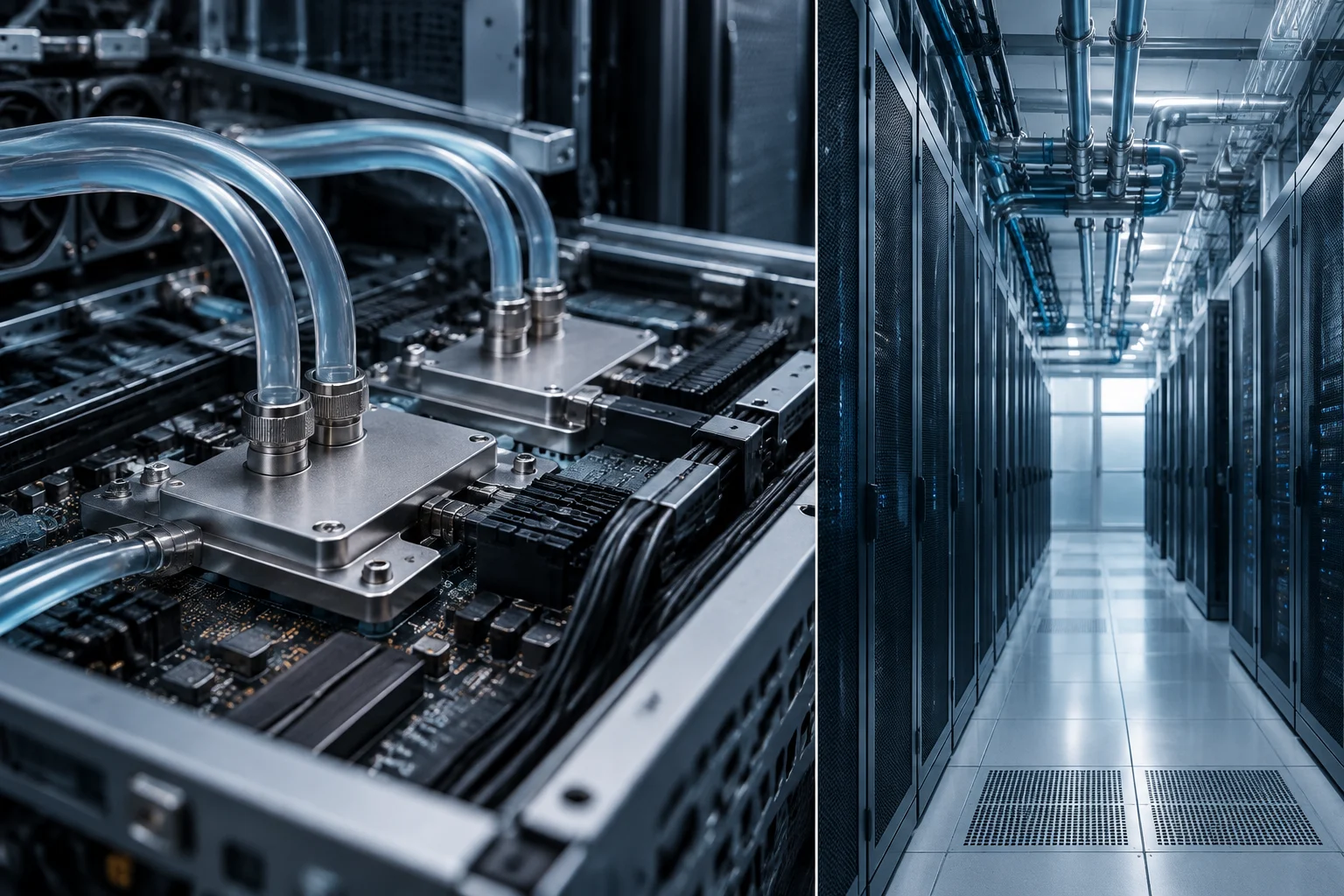
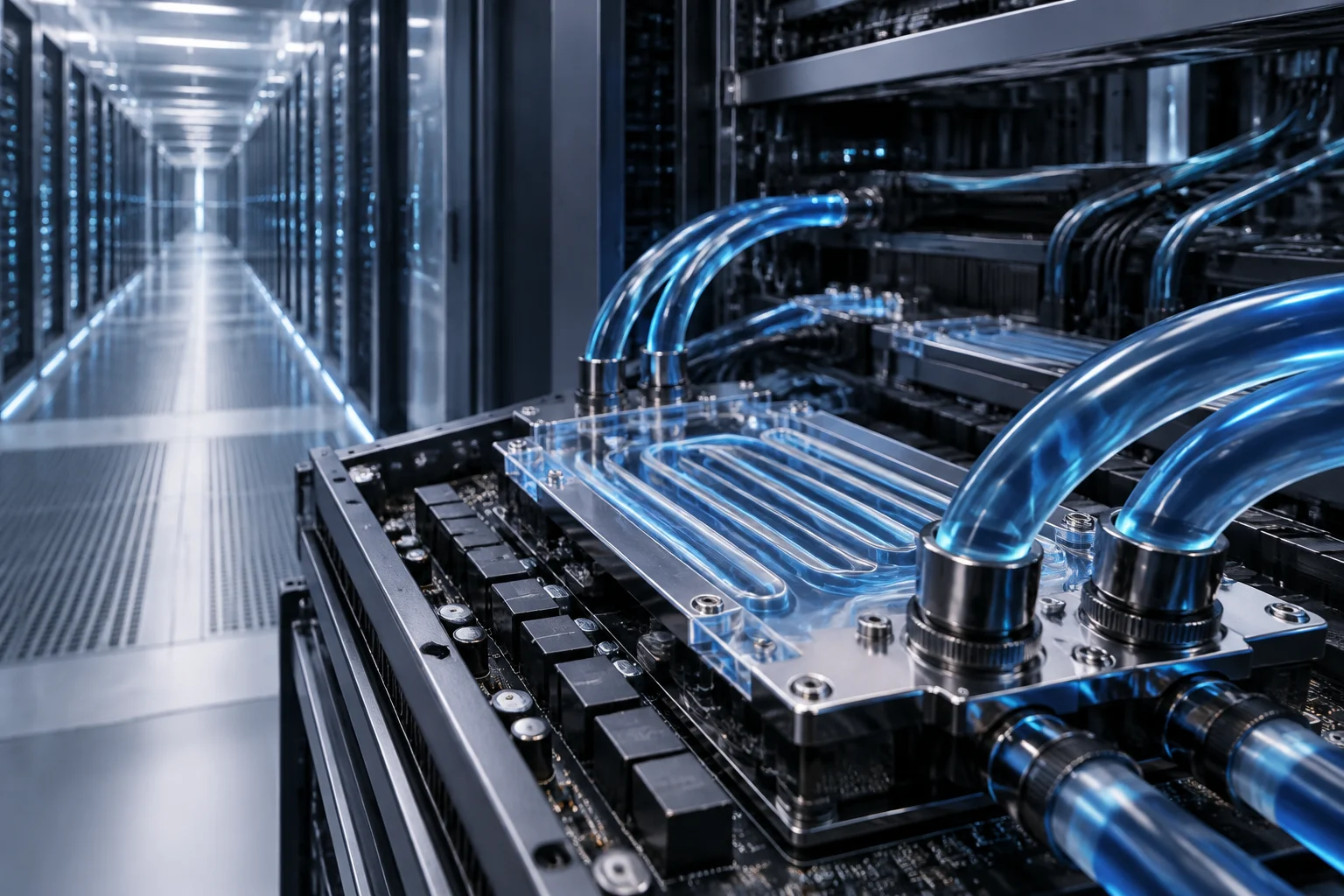
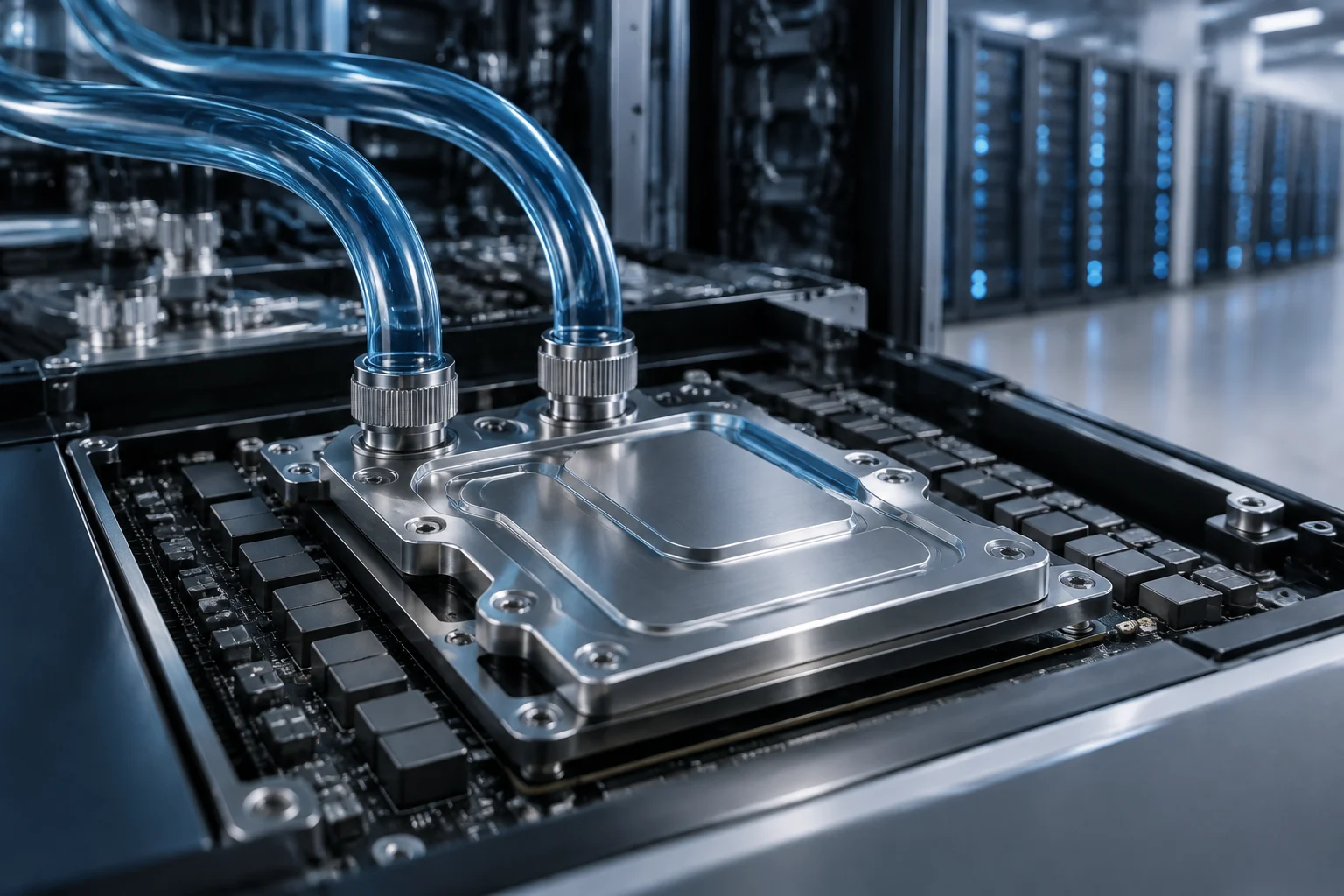
In cold plate systems, the liquid circulates through a cooling component coupled to the chip; it does not pass through channels etched in the silicon. This approach prevents cooling from depending on modifying the chip itself and allows combining liquid heat extraction from GPU and CPU with air circulation for other components. Direct liquid cooling should not be confused with immersion: the sources in this package document cold plates and hybrid systems, but do not offer sufficient data to compare immersion deployments with these solutions.
To evaluate any of these architectures, an isolated specification—for example, the coolant temperature—does not allow concluding what the result will be in an installation. Operation also depends on the circuit design, distribution equipment, final heat rejection, and actual load. The available sources do not provide an independent and homogeneous comparison of microfluidics, cold plates, and immersion; therefore, they do not justify an efficiency ranking between them.
Adoption: The AWS Case and the State of Microfluidics
AWS: A Liquid Platform Deployed at Scale
In July 2025, Data Center Dynamics reported that AWS had deployed liquid cooling at scale with Nvidia GB200 NVL72 systems and cited the Vice President of Compute and Machine Learning at AWS. According to that coverage, AWS developed its own solution after considering that commercial alternatives did not fit its space, facility adaptation, and water consumption needs. This supports the claim of scale deployment on that platform, but does not prove by itself that all AWS data centers use liquid cooling or that the solution can be installed without changes in any existing room.
AWS's official publication on its P6e-GB200 UltraServers confirms the general availability of that offer and describes up to 72 NVIDIA Blackwell GPUs connected via NVLink, 360 petaflops of FP8 compute, and 13.4 TB of HBM3e memory. These specifications characterize the computing system. They are not, in themselves, cooling efficiency metrics: the publication does not quantify a reduction in PUE, cooling energy, or water consumption attributable to the IRHX. The existence of the server and the performance of its thermal circuit are distinct claims.
Microsoft: Test Result, Not Confirmed Commercial Deployment
Microsoft's information published on September 23, 2025, presents microfluidics as a tested system. It reports heat extraction up to three times higher than cold plates and a 65% reduction in the maximum silicon temperature rise in GPU tests. The available text does not confirm a commercial availability date, an implementation in production data centers, or a measured reduction in total consumption. The rigorous way to describe the status is technology tested by Microsoft, not technology already deployed at scale.
This difference helps to read announcements and technical sheets: a thermal test of a component can demonstrate viability, but it does not automatically resolve manufacturing, maintenance, reliability over long periods, or integration with infrastructure. To move from prototype to verifiable adoption, data from operating systems, comparable test conditions, and a clear statement of availability are needed. The available documentation does not allow concluding that Microsoft has already generally incorporated microfluidics into its data centers.
Market Projections: What They Say and What They Don't
Mordor Intelligence estimates that the global GPU liquid cooling market would go from $6.9 billion in 2025 to $8.35 billion in 2026, reaching $26.91 billion in 2031. The firm projects a compound annual growth rate of 26.37% between 2026 and 2031. These are market estimates published in a commercial report, not a census of installed servers or an audit of realized revenues. The magnitude should be read as a forecast of the segment defined by the provider, not as independent proof of adoption.
For Europe, Mordor Intelligence projects $1.17 billion in 2025, $1.4 billion in 2026, and $4.15 billion in 2031, with a compound annual rate of 24.37% for 2026-2031. As the source separates the regional market from the global one, these figures can be presented together as forecasts, but they should not be mixed with measurements of power per rack or building savings. A sales projection is not equivalent to an efficiency improvement nor does it allow inferring the total cost of ownership of a specific installation.
Forecasts are useful for understanding investment expectations and the likely direction of supply, provided they are attributed to their source and their time horizon is kept clear. They do not replace an engineering evaluation: the buyer needs quotes, infrastructure requirements, circuit specifications, and operation results of a comparable configuration. In the available sources, there is no solid basis to attribute universal energy, surface, or cost savings to liquid cooling.
Limits of Evidence and Criteria for Evaluating an Installation
The sources consulted do not sufficiently document several data points necessary to compare systems in production: pump and fan consumption, flow rate, pressure, inlet and outlet temperatures, circuit availability, behavior in case of failure, and required maintenance. They also do not offer an independent comparison that uses the same workload and environmental conditions for microfluidics and cold plates. The absence of these data limits economic conclusions, but does not invalidate the more bounded facts: AWS communicated a scale deployment for a platform and Microsoft communicated microfluidics trials.
Before approving a purchase or expansion, it is advisable to request specific documentation of the system and verify, at a minimum, these points:
- Scope of deployment: prototype, pilot, production installation, or available service; identify model, date, and location when published.
- Thermal conditions: dissipated power, supply and return temperatures, flow rate, and pressure in the tested configuration.
- Auxiliary consumption: energy of pumps, fans, and heat rejection equipment, in addition to accelerator consumption.
- Operation and compatibility: room requirements, connections, maintenance procedures, leak response, and failure mode.
- Comparable results: workload, measurement period, and method used to calculate energy, availability, and PUE.
For an economic comparison, the thermal indicator of a chip must be linked with the consumption of the entire installation and with adaptation and operation costs. The reduction in maximum silicon temperature rise communicated by Microsoft is not interchangeable with an equivalent drop in electrical consumption; nor do AWS's computing specifications measure the efficiency of its cooling. The practical decision is to demand metrics of the complete system, documented under conditions that resemble the expected load and environment.
Conclusion: Separating Deployment, Test, and Forecast
The available evidence allows drawing a useful boundary. AWS offers a reference of liquid cooling deployed at scale on the GB200 NVL72 platform, supported by specialized coverage and the official availability of P6e-GB200 UltraServers. Microsoft has published microfluidics test results, including thermal extraction values and maximum temperature variation, but the sources consulted do not confirm its general commercial deployment. Mordor Intelligence's projections point to an expanding market, although they do not certify the performance of each installation.
For infrastructure teams, the criterion should not be choosing the technology with the most striking figure, but checking what was measured, in which system, and with what limit. Thermal test, commercial adoption, and energy savings are different levels of evidence. Requesting complete specifications and measurements of the circuit and the data center allows comparing solutions without transferring laboratory results or market forecasts to a real installation.