Flexibility is not just changing parts
In a manufacturing line, flexibility means responding to relevant product or process variations without rebuilding the installation or relying on prolonged manual adjustments. The promise may include format changes, small batches, parts arriving in variable positions, or inspections adapted to different models. There is no single definition sufficient to certify it: one must specify which variation is admitted and what must continue working when it appears.
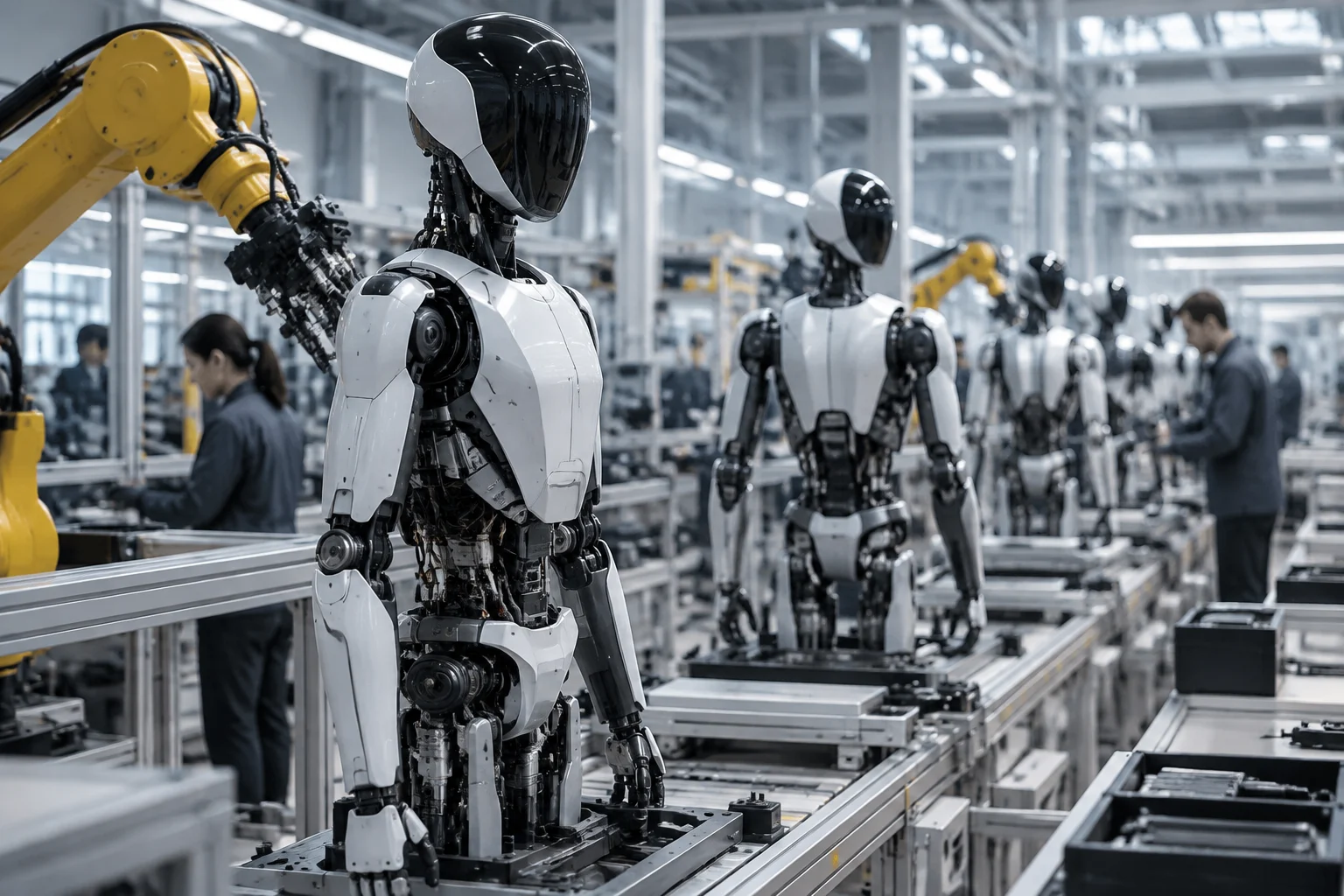
The combination of robotics and 3D vision addresses a specific task within this problem: identifying the position and geometry of a part and orienting the robot's action based on observations. This can be useful when a part does not always arrive in the same position. It does not automatically make the entire line flexible: feeding, tooling, safety, quality control, recipe changes, and connection to the production system also condition the result.
Therefore, a useful evaluation starts with the real process, not the technology label. One must clarify which references the line handles, what differences exist between them, how parts are presented, and how often the product changes. If the system only works with one part and a fixed layout, the test may demonstrate automation, but it provides little evidence of adaptation to variety.
What a 3D vision demonstration proves
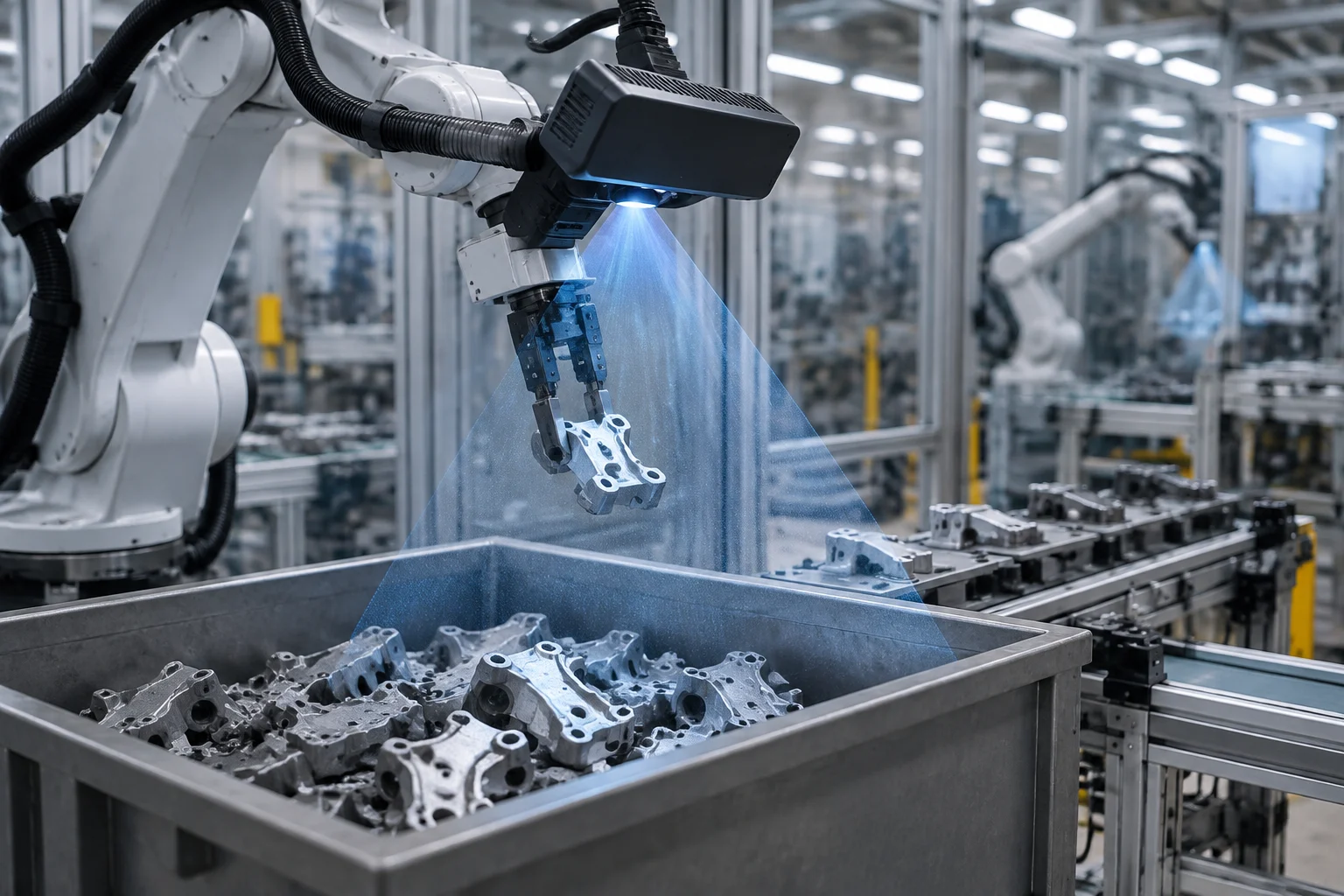
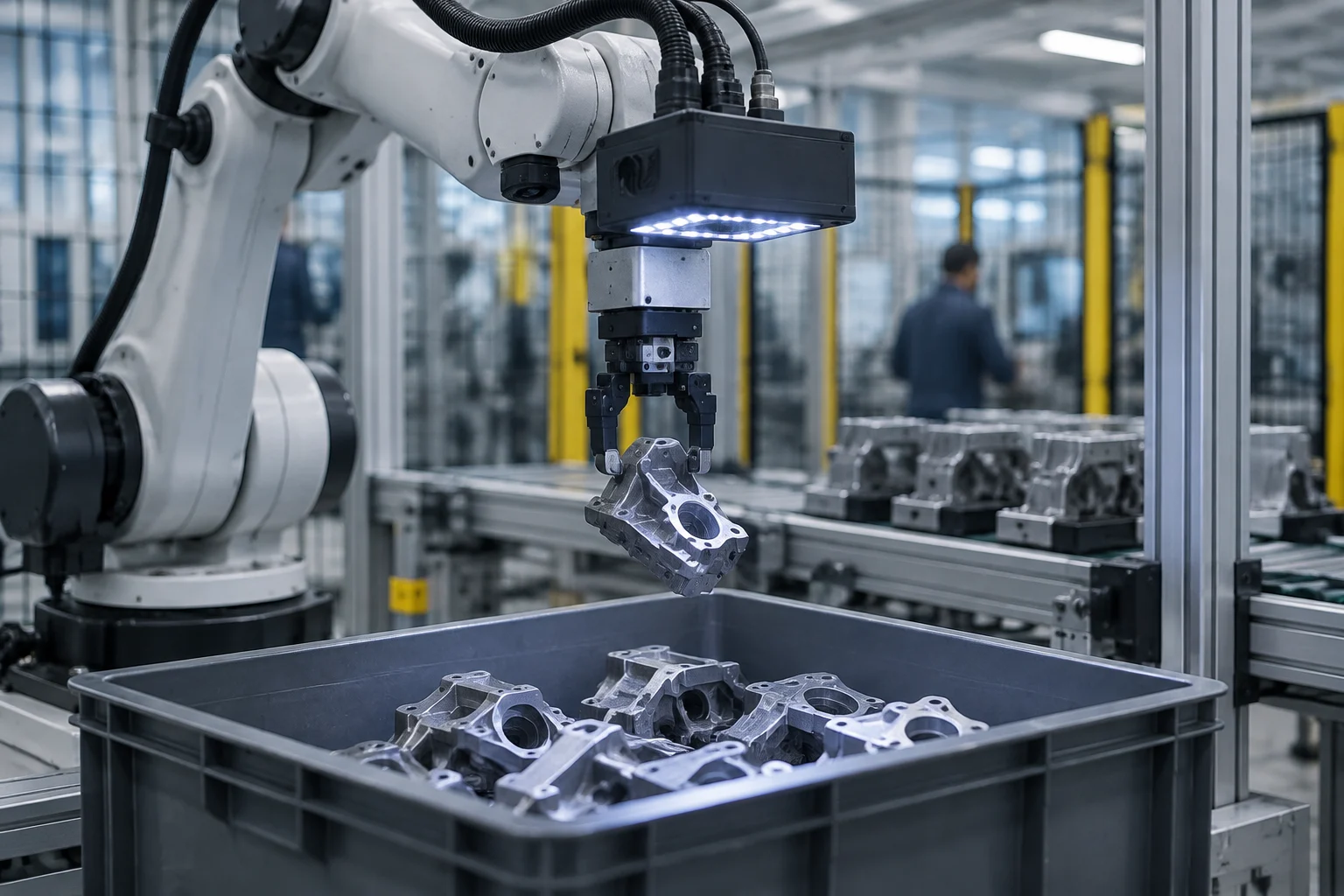
Omron's documentation on its FH-3D system describes a robotic guiding solution for picking parts, including bulk part identification via 3D measurement and recognition. It also proposes a compact assembly and the possibility of mounting the sensor on a robotic arm. This is useful information to understand the type of function offered, but it comes from the manufacturer and does not equate to an independent evaluation of results in a specific plant.
Functionally, a demonstration can show that the system obtains a 3D representation, locates a part within a scene, and delivers a position or orientation to the robot to execute the pick. To assess what this means in an application, one must know the complete sequence: capture, processing, part selection, trajectory calculation, gripping, transfer, and confirmation that the part was correctly placed. A video of a successful cycle does not reveal by itself how many attempts fail or what happens with partially occluded or overlapping parts.
Visual inspection constitutes another distinct function. It may use cameras, lighting, and image processing to classify or detect product features, but guiding a pick does not demonstrate defect detection. If a solution claims to combine manipulation and inspection, it is advisable to request separate evidence for each task, including acceptance criteria, samples used, and how doubtful results are handled.
Metrics that allow comparing capability
A technical test should first describe the set of parts and conditions it covers. Counting references is not enough: size, finish, material, orientation, dirt, reflections, and overlap variations matter, as does how they are presented. It must also be clarified whether parts were selected for the test or represent the usual production mix. Coverage must be delimited to avoid extrapolating a result from few parts to a complete family.
Then, performance must be measured with explicit denominators. For identification, for example, it is interesting to know how many opportunities were evaluated, how many were correctly located, and how many provided a valid position for the robot. For defect inspection, detected defects, missed defects, and rejected conforming parts must be separated. A "precision" figure without definition, class distribution, and capture conditions does not allow knowing what operational risk it implies.
Cycle time must also be measured from an agreed point to another, including capture, calculation, movement, gripping, and error recovery where appropriate. The number of cycles, variability, and pauses or restarts must be reported. The average alone can hide intermittent failures; percentiles, failed cycles, and recovery time help estimate if the operation fits the line's pace.
An evaluation sheet can request, at minimum:
- References and conditions covered, with variation examples and known limits.
- Detection or identification rate, failures, false rejections, and calculation method.
- Cycle time, time distribution, and frequency of human intervention.
- Test duration, number of cycles, product changes, and incident log.
- Lighting, cleaning, vibration conditions, and production data availability.
These indicators do not replace safety validation or process acceptance; they help specify what was tested and what remains pending.
Demonstration, pilot, and production are not the same
Evidence gains value when it allows distinguishing three levels. A functional demonstration teaches that a sequence can be executed under controlled conditions. A pilot adds a test in a representative environment, with parts, personnel, and restrictions similar to the intended operation. A production deployment additionally requires documenting continuous use, maintenance conditions, and response to failures. Each level supports different conclusions and they should not be presented as equivalent.
To check if a solution has left the laboratory, one must look for data identifying the test location and period, the process involved, the references covered, and the integration mode with existing equipment. It also matters to know who operated the test, who verified the results, and if there was a comparison with a baseline. A case described only as a "developed solution" or "automation project" does not by itself certify stable production operation.
Integration can be the difficult point even when perception and manipulation work in an isolated station. One must review how orders are exchanged with cell control, what happens when the robot does not find a part, how rejection is managed, and if the system keeps traceable records. Safe stop conditions and recovery after an incident must also be defined; these aspects are not deduced from the robot successfully picking parts in a demonstration.
What available evidence can and cannot say
The provided sources include commercial documentation of a 3D vision system, industrial outreach pages, and Tecnalia materials on automation and flexible factory. They serve to describe functions and objectives, but they do not offer a verifiable set of results from the same line with variety, failure, cycle, and duration metrics. They do not allow quantifying a productivity or quality improvement nor confirm that a specific capability is maintained under plant conditions.
An academic reference indexed in Dialnet summarizes a study on automated visual inspection and collects figures on defect reduction in industrial sectors. However, the abstract indicates that the analysis is descriptive-correlational and relies on secondary information; it does not present in the sheet a validation of a specific robot and 3D vision system. Therefore, those figures should not be transferred to the robotic guiding solution nor treated as a guarantee for a particular installation.
The most useful independent contrast would be an acceptance or evaluation report describing protocol, samples, error definition, baseline, and observed results under comparable conditions. If alternatives are compared, it is advisable to keep parts, lighting, pace, and quality criteria constant. When such material does not exist, the responsible conclusion is more limited: the technology has plausible applications and documented functions, but local performance remains to be demonstrated.
Practical questions before investing
For an operations or engineering team, the initial decision is not whether 3D vision is "flexible" in the abstract, but which variable task deserves automation and what is the current cost of solving it. A case with unpredictable orientations may justify a guiding test; another with stable presentation may be solved with a simpler mechanical fixation. The comparison must include format changes, maintenance, programming, integration, and downtime, in addition to equipment cost.
Before authorizing a pilot, it is advisable to agree in writing what result will be considered satisfactory: included references, minimum identification rate, rejection or failure limits, required cycle, and maximum recovery time. It must also be defined who collects records and how incidents are reviewed. A prior acceptance criterion avoids a visually convincing demonstration being evaluated with different rules after knowing the result.
The conclusion is practical: 3D vision and robotics can be components of a more adaptable line, but they do not by themselves prove that the factory changes product quickly, maintains quality, or increases production. To sustain these claims, representative tests, reproducible metrics, and integration evidence are needed. If they are missing, it is prudent to treat the capability as an engineering hypothesis deserving validation, not as a demonstrated benefit.