Distinct Architectures for Distinct Purposes
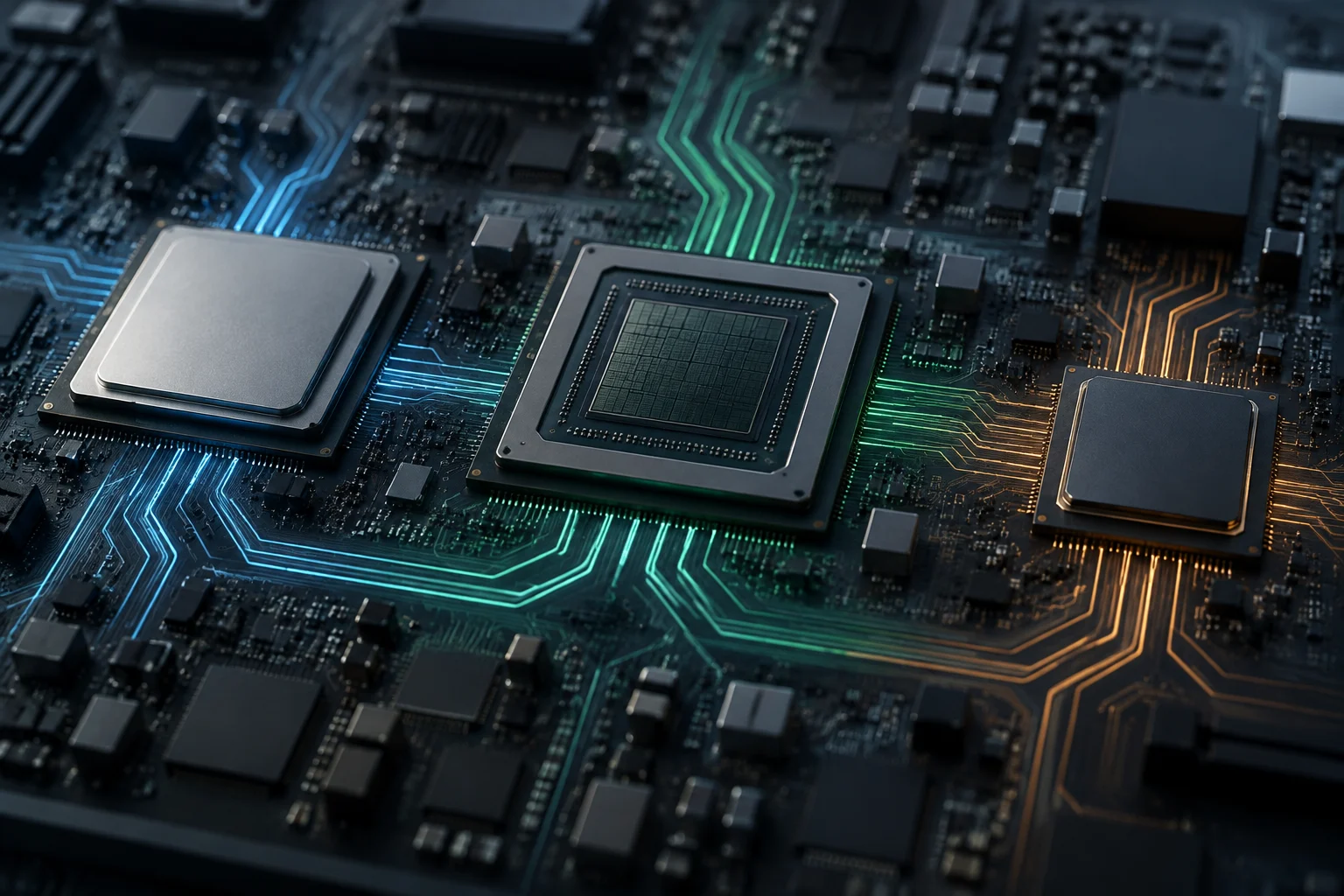
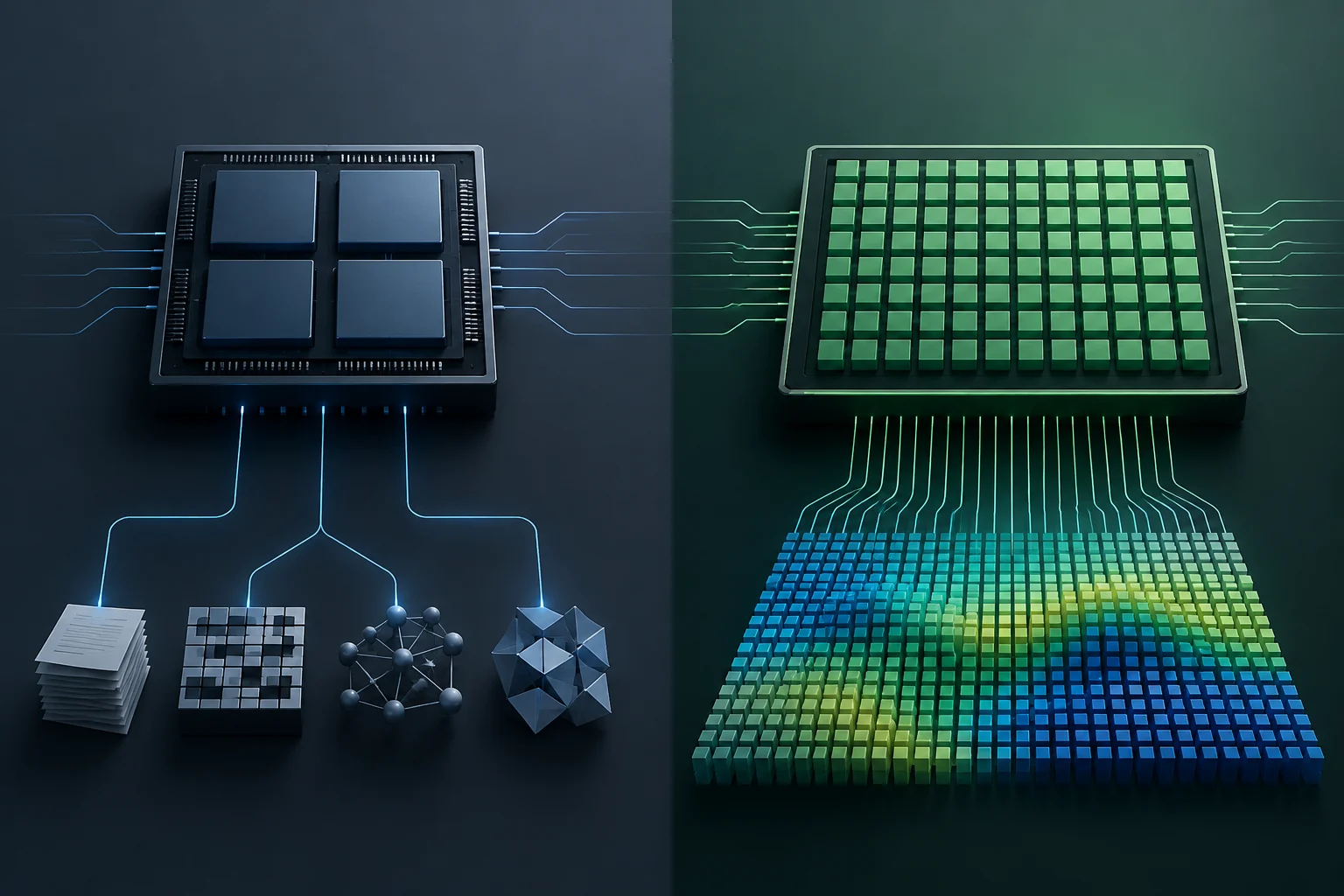
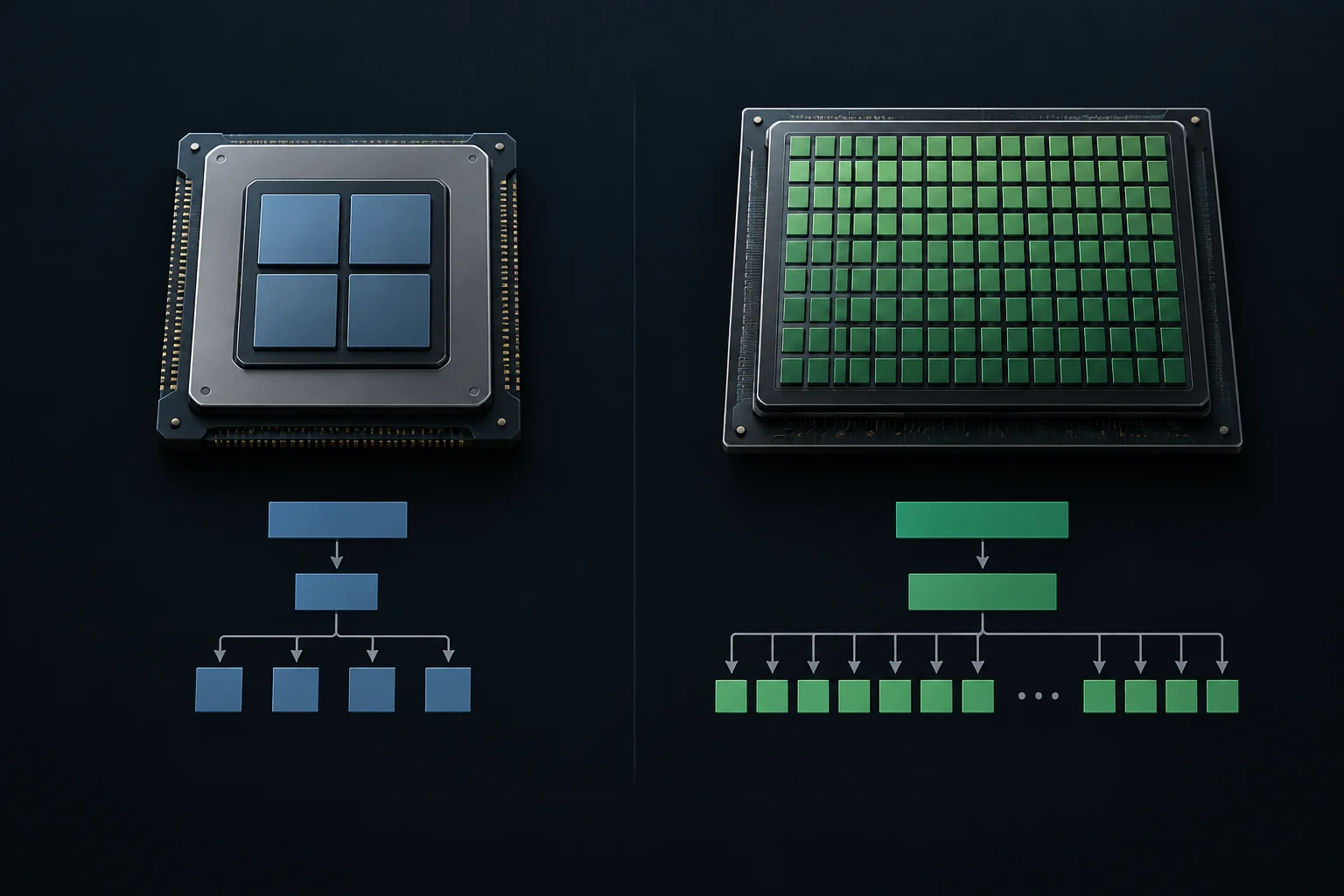
The fundamental difference between a CPU and a GPU lies in their design philosophy. While the CPU is optimized to execute complex sequential instructions with low latency, the GPU is built to perform a large number of simple operations simultaneously. This division of roles is the foundation of heterogeneous computing: each type of processor better serves a different class of work, and the system can combine them according to needs.
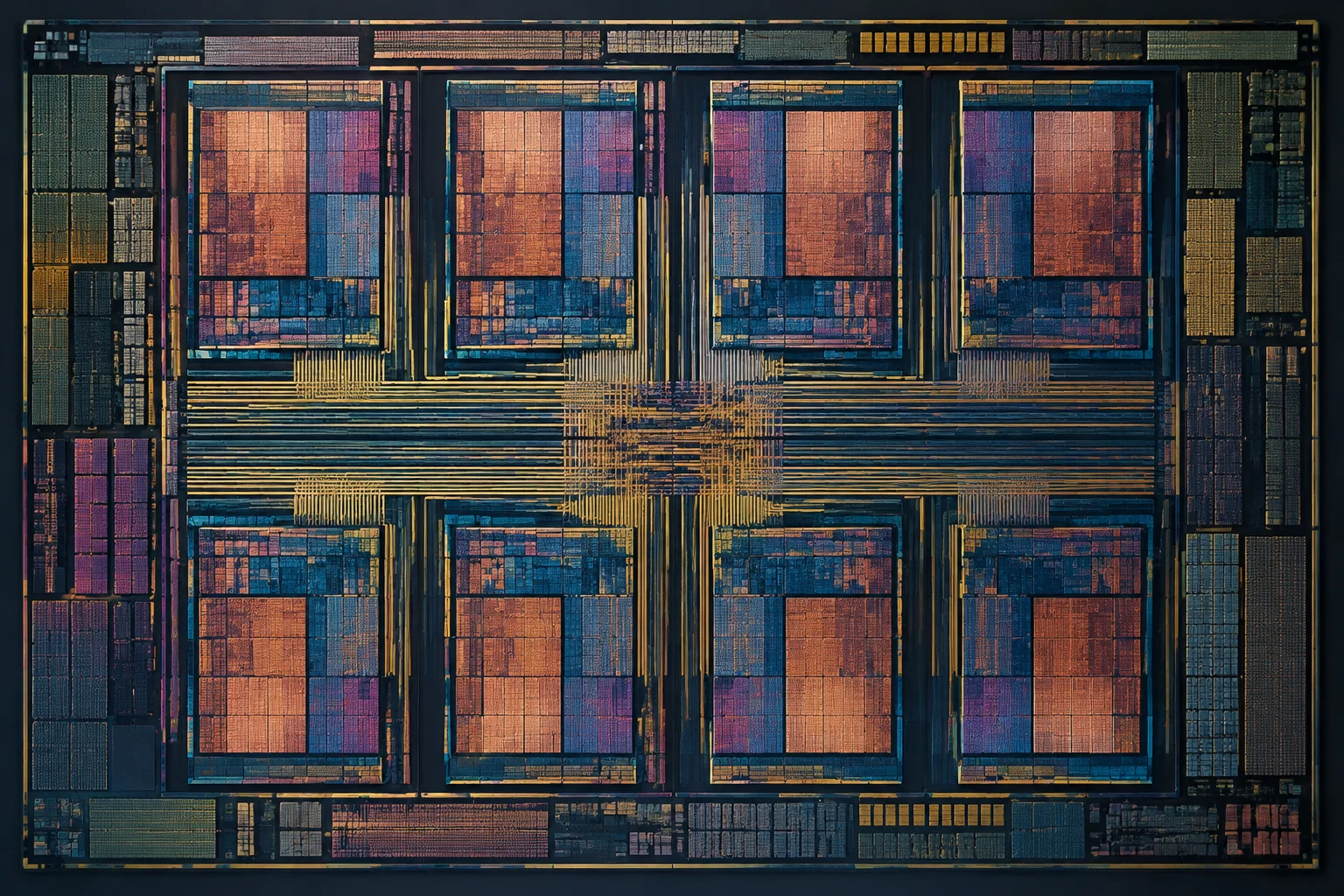
According to Intel documentation, CPUs are the 'brain' of the system, responsible for logic and control, while GPUs possess many small, specialized cores that divide tasks among themselves. This structure allows the GPU to handle thousands of execution threads at once, something a few-core powerful CPU cannot efficiently replicate. The distinction does not mean one unit is superior in all cases: it indicates they are optimized for different ways of processing instructions.
The Role of the NPU
In addition to the CPU and GPU, modern systems incorporate neural processing units (NPUs). These units are specifically designed to accelerate artificial intelligence workloads, complementing the GPU in machine learning model inference and training tasks. Their presence adds another specialized processing option, although the choice between units still depends on the specific task.
The Sine Qua Non Condition: Parallelism
For a GPU to accelerate a program, the workload must be intrinsically parallelizable. If a task requires each step to depend on the result of the previous one (data dependency), the GPU cannot execute it efficiently because its cores must wait for the sequence to resolve. In that case, having many cores does not eliminate the dependency that forces respecting the order of operations.
Ideal tasks for a GPU are those where the same operation can be applied to thousands of independent data elements, such as pixel processing in an image or matrix multiplication in deep learning. In these cases, the GPU can distribute work among many threads and leverage its memory bandwidth and computing capacity. The advantage appears when there is enough independent work to keep those units busy.
However, many real-world applications have a mix of sequential and parallel code. The sequential part must run on the CPU, limiting the total benefit of acceleration. This phenomenon is known as Amdahl's Law, which states that total improvement is limited by the fraction of time the program spends in the non-parallelizable part. Therefore, accelerating a section of the program does not imply the total time reduces by the same proportion: the rest of the work continues to impose a limit.
The Data Transfer Bottleneck
One of the biggest obstacles to GPU acceleration is data transfer between system memory (RAM) and GPU memory (VRAM). This communication happens over the PCIe bus, which has limited bandwidth compared to the GPU's internal memory. Thus, before leveraging parallel computation, it may be necessary to move data to the device and, afterward, return results to the system.
A University of Michigan study highlights that limited memory capacity and CPU-GPU communication over PCIe links are significant bottlenecks for large-scale data analytics workloads. If data transfer time exceeds computation time, the GPU waits, nullifying its speed advantage. In practice, the time of the complete process matters, not just how long the GPU takes to execute operations once it has the data.
Optimization Techniques
To mitigate this problem, developers use techniques like pinned memory, which allows faster transfers by avoiding the operating system's intermediate copy. Additionally, frameworks like CUDA and OpenCL offer optimized input/output primitives to minimize the impact of data transfer on overall performance. These tools help reduce the cost of moving information, but they do not make the limitations of the link between the CPU and GPU disappear.
The Software Ecosystem and APIs
The availability of a powerful GPU is useless if the software is not designed to leverage it. Programming APIs like NVIDIA's CUDA and Khronos Group's OpenCL provide the necessary tools to write code that runs on the GPU. The program must express work in a way compatible with the device and organize data and operations so that parallel execution is viable.
OpenCL 2.0, specified by Khronos, introduced significant improvements such as shared virtual memory, which allows host and device cores to share complex data structures directly. This eliminates costly data transfers and simplifies the programming of heterogeneous algorithms. By facilitating access to shared structures, this feature can reduce some of the complexity involved in coordinating CPU and GPU.
Software support is a critical factor. Not all applications have GPU-optimized versions. In many cases, the developer must manually port code to the GPU API, a process requiring deep knowledge of the hardware's architecture and limitations. Therefore, the presence of a GPU in the system does not guarantee that a specific application will use it or that adapted code will achieve an improvement.
Evidence and Performance Measurement
Claiming that a GPU accelerates a program without specific tests is a dangerous generalization. Performance depends on the specific workload, data size, GPU architecture, and code efficiency. It is also necessary to distinguish between the speed of an isolated operation and the time the complete program takes, because the latter includes tasks that may not run on the GPU.
A study published in Cluster Computing evaluated performance and energy consumption in hybrid CPU+GPU architectures, concluding that energy efficiency largely depends on the specific workload. What works well for one scientific application may not be optimal for another. Comparison must address both performance and consumption, as a faster solution is not necessarily the most energy-efficient.
How to Measure Correctly
To evaluate the benefit of a GPU, it is necessary to measure total execution time, including initialization, data transfer, and synchronization. Profiling tools like NVIDIA Nsight or the OpenCL Profiler allow identifying bottlenecks and optimizing code. Comprehensive measurement avoids attributing to the GPU an improvement that could be offset by time spent preparing or moving data.
It is crucial to compare performance under controlled conditions, using the same data and hardware configuration. Differences in the operating system, drivers, or API version can significantly influence results. Keeping these conditions constant allows better interpretation of measurements and evaluation of whether the observed difference is due to the implementation examined.
Practical Conclusions for the User
The decision to use a GPU to accelerate a task is not binary. It depends on a careful evaluation of the workload's parallelizability, data transfer cost, and availability of optimized software. It is also advisable to observe which part of the program actually benefits, because an accelerated section can coexist with others that continue running sequentially.
For the end user, the recommendation is not to assume that a powerful GPU will improve the performance of all applications. Instead, it is better to look for applications explicitly optimized for GPU, such as video editors, games, or artificial intelligence tools. Performance will also depend on the specific workload and how the program leverages the hardware, so the compatibility label does not replace the evaluation of real use.
In summary, the GPU is a powerful tool, but not a magic wand. Its effectiveness depends on the alignment between hardware architecture, the nature of the workload, and the quality of the programming software. Understanding these limits allows making informed decisions about the use of heterogeneous computing and avoiding confusing theoretical power with a guaranteed improvement in any program.