What the Flex Printer actually demonstrates
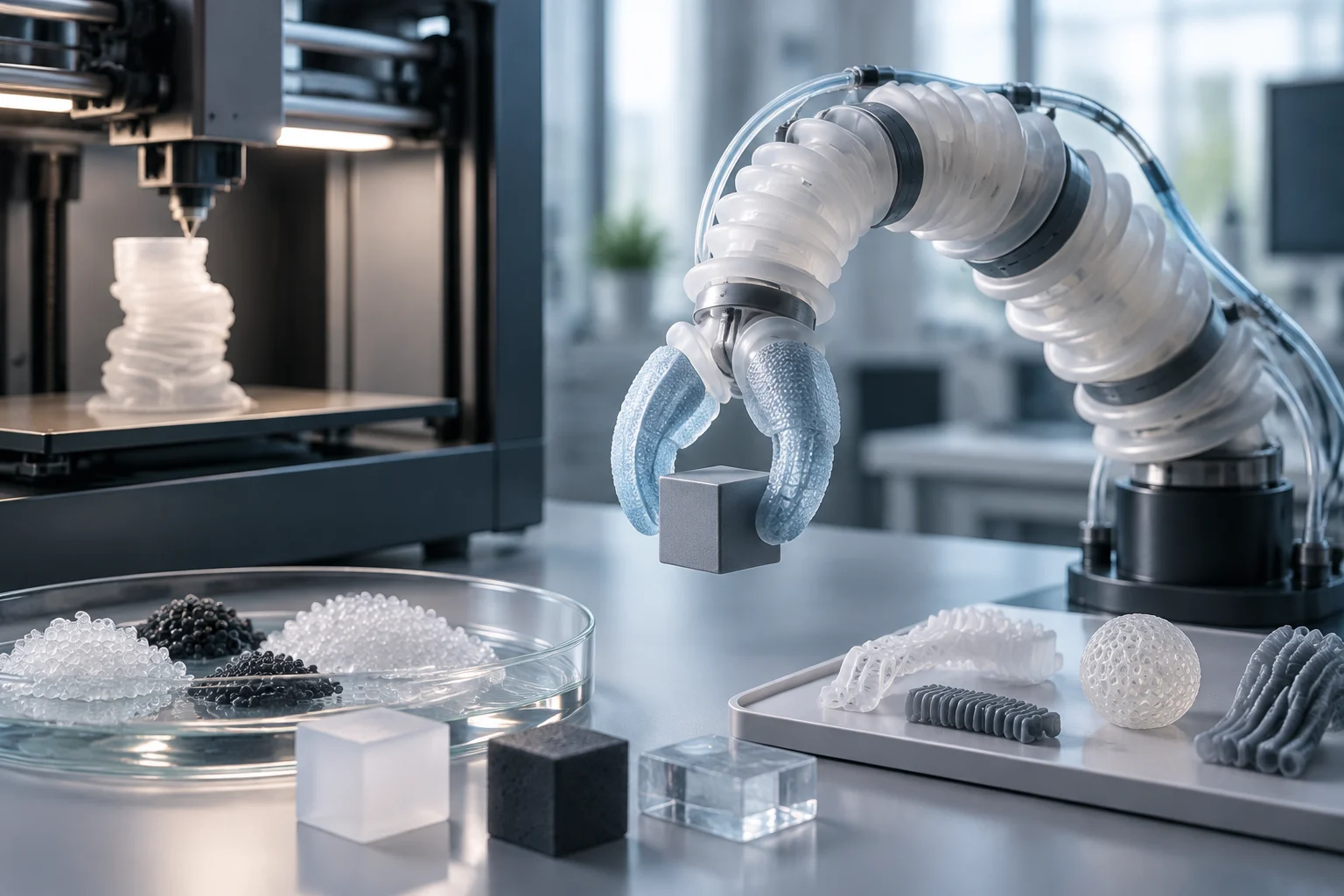
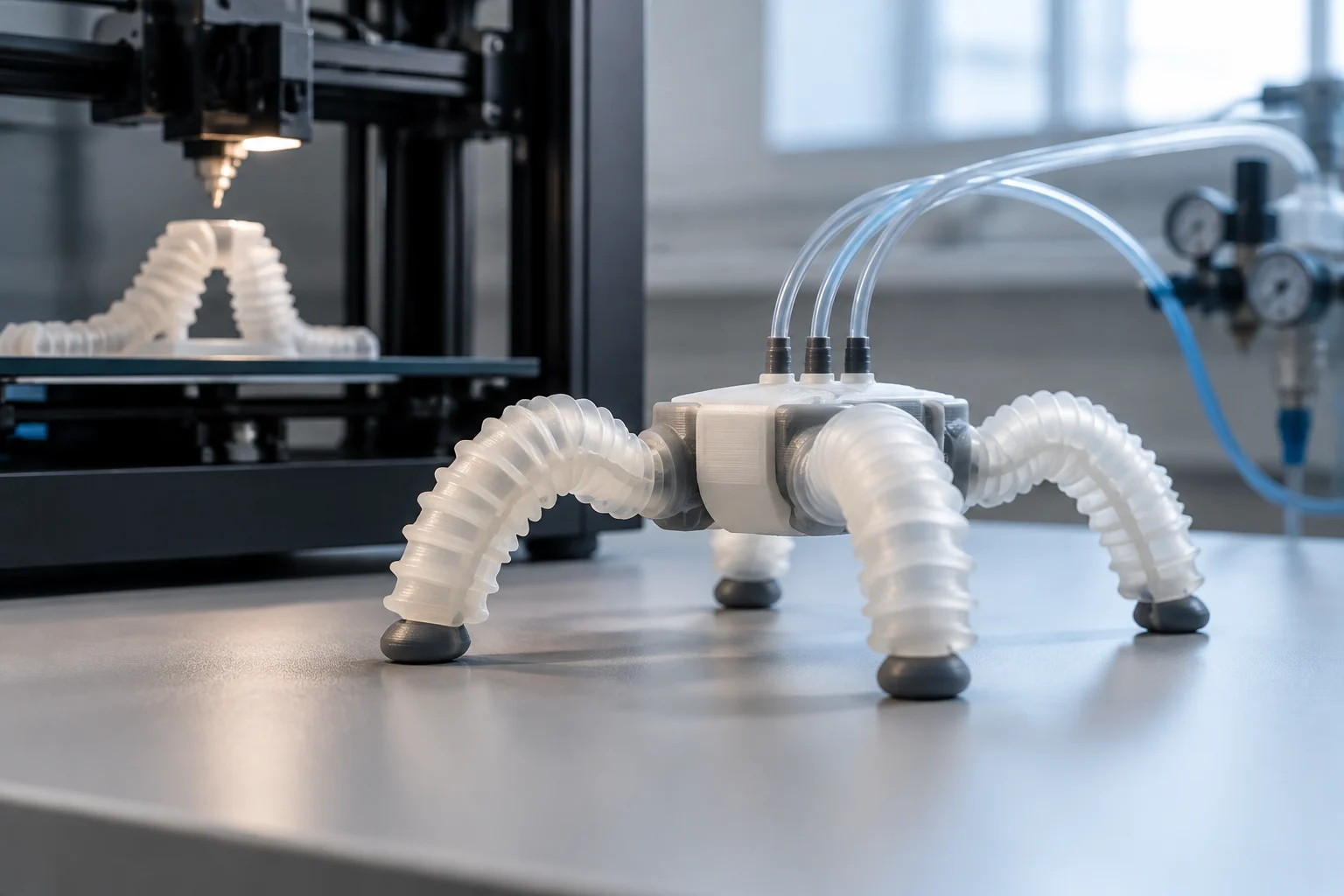
The Flex Printer is a 3D printing platform developed by researchers at the University of Edinburgh to manufacture soft robots. In the described demonstration, a four-legged robot can walk after being connected to a compressed air source. The movement is air-driven, without internal electric motors or electronic circuits, according to project coverage.
The news was published on May 26, 2025, and notes that the work appeared in the journal Device. The coverage describes a robot capable of walking after connection to compressed air. The demonstration shows pneumatic locomotion in a soft robot manufactured with the Flex Printer; it should not be confused with an autonomous robot carrying its own power source.
Printing the robot and setting it in motion are distinct stages. The printer fabricates the flexible structure, but the described demonstration includes connecting the robot to a compressed air source. External pressure is part of the test: the result proves that this configuration can produce movement, not that the robot functions without support infrastructure. This difference matters when comparing a prototype with a system prepared for a specific task.
How movement is generated without electric motors
The described robot has four legs and is made of flexible plastic. When connected to a compressed air source, it can walk. The prototype is pneumatically actuated and, according to coverage, does not incorporate electric motors or internal electronic circuits.
To assess a specific use, it is not enough to know that the robot walks: it matters what task it must perform and under what conditions. In an inspection, for example, one would need to know the terrain, available space, and how air is supplied; in a manipulation task, force and contact control would also be of interest. The context defines the necessary tests, and a locomotion demonstration does not by itself establish results in other functions.
The coverage cites the cost of standard components to assemble the Flex Printer at under 400 British pounds. This figure is attributed to the platform and not to an official manufacturer price list. It is not the cost of a finished industrial robot: it does not describe the full cost of integration, air supply, operation, maintenance, or validation of a solution for a plant.
What 3D printing allows—and what it does not guarantee
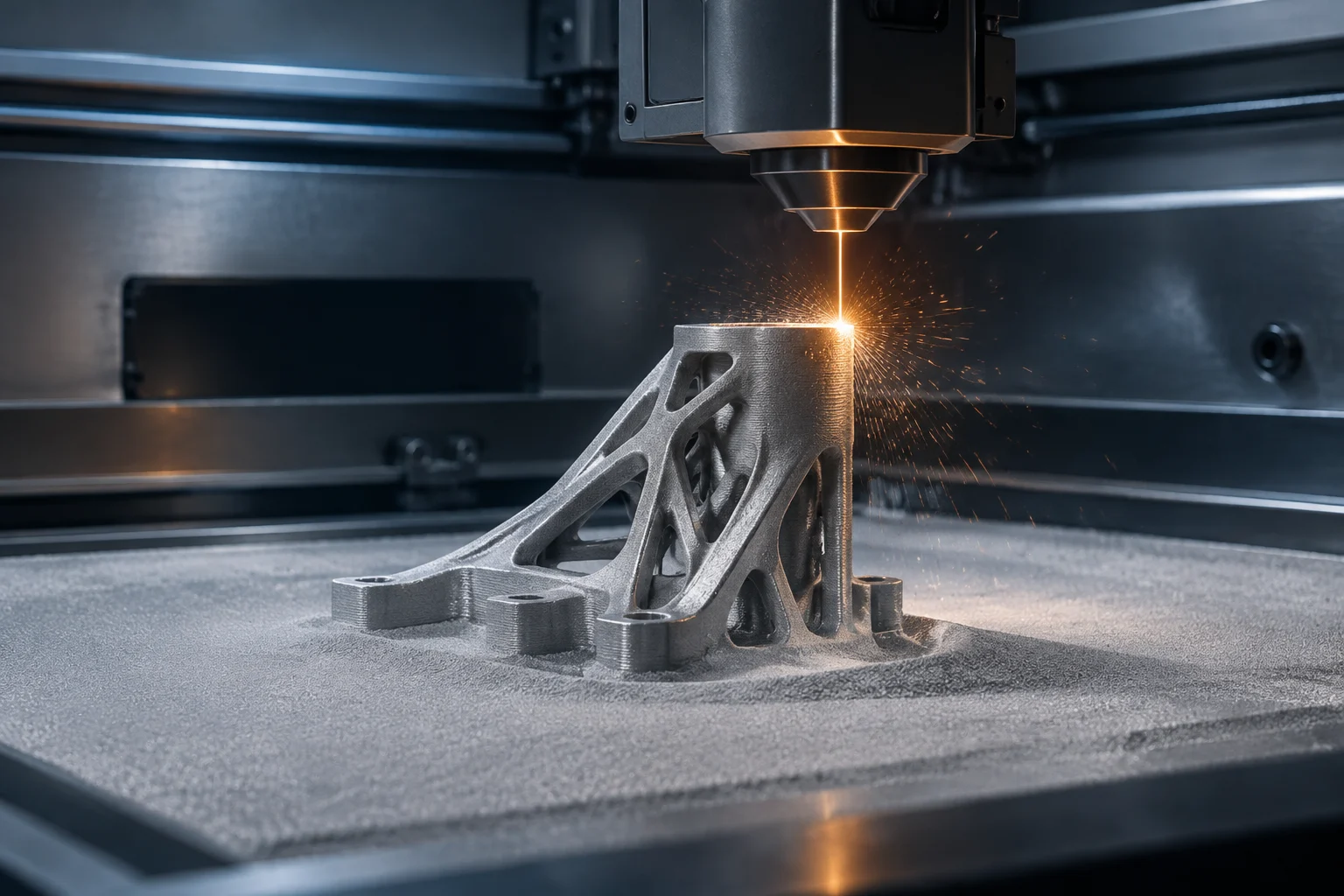
Additive manufacturing allows the production of complex geometries and, in certain designs, brings together in a single part elements that would otherwise require assembly. In soft robotics, the shape of the body and the way it deforms can be part of the movement mechanism. Geometric freedom is an advantage of the process, but it depends on the materials and techniques that can be printed; it does not imply that any shape or combination is viable.
An academic review on 3D printing for soft robotics analyzes various technologies, materials, and devices studied. It also points out process limitations, including manufacturing speed and the difficulty of scaling production. Printing a complex geometry does not automatically solve production: to move from an experimental part to a repeatable series, time, consistency between units, and usage conditions also count.
Soft robotics does not require all robots to dispense with electronics. AIMPLAS presents SOFTRONIC as a research project on conductive elastomers and plastomers, hybrid additive manufacturing, and integration of flexible sensors. There are designs that combine deformable materials and sensors when the function requires detecting a deformation or responding to a signal. The Flex Printer and this type of research show different architectural choices, not stages of the same product.
Two design priorities
The Flex Printer demonstration uses compressed air to make a soft robot walk. Other soft-robotics research, such as AIMPLAS’s SOFTRONIC project, explores flexible sensors integrated into devices. These are different design approaches: the described Edinburgh robot demonstrates pneumatic locomotion, while SOFTRONIC investigates integrated electronics and sensing.
What has been validated and what remains to be checked
The reported result is specific: a flexible four-legged robot can walk when connected to compressed air. The coverage also attributes to the project the use of standard components to assemble the printer and the publication of designs to facilitate reproduction. Locomotion is what has been demonstrated; to assess real tasks, one would have to study the device's behavior and its air supply under relevant conditions, including gait stability and response to obstacles.
Walking in a demonstration does not certify performance in a factory, a hazardous installation, or a clinical environment. To decide if the concept fits an application, it would be advisable to measure aspects such as operating duration, payload, speed, displacement precision, behavior after repeated cycles, and response to leaks. It is also important to know the variation between separately manufactured robots, as this affects repeatability. A movement test does not replace a reliability evaluation with criteria suitable for the task.
Useful life must be evaluated in the manufactured assembly and under conditions representative of the intended use. Properties of a different commercial elastomer cannot be automatically transferred to the Edinburgh robot: the formulation, geometry, printing process, and loads may change. In an industrial application, one would have to determine the specific part's compatibility with temperature, humidity, chemical agents, and mechanical stresses. Durability depends on the system and the environment, not just on the material being described as flexible.
The Flex Printer versus other manufacturing routes
In February 2026, Harvard presented a rotational multi-material 3D printing method to create filaments with internal channels that can be pressurized and deformed in a programmed manner. Among the structures shown are a floral pattern and a five-fingered gripper. It is a different approach from the Flex Printer: the Edinburgh demonstration focuses on a quadruped robot that walks with compressed air.
In the method described by Harvard, the filament has a polyurethane coating and a temporary poloxamer core. Removing the latter leaves a hollow channel that can be pressurized. The University also describes how the orientation and shape of the channel are controlled via process parameters. The two demonstrations are not interchangeable: one addresses a pneumatic quadruped robot and the other printed structures with programmable channels; their results do not allow assuming they share components or performance.
The academic review on additive manufacturing highlights both design flexibility and speed and scalability limitations. To choose a route, it is useful to start from the desired function: pneumatic locomotion, a deformable gripper, integrated sensors, a customized geometry, or repeatable manufacturing. The process must respond to the technical requirement, not just the general label of '3D-printed robot'. This avoids comparing prototypes that respond to different objectives as equivalents.
How to assess a possible industrial application
Flexibility can be useful when interacting with delicate objects or adapting to variable spaces. AIMPLAS describes research lines in soft robotics related to health, manipulation, and industrial applications; its SOFTRONIC project explores pneumatic actuators and integrated sensors. These are development lines in the field, not proof that the Flex Printer has been deployed in those sectors.
For an engineering team, it is advisable to distinguish a movement demonstrator from a productive tool. Before considering an operational use, one would have to check material compatibility, manufacturing repeatability, pressure control, and behavior during prolonged cycles. The task also determines what sensors, stopping mechanisms, and safety measures are necessary. The evaluation must cover the complete system, including air supply and interaction with the environment, not just the printed part.
The Flex Printer demonstration describes a soft robot that walks when connected to compressed air, without internal electric motors or electronic circuits. Other designs, including work explored in AIMPLAS’s SOFTRONIC project, integrate flexible sensors. These examples illustrate different architectures; the demonstration does not establish the Edinburgh robot’s suitability for a particular task.
The Flex Printer is an experimental platform to explore manufacturing and pneumatic locomotion. The demonstration shows a soft robot that walks when connected to a compressed air source. To assess an application, one must start from the task and check the device's behavior under representative conditions, without confusing the shown movement with industrial validation.
Two approaches to 3D-printed soft robotics
The Edinburgh and Harvard examples use different printing methods and demonstrate different structures.
| Edinburgh demonstration | Pneumatically driven four-legged robot |
|---|---|
| Harvard demonstration | Programmable pneumatic filaments and soft structures |
This comparison describes fabrication and demonstrated forms, not application readiness or equivalent performance.