The Weight of Climate Control in the Household Bill
Heating and air conditioning account for over 50% of energy consumption in an average home, according to data cited by Saneamientos Pereda. This proportion explains why temperature control is the most direct savings lever available to the average owner. Reducing the operating time of the boiler or heat pump when no one is in the home immediately impacts the monthly bill, without the need for construction work or infrastructure changes.
In this context, home automation devices are not a luxury, but a management tool. According to the Institute for Energy Diversification and Saving (IDAE), home automation can save up to 39% on heating and 27% on domestic hot water. These percentages are not marketing promises, but estimates based on the optimization of equipment working cycles, which is exactly what a smart thermostat automates.
What Distinguishes an AI Thermostat from a Traditional One?
A traditional thermostat, whether dial or programmable digital, operates under fixed logics: it turns the equipment on and off when the ambient temperature crosses a threshold or according to a preset schedule. Its main limitation is operational rigidity; it does not distinguish between a cloudy day and a sunny one, nor between a workday and a rest weekend. The user must manually adjust parameters every time their routine changes.
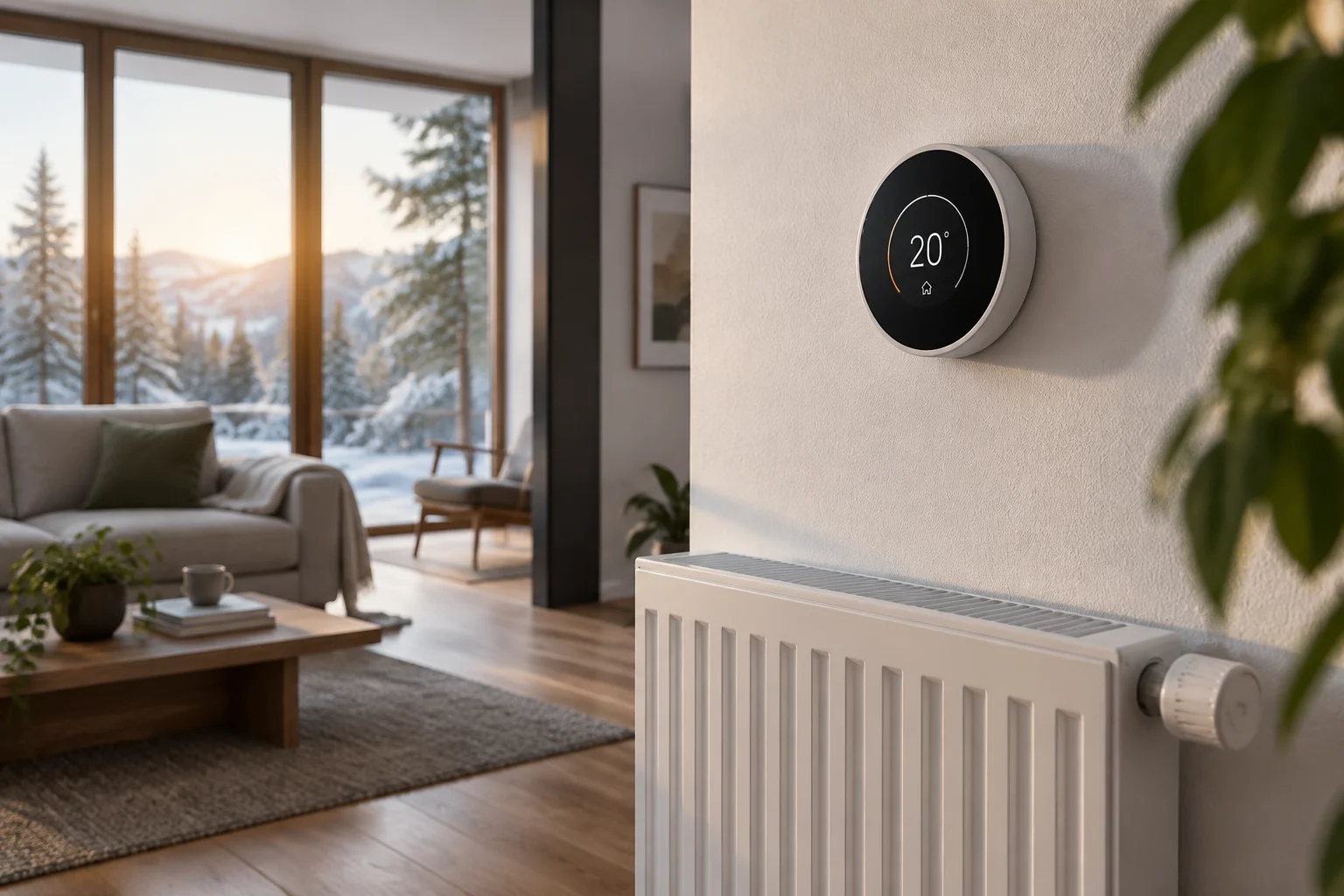
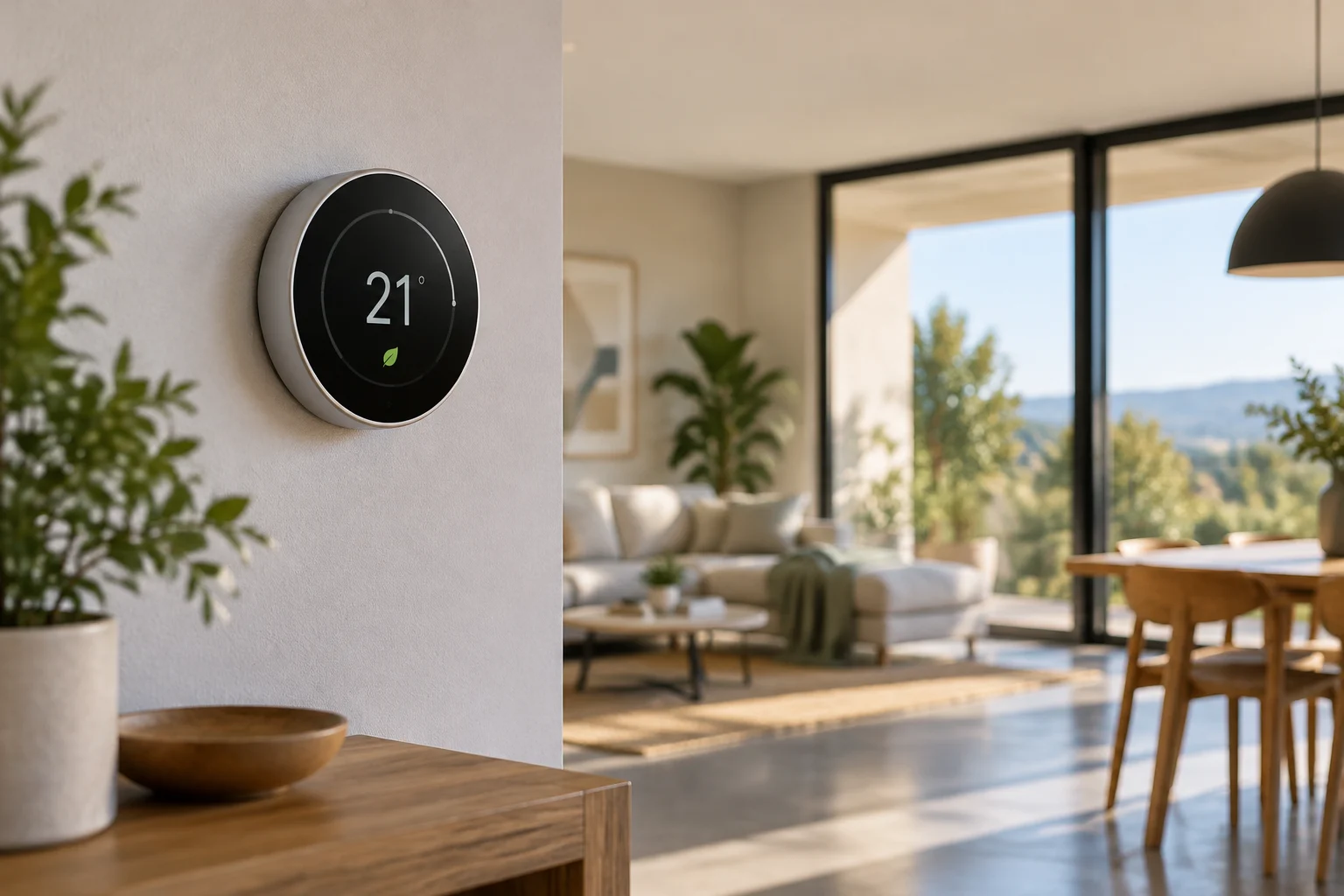
The AI smart thermostat, on the other hand, incorporates presence, temperature, and humidity sensors, along with machine learning algorithms. According to BBVA, these systems allow the home to learn from user habits to automate tasks and improve efficiency. Models like the Google Nest Learning Thermostat or the Tado° V3+ detect when the house is empty and adjust the heating power accordingly, eliminating the unnecessary consumption that characterizes the static model.
Energy Savings: Verifiable Figures vs. Promises
The difference in savings between both types of devices is significant, but varies depending on the source and context. Alberto Brunete, a telecommunications engineer, estimates in a BBVA podcast that the installation of smart devices can reduce electricity consumption by 10% to 20%. In a later article, the same expert, a PhD in Robotics and Automation from the Polytechnic University of Madrid, raises this figure to 20% and 30% when incorporating data analysis and advanced machine learning systems.
Other studies support these magnitudes. Powerplanet Online states that it is possible to save up to 22% on the energy bill without sacrificing comfort, while Systoremote suggests a 30% savings in energy bills with state-of-the-art touch thermostats. The Spanish Home Automation Association (CEDOM) places the average home automation savings at 30%. These figures are not uniform: they depend on the previous efficiency of the home, the climate zone, and the degree of automation implemented.
| Source | Estimated Heating Savings | Overall Home Automation Savings | Context |
|---|---|---|---|
| IDAE | 39% | - | Cycle optimization |
| BBVA (Brunete) | 10-20% | 20-30% | AI and machine learning |
| Powerplanet | - | 22% | WiFi thermostats |
| CEDOM | - | 30% | Sector average |
Technical Compatibility: The Decisive Factor in Spain
Before evaluating savings, it is essential to verify compatibility with the existing installation. In Spain, the diversity of heating systems (gas boilers, heat pumps, electric radiators, underfloor heating) means that not all thermostats are universal. Netatmo and Tado° offer versatility for individual and collective boilers, and even conventional split heat pumps, according to Wollyhome. However, other models have technical limitations depending on the type of installation.
Irsap, a heating systems manufacturer, warns that the key is to find the technology that best fits the radiators and the user's lifestyle. A thermostat that does not communicate correctly with the boiler can generate inefficient on/off cycles, nullifying any AI benefit. Therefore, verifying compatibility with the specific brand and model of the boiler is a non-negotiable step in the buying phase.
Buying Criteria: Beyond the Screen
The choice between an AI model and a traditional one should be based on three pillars: ease of configuration, integration with voice assistants, and installation cost. AI models usually require a more complex initial configuration to calibrate learning algorithms, but offer a smoother user experience in the long term. Traditional models are cheaper and easier to install, but require constant manual management to maintain efficiency.
WiFi connectivity is a standard in smart models, allowing control from the mobile app and integration with Alexa, Google Home, or Apple HomeKit. This integration is not an extra, but a central functionality that allows creating automated routines (for example, lowering the heating when leaving the house and raising it when approaching). For users who do not want to manage apps or routines, a classic programmable thermostat may be sufficient, provided that realistic schedules are set and respected.
- Verify compatibility: Confirm that the thermostat is compatible with the installed boiler or heat pump.
- Evaluate connectivity: Ensure that the WiFi router covers the thermostat's location.
- Review the app: Check the availability of consumption reports and ease of use.
- Calculate the ROI: Estimate annual savings against the purchase and installation cost.
How to Measure Performance in Your Home
To validate real savings, it is necessary to establish a baseline of consumption before installation. It is recommended to record the energy consumption (kWh) of the heating for a full month, ideally in a season of intensive use. Once the smart thermostat is installed, the measurement must be repeated in the same period of the following year, controlling variables such as outdoor temperature and usage habits.
Smart thermostat apps usually include energy consumption reports that allow visualizing savings in real time. These reports are useful for identifying waste patterns and adjusting the configuration. However, it is important not to confuse the savings estimated by the app with the real savings on the bill. The only reliable metric is the comparison of kWh consumed and the final amount of the electricity or gas bill.
Final Decision: When to Choose AI and When to Choose Classic
The AI thermostat is the recommended option for homes with variable routines, families with flexible schedules, or users seeking maximum automation. Its learning capacity allows it to adapt to routine changes without manual intervention, maximizing the potential savings of 20-30% cited by BBVA. It is especially useful in homes with heat pumps or underfloor heating systems, where thermal inertia is high and fine power management is critical.
The traditional or programmable thermostat is suitable for users with fixed schedules, tight budgets, or old installations that do not support WiFi connectivity. Although its savings are lower (10-15% in the best case), its simplicity and low entry cost make it a viable option for those who do not want to manage apps or algorithms. The final decision should balance potential savings, installation complexity, and desired comfort.