A2B connects vehicle audio components
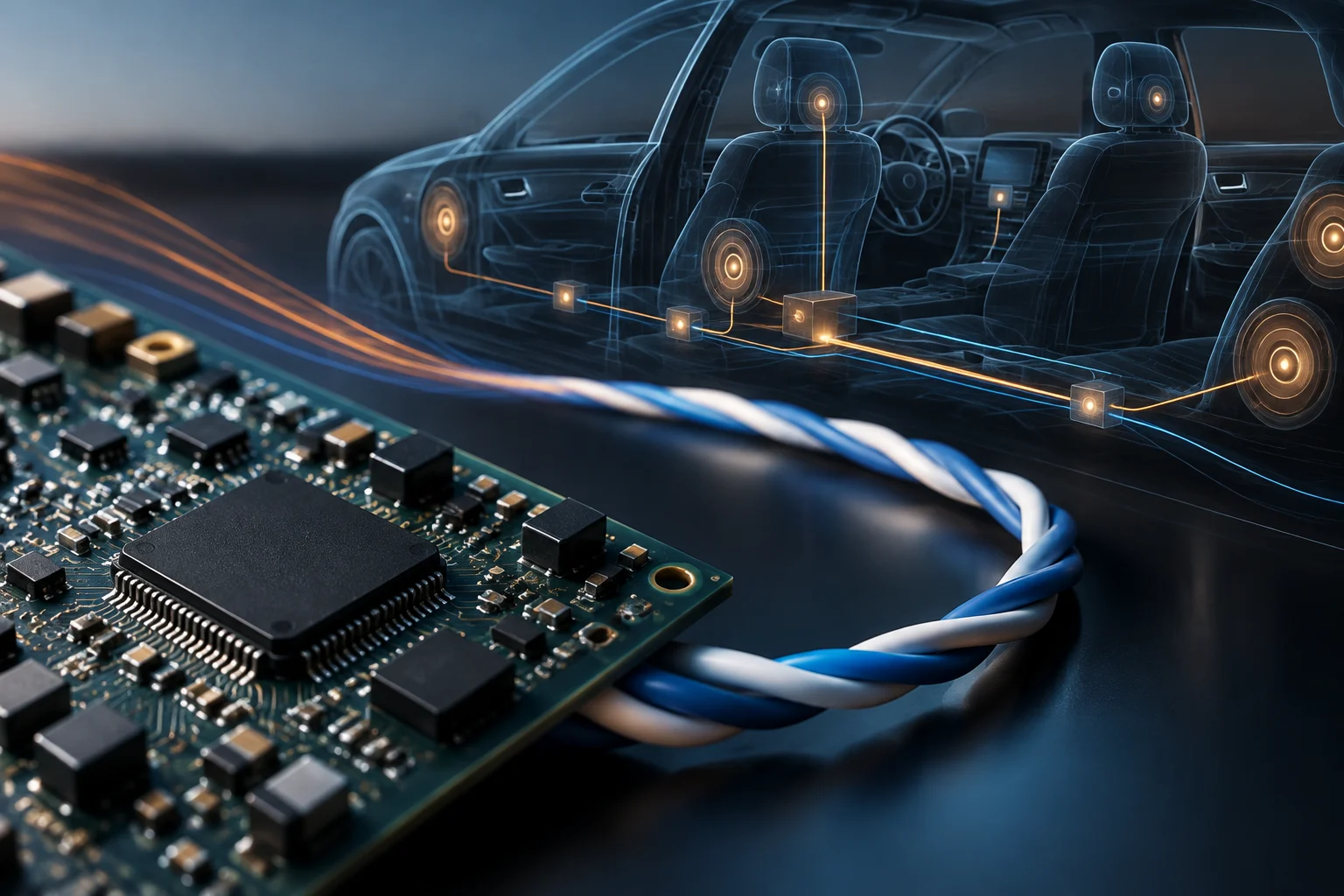
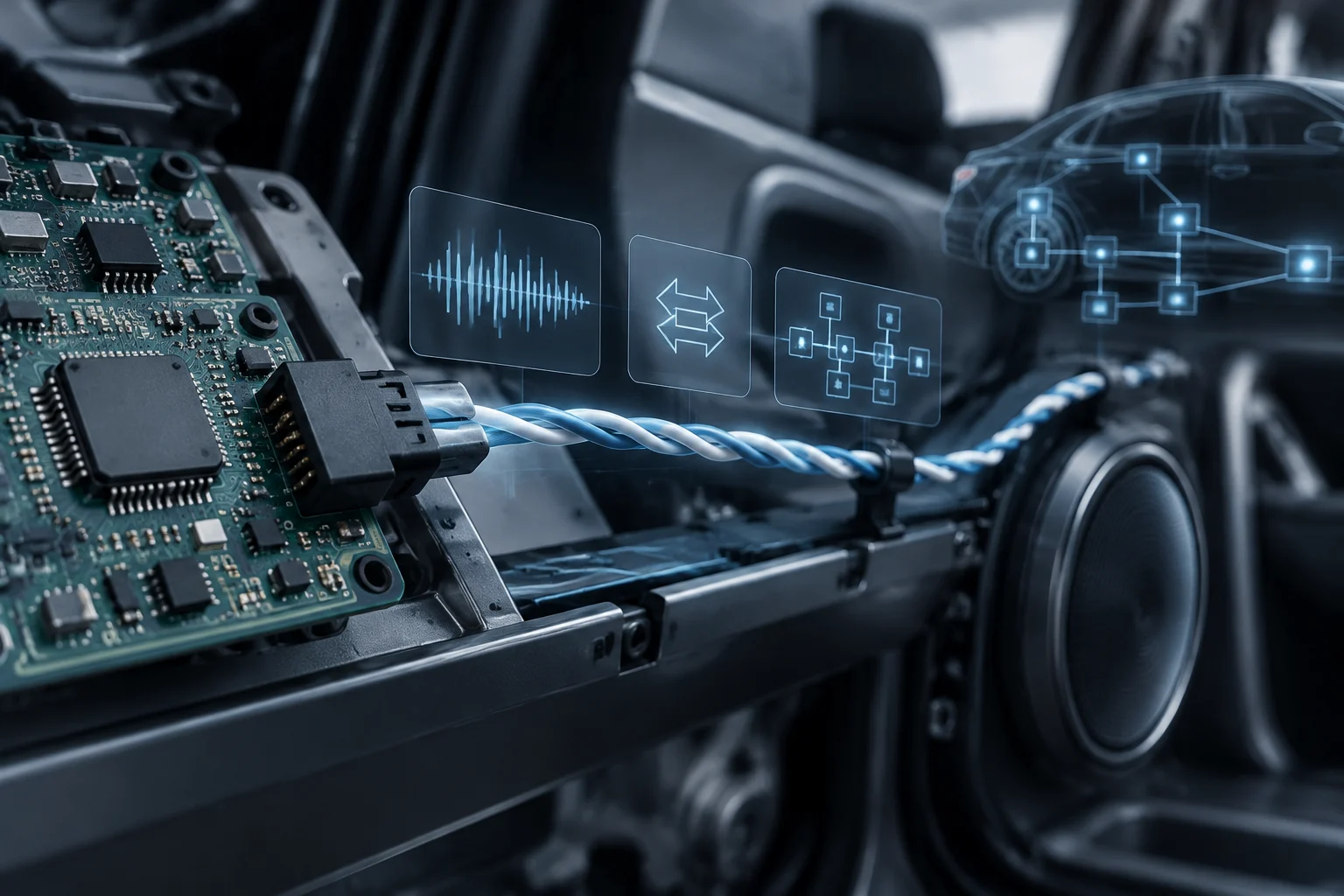
A2B, standing for Automotive Audio Bus, is an Analog Devices technology for transporting audio between vehicle components. In a daisy-chain architecture, a master node communicates with several sub-nodes, such as those associated with microphones, amplifiers, or audio units. The proposal is to reduce dedicated connections and simplify system wiring, not to replace all vehicle networks.
A2B 2.0 is the evolution of that platform. In April 2026, Analog Devices announced that the ADAA245x series had reached production. For automotive manufacturers and suppliers, the practical difference is that the new generation increases available capacity and adds Ethernet data tunnels, maintaining A2B's focus on audio transport with predictable timing. The date matters: this is a platform announced and put into production in 2026, not a future technology still pending release.
What the 98.3 Mbps and 119 channels indicate
The central figure is up to 98.3 Mbps in full duplex, which Analog Devices presents as four times the bandwidth of A2B 1.0. Full duplex means communication can operate in both directions; it should not be confused with a single audio rate available exclusively for one direction. The maximum rate also does not automatically equate to the amount of useful audio a specific implementation can transport, as configuration and system needs intervene.
The platform supports up to 119 upstream and 119 downstream audio channels. In design terms, this capacity offers margin to connect more signals and organize more complex in-cabin audio architectures. It does not mean every car will use all channels, nor that each channel corresponds to a speaker: the effective number depends on how the manufacturer distributes inputs, outputs, and other system resources.
The important limit is not to turn transport capacity into an experience promise. More channels can facilitate multi-zone system design or microphone signal transport alongside playback signals, but alone they do not prove compatibility with a specific spatial format, a determined resolution, or a commercial feature. Those capabilities require additional components, processing, software, and integration decisions.
Especificaciones técnicas clave de A2B 2.0
Resumen de las mejoras principales de la plataforma A2B 2.0 en comparación con la versión anterior, destacando los parámetros de rendimiento y eficiencia.
| Ancho de banda | 98.3 Mbps (dúplex completo) |
|---|---|
| Canales de audio | 119 subidas / 119 bajadas |
| Latencia | 62 μs |
| Integración Ethernet | Vía interfaz OASPI |
| Ahorro de costos del sistema | Hasta 30% |
| Reducción de cableado | Hasta 75% |
Los valores de ahorro de costos y reducción de cableado son máximos indicados por el fabricante.
Sources and references1
Latency: a network figure, not the whole system
Analog Devices indicates a latency of 62 μs and describes A2B behavior as deterministic. The utility of low, predictable latency is understood in systems needing to coordinate audio signals between nodes, such as microphone capture and sending audio to different parts of the vehicle. However, the figure refers to the A2B link and does not alone allow deducing the total response time of a complete function.
In an application like road noise cancellation, the result also depends on capture, processing, amplifiers, speakers, and vehicle calibration. Therefore, 62 μs is not a guarantee of effective cancellation nor a measure of how long a voice assistant takes to respond. The complete route incorporates stages outside the bus, and final performance must be evaluated at the system scale.
The distinction is relevant for engineers comparing datasheets: a fixed transport latency helps budget times and synchronization, but it does not replace end-to-end analysis. It is also insufficient to conclude that a specific solution is superior to Bluetooth LE Audio or an IP-based audio network. The architectures, loads, temporal requirements, and compared interfaces are not necessarily equivalent.
Ethernet tunneling and software-defined vehicle networks
A2B 2.0 incorporates Ethernet data tunnels via OASPI, standing for Open Alliance SPI. The integration allows transporting Ethernet data through the A2B connection, in addition to audio traffic, and is designed to facilitate the relationship with software-defined vehicle (software-defined vehicles, SDV) networks. This describes a connectivity path; it does not mean A2B becomes a general Ethernet network or that any type of vehicle traffic must flow through it.
The practical reading is one of complementarity. A2B addresses audio connectivity between cabin nodes; Ethernet can cover other vehicle communication needs. The journalistic source The Elec collects comments from an Analog Devices executive on the differences between audio and Ethernet requirements, but the choice between both technologies depends on the specific design. There is no basis to present one as a universal replacement for the other.
OASPI should be treated as an interface associated with this integration, not as an automatic guarantee of interoperability between products from different suppliers. For a project, the useful question is which devices support the function, what configuration the network requires, and how traffic is managed in the complete system. The interface name does not replace product compatibility documentation or architecture validation.
Compatibility with A2B 1.0 and update decisions
Analog Devices indicates that the ADAA245x series is compatible with A2B 1.0 wiring and connectors and that devices can connect to networks of that generation. This offers a possible infrastructure reuse path, but it does not equate to a direct update without changes: physical compatibility does not alone confirm that all existing modules, configurations, and functions can be retained without adaptation.
To evaluate a transition, a manufacturer must separate at least three issues: whether the cable and connectors work, whether the system's nodes and devices are compatible, and whether the architecture and software support the intended configuration. Reuse can reduce the scope of a redesign, but each vehicle and topology require their own verification. It is not prudent to turn declared compatibility into a promise of savings or integration without modifications.
The series includes three variants identified in technical coverage as ADAA2457, ADAA2456, and ADAA2455; they are described, respectively, as an option with Ethernet, an intermediate one, and a lower-cost one. This segmentation can help select devices according to system requirements, but published figures on variants do not replace individual datasheets for each component. Selection must be based on the electrical and integration documentation corresponding to the exact model.
What a design team can conclude
A2B 2.0 raises declared capacity to 98.3 Mbps and 119 channels per direction, maintains an indicated latency of 62 μs, and adds Ethernet tunnels via OASPI. Together, these are attributes pertinent for manufacturers needing to connect more audio sources and destinations and link that infrastructure with broader vehicle networks. They do not, alone, prove high-resolution audio, operational personalized zones, or a specific voice assistant response.
Analog Devices also communicates a potential reduction of up to 30% in system cost thanks to greater functional integration and fewer external circuits. This is a maximum announced by the provider, not a guaranteed saving for all designs. The result will depend on components, wiring, production volume, architecture, and validation costs. The same caution applies to general wiring reduction claims associated with A2B: they are design objectives, not an automatic result for each vehicle.
The practical decision is to compare the project's real requirements with the capabilities offered by each variant: number and direction of signals, need to transport Ethernet, node and wiring compatibility, and end-to-end latency. For a platform already based on A2B 1.0, declared compatibility can justify studying an update; it is not enough to approve it. For a new design, A2B 2.0 merits consideration when synchronized audio and connection to the vehicle network weigh more than the flexibility of a generalist network.