The New Supply Chain Landscape
The hardware industry faces a structural challenge in 2026 that transcends traditional supply and demand cycles. The determining factor is the massive demand for AI infrastructure, which has caused manufacturers to shift production capacity toward high-bandwidth components, such as HBM memory, leaving very limited availability for the corporate and consumer markets. This strategic reorientation prioritizes the immediate profitability of large data centers over the stability of the generalist market.
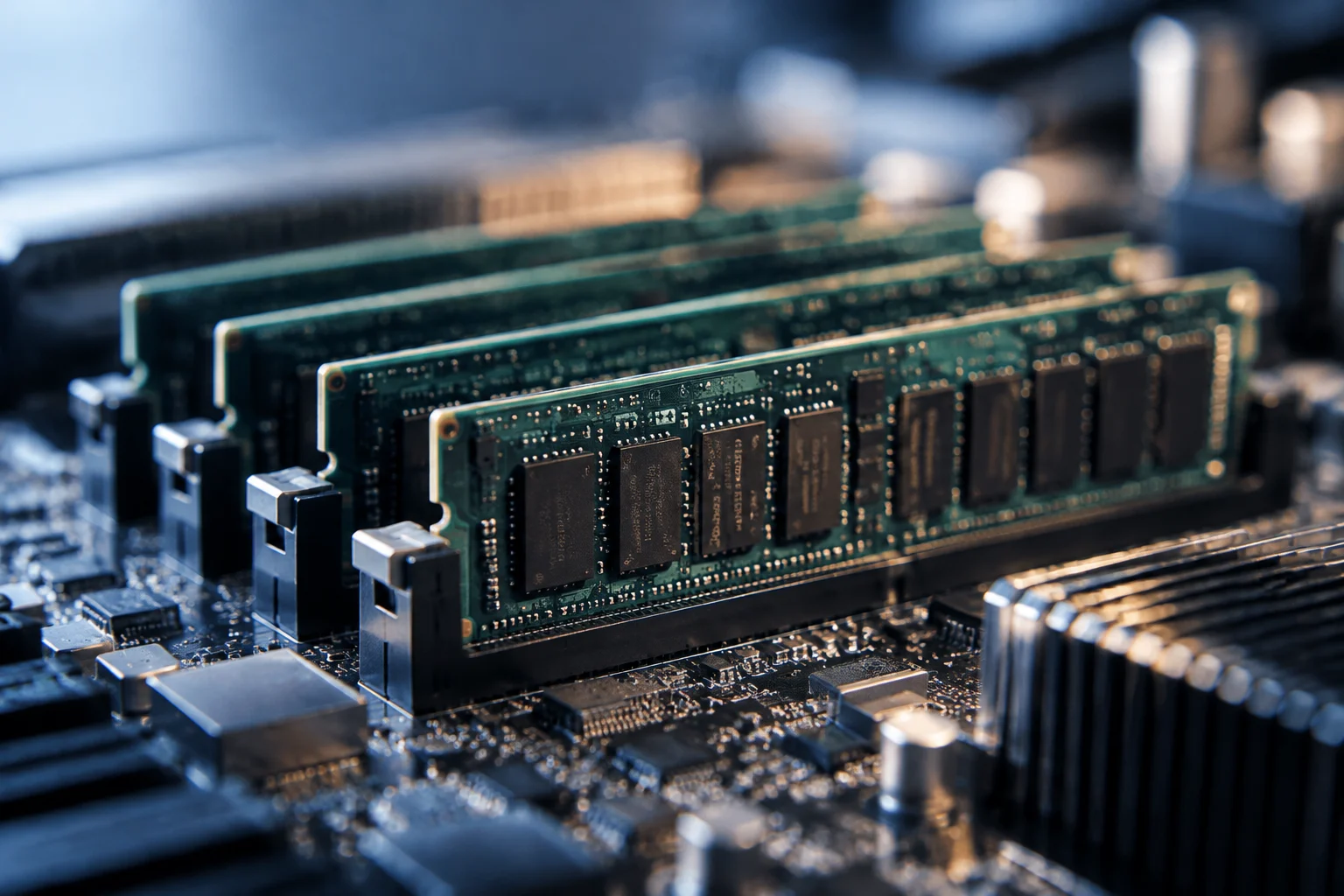
This production shift has generated sustained inflationary pressure. Market data indicates that DRAM memory modules have experienced price increases of up to 171.8% year-over-year during 2025, with projections suggesting continued increases of 50% or more throughout 2026. This phenomenon has altered the historical pattern of decreasing costs that characterized the sector, forcing buyers to reevaluate their assumptions about price evolution.
The impact is not limited to memory. Data center storage demand has depleted complete inventories of hard drives and SSDs for 2026. Integrators have already warned of immediate new price hikes for these components, forcing a rethinking of procurement strategies and medium-term budget planning. Scarcity has become the operational norm, not a temporary anomaly.
Impact on Key Component Costs
Price volatility is particularly acute in RAM memory modules. The most common modules, such as 16 GB and 32 GB DDR5, have seen extreme increases ranging from 163% to 619% in some markets since late 2025. This disparity reflects the complexity of the supply chain and the difficulty in forecasting actual short-term availability, where uncertainty is at its highest.
For businesses, this means that the initial purchase cost of a computer has ceased to be a reliable indicator of its long-term value. Memory and storage, which historically represented a moderate fraction of the total cost, now constitute the main point of financial pressure in new hardware acquisition. Ignoring this variable can lead to significant overcosts in the asset lifecycle.
The situation demands a review of technical specifications. In a scarcity environment, performance-per-watt optimization and memory usage efficiency become purchasing criteria as important as the raw power of the processor or graphics card. Technical efficiency stands as an economic lifeline against component inflation.
Total Cost of Ownership as a Decision Tool
In the face of price uncertainty, Total Cost of Ownership (TCO) analysis becomes an indispensable tool for aligning purchasing options with business objectives. TCO involves accurately accounting for all costs related to the complete equipment lifecycle: ownership, operation, and decommissioning. This comprehensive approach allows visualizing the true financial burden of hardware.
Focusing solely on the sticker price is a strategic error similar to choosing a vehicle only by its purchase cost, ignoring fuel, maintenance, and depreciation. In the current context, where components can drastically increase in price before the equipment lifecycle ends, TCO allows visualizing the real impact of component inflation on the operating budget. Long-term vision is the only way to protect profitability.
Key factors in TCO calculation include initial purchase and installation costs, operating costs (energy, licenses, support), and decommissioning costs. Understanding these elements is crucial for making intelligent decisions that protect long-term profitability, especially in sectors where technology is a critical asset. Transparency in calculating these costs is the foundation of effective financial management.
Mitigation Strategies and Planning
One of the most effective strategies to mitigate the impact of scarcity is longer lifecycle planning. Historically, the equipment purchase cycle for small and medium-sized businesses revolved around a three-year horizon, determined by standard warranties. Today, the trend shifts toward five-year planning, aligned with certifications like TCO Certified Generation 10. This extension reduces purchase frequency and, therefore, exposure to price peaks.
The extension of manufacturer warranties to five years, as implemented by AOC in its professional lines, not only offers greater coverage but also simplifies sustainability reports and allows for smarter IT budget planning. This initiative reflects confidence in design durability and adaptation to new market realities. Extended warranty acts as insurance against premature obsolescence.
Furthermore, supplier diversification and long-term supply contract negotiations can help stabilize costs. Companies that integrate component inflation forecasts into their financial models will be better positioned to absorb price shocks without compromising innovation goals. Contractual flexibility is key to navigating volatility.
Market Outlook and Future Trends
The global IT hardware market, valued at $152.13 billion in 2026, is projected to grow to $221.34 billion in 2031, with an annual growth rate of 7.78%. However, this growth is conditioned by the industry's ability to manage the scarcity of critical components. The sustainability of growth depends on supply chain management efficiency.
The Asia-Pacific region is poised to be the fastest-growing market, while North America remains the largest market. Market concentration is moderate, with a series of key players competing for manufacturing capacity and corporate customer loyalty. Regional competition intensifies the fight for limited resources.
As technological competition redefines foreign policy and business strategies, hardware availability becomes a geopolitical factor. Companies that understand supply chain dynamics and adopt a rigorous TCO approach will have a significant competitive advantage in this new environment. Strategic adaptability will be the key differentiator.