The End of Total Cloud Dependence
The mobile software industry is undergoing a structural shift: the execution of artificial intelligence models directly on the device. For years, generative AI was associated with powerful servers and cloud platforms, but the new generation of mobile applications is beginning to run AI models locally. This change enables the creation of faster, more private, and efficient applications, as sensitive data no longer needs to leave the phone to be processed.
For IT consultants and developers, this implies a redefinition of digital product architecture. It is no longer just about "using AI," but about strategically deciding which part of the processing occurs in the cloud and which part happens locally. This technical decision directly impacts infrastructure costs, data protection, and the ability to offer truly intelligent and personalized experiences without perceptible latency.
Edge Computing: The Technical Foundation of Local AI
Edge computing is the distributed computing framework that makes this transition possible. It is defined as a model that brings enterprise applications and data storage closer to data sources, such as Internet of Things (IoT) devices or smartphones themselves. This proximity to data at its origin delivers key business benefits: faster insight acquisition, better response times, and greater bandwidth availability.
Before edge computing, all data produced at an endpoint had to be sent to a centralized server for processing. Today, the device can process data at its source and only send analyzed information or final results. This relieves the load on centralized data centers and solves the latency and bandwidth issues that arise when sending massive volumes of data generated by connected devices to the cloud.
Hybrid Architectures: The New Design Standard
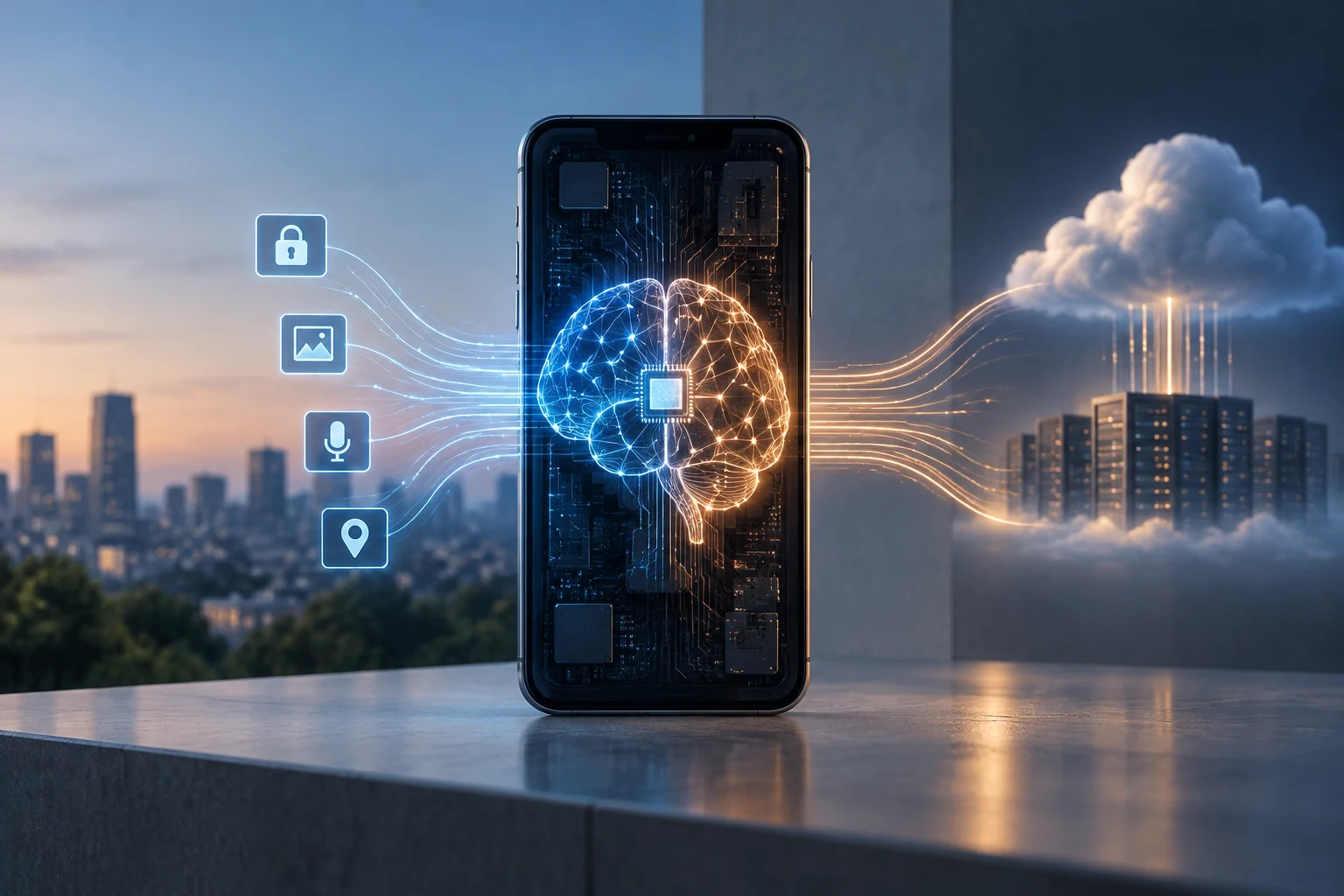
Today, there are two main approaches to implementing generative AI on mobile devices, and the dominant trend is the hybrid architecture. This combines on-device AI with cloud processing, allowing developers to optimize costs and protect data. The key to modern design lies in the ability to dynamically orchestrate workloads: low-complexity tasks or those with high privacy sensitivity are resolved locally, while complex queries or those requiring large knowledge bases are delegated to the cloud.
This duality offers a significant competitive advantage. Applications can maintain a fluid and offline experience for basic functions while scaling to cloud infrastructure when users request advanced capabilities. For businesses, this means a reduction in API costs and greater resilience against network interruptions, as the application does not become unusable if the connection is lost.
Privacy and Data Sovereignty on the Device
One of the biggest drivers of local AI is privacy. By running models on the device, biometric, location, or user behavior data is not transmitted to third parties. This is crucial in regulated sectors such as health or finance, where regulations require certain data not to leave the jurisdiction or the user's direct control. Local AI allows compliance with these requirements without sacrificing the application's intelligent functionality.
Furthermore, local execution reduces the attack surface. By not relying on a constant connection with external servers, data interception vectors in transit are minimized. For users, this translates into greater trust in the application, a factor that is increasingly decisive in the adoption of AI technologies in daily life.
Use Cases: From Photography to Productivity
Local AI is already transforming specific smartphone functions. In photography, devices use vision neural networks to project composition guides and suggested postures based on the environment, eliminating rigidity in portraits. In wellness, latest-generation processors analyze speech and writing patterns to detect early signs of cognitive fatigue or chronic stress, proactively suggesting active breaks or temporary notification blocks.
In the productivity sphere, local AI allows for the drafting of effective prompts and the automation of administrative tasks directly on the device. This is especially relevant in educational and professional contexts, where the ability to manage documents, create rubrics, or self-correcting questionnaires without relying on connectivity improves operational efficiency and user autonomy.
Strategic Implications for Software Development
For companies developing mobile applications, the adoption of local AI requires a reevaluation of their development strategies. It is not enough to integrate an AI API; it is necessary to design systems that can operate autonomously and efficiently on the device. This implies optimizing models for mobile hardware, managing memory and battery consumption, and clearly defining the limits between what is processed locally and what is sent to the cloud.
The practical decision for IT teams is clear: local AI is not an alternative to the cloud, but an essential complement. Organizations that integrate this hybrid architecture into their digital products will be better positioned to offer faster, more private, and personalized experiences, anticipating the expectations of a consumer who demands technology that not only reacts but also predicts and shapes the user experience.