Definition and Distinction from Traditional AI
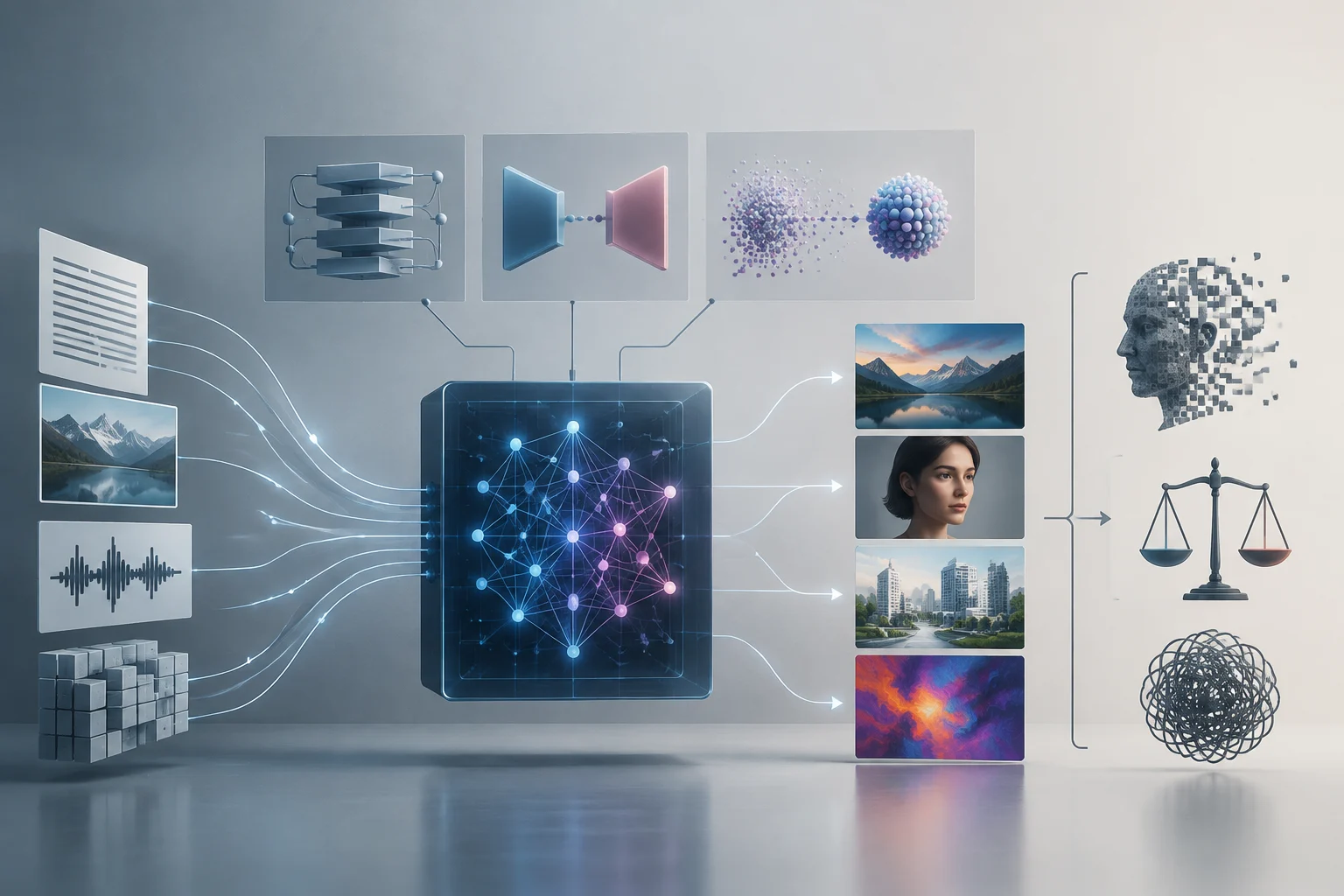
Generative AI is a subfield of artificial intelligence designed to create new and original content, such as text, images, audio, video, or code, based on patterns learned from large datasets. Unlike analytical or predictive AI, which classifies data or predicts outcomes based on existing information, generative AI synthesizes novel information that was not explicitly present in its training. This synthesis capability marks a clear boundary with traditional systems, which are limited to processing what already exists.
This distinction is fundamental to understanding its practical value. While a traditional AI system might predict the probability of fraud in a transaction, a generative system could draft the audit report or generate a synthetic example of a fraudulent transaction to train other models. The capacity for content production positions it as a creation tool, not just an analysis tool, expanding the scope of business and creative applications.
The term encompasses a variety of techniques, but their common denominator is the use of deep learning models trained on enormous volumes of data. These models do not 'understand' content in the human sense, but rather capture statistical and structural relationships that allow them to generate coherent and plausible outputs. This mechanization of creativity depends entirely on the quality and diversity of the training data, underscoring the importance of data curation in the development of these systems.
Technical Architectures: LLMs, GANs, and Diffusion Models
There are three main families of models driving current generative AI, each optimized for different data types and operating mechanisms. The choice of architecture depends on the type of content to be generated and the quality and speed requirements. Understanding these technical differences is key to selecting the right tool for each specific task.
Large Language Models (LLMs)
LLMs are the foundation of most conversational text tools. They use the transformer architecture to process word sequences and predict the most likely next token. Their training is based on self-supervised learning over trillions of words, allowing them to capture context, nuances, and complex grammatical structures. This long-context modeling capability is what gives them their versatility in writing and analysis tasks.
Generative Adversarial Networks (GANs)
GANs consist of two competing neural networks: a generator that creates data and a discriminator that evaluates its authenticity. This adversarial process allows for the generation of highly realistic images, although their training can be unstable and prone to mode collapse, where the generator produces a limited range of variations. The competitive dynamic between both networks is the engine driving the continuous improvement of visual quality.
Diffusion Models
These models learn to invert a noise addition process. During training, data is corrupted with Gaussian noise step by step; when generating, the model starts from pure noise and gradually removes it until forming a coherent image or audio. Currently, they are the dominant technology in high-quality image generation from text, offering superior stability compared to GANs in many scenarios.
Comparison of Generative Architectures
The following table summarizes the key differences between the three main architectures, facilitating the understanding of their typical applications and operating mechanisms. This comparative view helps to quickly identify which technology is most suitable for a specific goal.
| Architecture | Main Output Type | Operating Mechanism | Typical Use Cases |
|---|---|---|---|
| LLMs | Text, code | Token prediction based on transformers | Chatbots, writing, programming |
| GANs | Images, audio | Competition between generator and discriminator | Facial synthesis, abstract art |
| Diffusion | Images, video, audio | Inversion of a gradual noise process | Text-to-image generation, editing |
Note: LLMs can also generate code and other structured formats, although their main strength is natural language. Diffusion models have surpassed GANs in image quality in recent benchmarks.
The Generation Process: From Prompt to Output
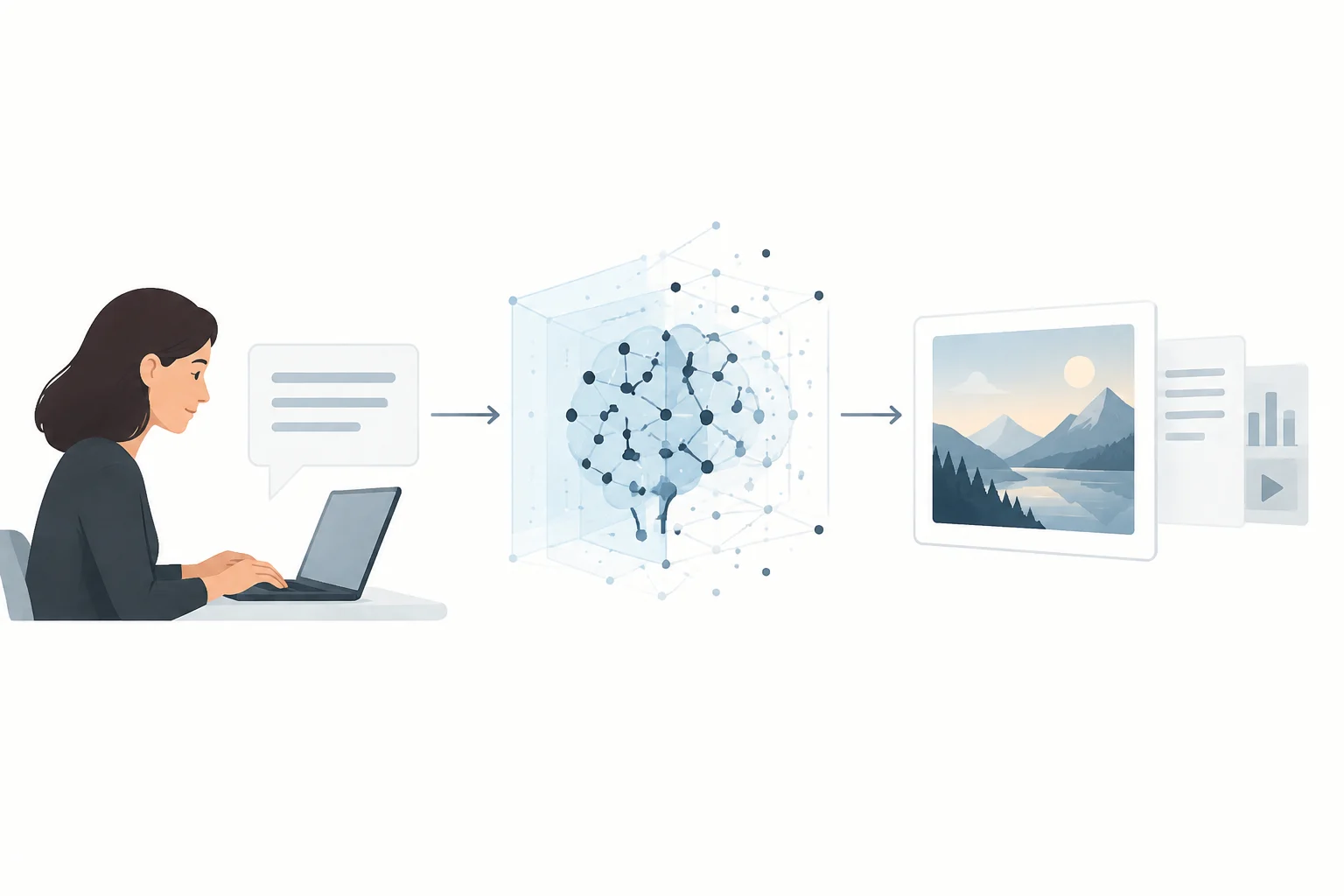
The basic workflow of generative AI follows a logical sequence: input, processing, and output. The user provides an input (prompt) in natural language or another format, which the model analyzes to identify patterns matching its training. The quality of the input directly influences the relevance of the output, making prompt formulation an essential technical skill.
The model uses these patterns to compile an output. In the case of LLMs, this involves repeatedly predicting the next word or token until the response is complete. In diffusion models, it involves iterating denoising steps. A crucial aspect is that the output is non-deterministic: for identical inputs, the model may generate different results in each run due to the probabilistic nature of generation. This variability introduces an element of unpredictability that must be managed.
This variability is a feature, not a bug, as it allows for creativity and diversity in outputs. However, it also implies that human supervision is necessary to ensure the accuracy and suitability of the generated content to the user's specific goals. The limited reproducibility requires users to actively validate results before final use.
Inherent Limitations: Hallucinations and Biases
The most documented limitation of generative AI is hallucination, which occurs when the model produces incorrect, misleading, or unfounded content. This happens because models predict the most grammatically likely next word, not the most factually correct one. A response may sound coherent and convincing but be completely false, posing significant risks in contexts where accuracy is critical.
Other limitations include training biases. If the data used to train the model contains social, cultural, or gender biases, the model will replicate them in its outputs. Additionally, the lack of access to real-time verified sources means the model cannot cross-check information, increasing the risk of factual errors. These biases can perpetuate stereotypes if not mitigated through fine-tuning or data filtering techniques.
Computational cost is also a significant barrier. Training and running large-scale models requires specialized hardware infrastructure and considerable energy. Finally, the need for human supervision is critical: generative AI should not be considered an autonomous source of truth, but an assistance tool requiring expert validation. Risk management must be comprehensive to address these technical and ethical limitations.
Practical Applications and Ethical Considerations
Despite its limitations, generative AI has transformative applications in multiple sectors. In software development, it accelerates code writing and debugging. In marketing, it generates copy variations and visual creatives. In education, it personalizes explanations and creates teaching material adapted to the student's level. These applications demonstrate AI's potential to enhance productivity and personalization in various fields.
Responsible use of these tools requires considering ethical aspects such as intellectual property, transparency about content origin, and the prevention of disinformation. Organizations must establish clear policies on the use of generative AI, including output verification and proper attribution when AI-generated content is used. Data governance is fundamental to ensure regulatory compliance and ethics in the use of these technologies.
The integration of generative AI into workflows should be gradual and supervised. Professionals must develop AI literacy to understand what the tool can and cannot do and how to critically interpret its outputs. This technical and ethical competence is increasingly valuable in the current job market, as it allows users to maximize the value of AI while minimizing its risks.