The spec sheet is not an efficiency test
In a desktop CPU, a power figure serves to describe an aspect of the design and guide decisions regarding cooling, motherboard, and consumption. It does not, by itself, answer the question that usually matters when buying: how much energy the processor needs to complete a specific task. Declared power and measured efficiency are not equivalent.
Context matters because manufacturers and the press publish data with different names, conditions, and dates. For example, Intel documents a processor base power of 65 W and a maximum turbo power of 219 W for the Core i9-14900. These are official values for that model, but they are not a measurement of the consumption of a complete system nor a performance-per-watt comparison with another CPU.
A useful buying guide, therefore, does not consist of ranking processors by a single figure. It consists of reading what the manufacturer declares, finding out which limit it refers to, and recognizing what is missing to calculate the energy consumed during a real load. This distinction allows avoiding both an insufficient cooler and the misleading conclusion that the chip with the lower nominal power will always be more efficient.
TDP, base power, and turbo: terms that should not be mixed
TDP is a common acronym in AMD spec sheets and processor conversations, but it should not automatically be treated as the maximum electrical consumption. The data describes a parameter defined by the manufacturer; to interpret a specific model, one must consult its sheet and the associated conditions, not simply transfer the definition from another platform.
In Intel's documentation, among others, the terms Processor Base Power (PBP) and Maximum Turbo Power (MTP) appear. In the Core i9-14900 sheet, Intel specifies 65 W of PBP and 219 W of MTP. PBP and MTP describe different limits and do not mean that the chip continuously consumes 65 W or that it will always consume 219 W.
They are also not directly interchangeable figures between brands. A documentary comparison must preserve the original name of the parameter and note which CPU it corresponds to. If a table gathers AMD's TDP, Intel's PBP, and laboratory-measured consumptions in a single column called "watts," it mixes different concepts and conditions.
For someone building a PC, these figures serve as a starting point to review the system's thermal and electrical requirements, but they do not replace the specifications of the motherboard, the cooler, or the power supply. The CPU's power is only part of the budget: a graphics card, the motherboard, memory, and peripherals also participate in the total consumption.
What can be compared in 2026 documentation
Available sources on the Intel Core Ultra 200S Plus series include an official quick guide dated April 8, 2026, and an Intel announcement from March 11, 2026. The guide identifies the family and refers to a model table; the announcement describes product changes and features that Intel attributes to the new series. A commercial announcement does not replace an independent energy measurement.
In the available research material, there is no equivalent, complete, and verifiable official table for desktop Ryzen 9000 models that allows pairing TDP, maximum power, and operating conditions with Intel's figures here. A March 2026 article mentions two supposed refreshed Ryzen 9000 models, but presents them as leaked information, not as confirmed official specifications. Therefore, those data do not serve for a firm comparison nor for cataloging those processors as announced products.
The consequence is important: with these sources, one can explain how to read the metrics, but not elaborate an efficiency verdict between the Intel Core Ultra 200S and AMD Ryzen 9000 families. Gaps should not be filled with rumors nor should it be inferred that two values with the same units describe the same phenomenon. For a valid comparison, official sheets for each model and tests under a common methodology are needed.
| Data | What it allows checking | What it does not demonstrate |
|---|---|---|
| PBP or TDP | The declared name and value for a specific model | Sustained consumption in all loads |
| MTP or equivalent limit | A defined power limit for the processor | Typical consumption of a complete PC |
| Measured consumption in a test | Energy observed under identified load and configuration | Result in other applications or systems |
| Performance per watt | The relationship between result and consumption in a specific test | Universal superiority between processors |
European energy label: a proposal for complete computers
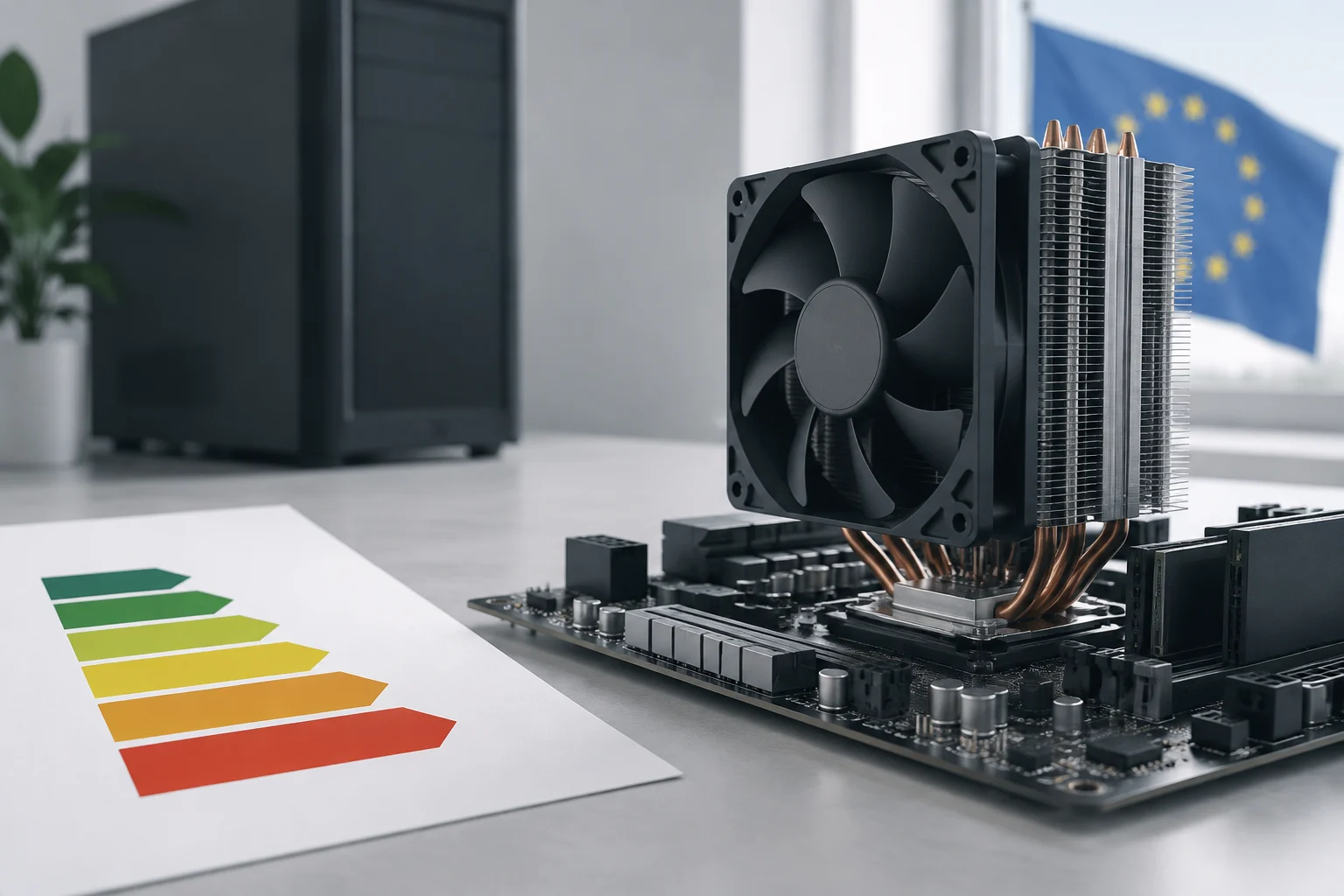
It is not advisable to confuse an energy label for a computer with a CPU power sheet. The European Commission page provided in the research, dated September 4, 2026, describes a preparatory study on the possible design of an energy label for computers and prior work for a potential delegated act proposal. The source speaks of a possible label, not an obligation already applicable to desktop processors.
According to the Commission's summary, the study explored how to present energy performance and found support for showing consumption per hour, expressed in Wh. It also recommends different scales according to the type of use for high-end and everyday devices. These are results of a design study; they do not in themselves constitute a mandatory label nor fix a current classification for each CPU.
For the buyer, the practical difference is that a label for a finished computer could provide information about the system in a usage context, while a CPU sheet refers to a component and to the manufacturer's own parameters. A CPU power value cannot be converted into Wh per hour of a computer without knowing the load, time, other components, and measurement conditions.
The chronology also avoids a frequent confusion: the Commission document is later than Intel's March 2026 announcement and the April guide of that year. It should be read as a regulatory novelty regarding a preparatory study, not as a norm that has retroactively redefined the specifications of those processors.
What spec sheets cannot resolve
A technical sheet does not show by itself the energy needed to complete a task. To measure it, a defined load, a measurement method, and a comparable result are required; it is also necessary to specify if the data is taken at the processor or at the system's power outlet. Without these details, two consumption figures may not be comparable even if both are expressed in watts.
Behavior can change with the application, load duration, cooling, motherboard power configuration, and ambient temperature. A processor that consumes more power during a task might also finish it sooner; to value efficiency, it is necessary to relate energy and work done, not just observe the instantaneous maximum. The useful question is how much energy an equivalent task requires.
Tests published by third parties can provide that perspective, but their validity depends on explaining the method, hardware, software version, and conditions. The available material includes a Puget Systems analysis on consumption, cooling, and efficiency of Intel Core Ultra 200S, which warns of its November 2024 publication date. This type of work provides laboratory context for the generation examined, but should not be extrapolated without further qualification to Plus models announced in 2026.
In a real purchase, it is also advisable to check platform support and the total system cost. A CPU with a lower power limit may be easier to cool, but that does not guarantee better performance per watt, better performance in a specific application, or lower idle consumption. Those answers require appropriate tests for the intended use of the equipment.
How to choose with criteria when building or updating a PC
For a practical decision, start by identifying the exact model and consulting its official sheet. Record TDP, PBP, MTP, or other limits separately, preserving the manufacturer's labels. Then check what cooling the system recommends and what power conditions the motherboard allows. Do not turn an isolated figure into an efficiency classification.
If the goal is gaming, content creation, or sustained calculations, look for tests that reproduce that type of load and compare equivalent results. Prioritize measurements that separate processor consumption from complete equipment consumption, and that explain the method. To estimate electrical cost, energy consumed during a period and a specific rate are needed; a maximum power limit is not enough to calculate the bill.
A short checklist reduces the risk of misinterpreting specifications:
- Verify that the sheet corresponds to the exact model and variant.
- Note the name of the limit, not just the number in watts.
- Confirm what load and what component were measured in the consulted tests.
- Compare performance and energy under a common methodology.
- Review cooling, motherboard, and complete system consumption before buying.
The documentary conclusion is more limited —and more useful— than proclaiming a winner: official specifications allow knowing declared parameters, not measuring complete efficiency. In 2026, available documentation allows explaining the difference between those limits and an energy test; it does not by itself support a classification between Intel Core Ultra 200S Plus and AMD Ryzen 9000. To decide, combine the official sheet of the model with independent measurements relevant to your load and configuration.