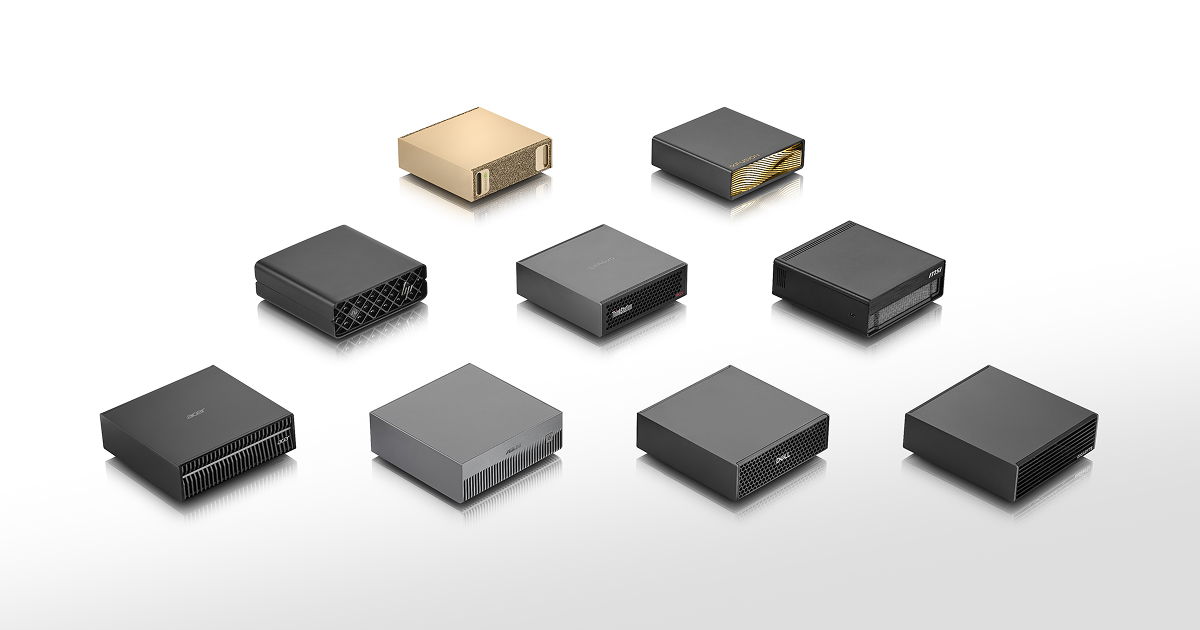
Positioning of the DGX Spark on the desktop
The NVIDIA DGX Spark is presented as a desktop computer category designed specifically to build and run artificial intelligence models. Unlike traditional workstations that combine an x86 CPU with a discrete GPU, it integrates both components into a single superchip. The proposal aims to reduce the barrier of transferring data between the processor and the accelerator, offering a coherent architecture to manage AI workloads from the same system.
With dimensions of 150 x 150 x 50.5 mm and a weight of 1.2 kg, its compact format allows it to be placed on a desk without resorting to a tower chassis. NVIDIA targets developers who need to prototype, tune, and locally run inference for models of up to 200 billion parameters. Having models available on the device itself reduces cloud dependency during development and when working with autonomous agents, although it does not mean the device replaces any computing infrastructure.
Architecture of the GB10 superchip
The core of the system is the GB10 Grace Blackwell superchip, which combines a 20-core Arm CPU with a Blackwell GPU. The CPU brings together 10 high-performance Cortex-X925 cores and 10 efficiency Cortex-A725 cores; the GPU incorporates fifth-generation Tensor Cores and fourth-generation RT cores. The connection between both components is made via NVLink-C2C, which allows high-speed communication and contributes to maintaining the data flow between CPU and GPU.
Memory is one of the most distinctive features of this architecture. The system features 128 GB of coherent unified memory LPDDR5x, shared between the CPU and GPU without needing to copy data from one to the other. This way, a model can be loaded into system memory without relying solely on the VRAM available on a discrete GPU, which is usually limited to 24 or 32 GB. Capacity alone does not guarantee fast inference, but it allows tackling models that would not fit in that amount of graphics memory.
Inference performance and comparisons
In raw power, the DGX Spark offers up to 1 petaFLOP of FP4 performance with sparsity. This figure describes computing capacity under a specific precision and conditions; it does not directly equate to the speed a person perceives when generating text. In language model inference, it also matters how long the system takes to supply the data needed for each operation.
Memory bandwidth, at 273 GB/s shared between CPU and GPU, conditions this supply and, therefore, the token generation rate. Available memory and access speed are different measures: high capacity allows loading large models, while bandwidth influences how quickly they are processed. Therefore, the maximum advertised power is not enough to anticipate the real performance of a workload.
Independent benchmarks indicate that for small models, under 20B parameters, the DGX Spark competes effectively with high-end GPUs. In larger models, the bandwidth limitation becomes more visible. In tests with GPT-OSS 20B, an RTX 5090 generated 205.5 tokens per second, compared to 60.9 for the DGX Spark. The discrete GPU retains the advantage in pure decoding speed, a relevant difference when the priority is obtaining answers with the least wait possible.
Memory and bandwidth limitations
Although the 128 GB allow loading quantized models of up to 200B parameters, the 273 GB/s bandwidth represents a significant bottleneck. For models over 30B parameters, token generation speed decreases notably. Consequently, being able to load the full model does not mean the interaction will be as smooth as on a system with higher memory bandwidth.
This limitation is linked to LPDDR5x technology, which prioritizes density and energy efficiency over transfer speed. The design makes it possible to gather a large memory capacity in the system, but that capacity and the rate at which data is read do not scale in the same way. Model size modifies the balance: the more demanding the load, the more important it is to also consider memory access.
For those who need fast inference with large models, the DGX Spark may not be the ideal option, despite its ability to load extensive models. The choice depends on what is prioritized: having enough memory to run the full model or maximizing response speed. In uses where latency is critical, solutions with more bandwidth may be more suitable; if capacity is paramount, unified memory offers a different advantage.
Viability for local AI workloads
The DGX Spark is especially useful for autonomous agent development and other inference tasks where latency is not the main factor. Its ability to run models locally continuously can be adequate when data privacy is a priority or when cloud access is not desired or possible. The utility in those scenarios comes from keeping the load on the device, not from speed always being superior to a discrete GPU.
The option to interconnect up to four units via ConnectX-7 allows scaling unified memory to 512 GB and AI performance to 4 petaFLOPS. Expansion by units offers a way to increase resources without going directly to a full data center. This can make the system viable for small teams needing advanced inference capabilities, although specific convenience will depend on their models and the importance they assign to capacity and speed.
Conclusion and relevance for 2026
The NVIDIA DGX Spark proposes a desktop alternative to traditional CPU plus discrete GPU configurations. Its unified architecture addresses the memory capacity limitation that may prevent loading large models on a GPU, but introduces a bandwidth restriction that affects the performance of those models. Its proposal is defined by that balance between being able to host more data and processing it at a speed conditioned by memory.
Looking ahead to 2026, the device positions itself as a tool for developers working with mid-sized models and local agents. The decision to adopt it must consider both the necessary memory capacity and the inference speed each task requires. High-end discrete GPUs remain superior in pure decoding performance; therefore, the DGX Spark fits better when loading the model locally and keeping data on the device weigh more than achieving maximum speed.